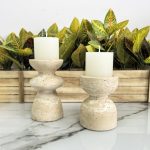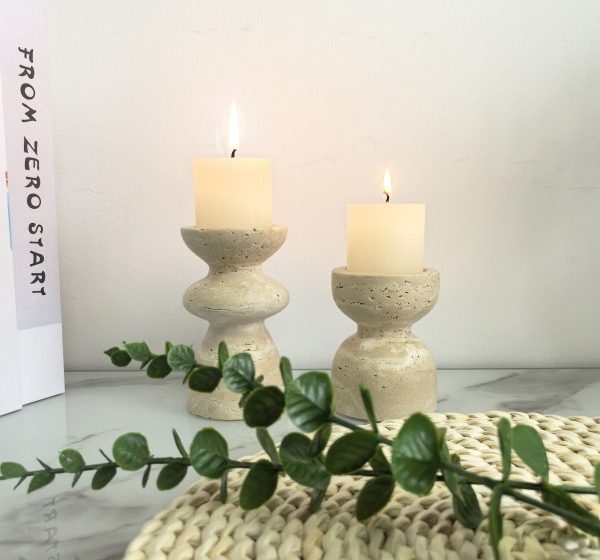

Most candle holders are an afterthought — a glass jar the candle came in, a brass stem from a home aisle, a dish that disappears the moment the wick is lit. The travertine candle holder takes the opposite approach: the stone is the point, and the flame is the guest it invited. Turned from beige travertine into a mid-century stack of soft curves, it holds a pillar candle the way a plinth holds sculpture — and the two materials, mineral and fire, do something together that glass and brass never quite manage.
Why Stone and Flame Belong Together
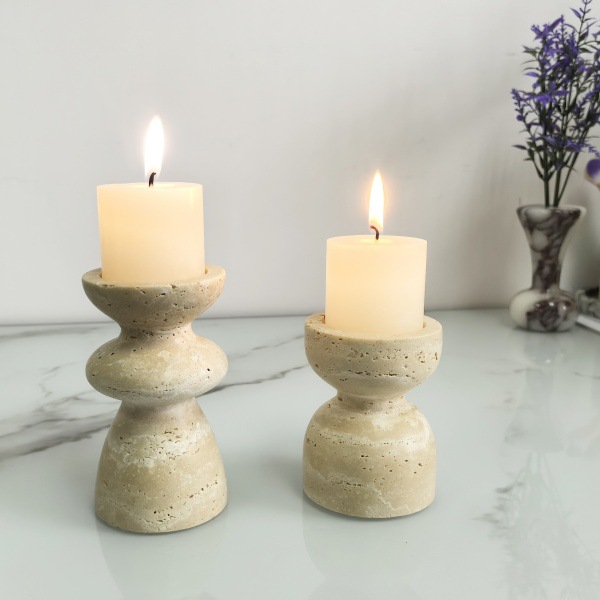
Candlelight is low, moving light, and it needs a surface that answers it. Glass competes — reflecting, glaring, doubling the flame. Brass shines and then tires the eye. Matte stone does neither: travertine absorbs the glow and returns it as warmth, the fine pores and banding catching just enough light to show their texture without ever glittering. As the candle burns down through the evening, the stone seems to warm with it, the oat tones deepening from sand to honey in a lit room. No other candleholder material performs that slow, quiet transformation — and it is the reason stylists keep reaching for stone when a room needs to feel gathered rather than decorated.
The Mid-Century Profile
The shape is borrowed from the turned ceramics of the 1950s and 60s: a stack of bulges and waistlines, each curve flowing into the next without a seam. That silhouette matters more than it looks. A geometric holder draws a box around the flame; a turned one draws a figure, and the eye reads it as an object with personality even unlit. Between dinners, the holder earns its counter space as sculpture — which is the practical test every good candleholder must pass, since candles burn for a few hours and the holder stands there for years.
Two Sizes, Endless Arrangements
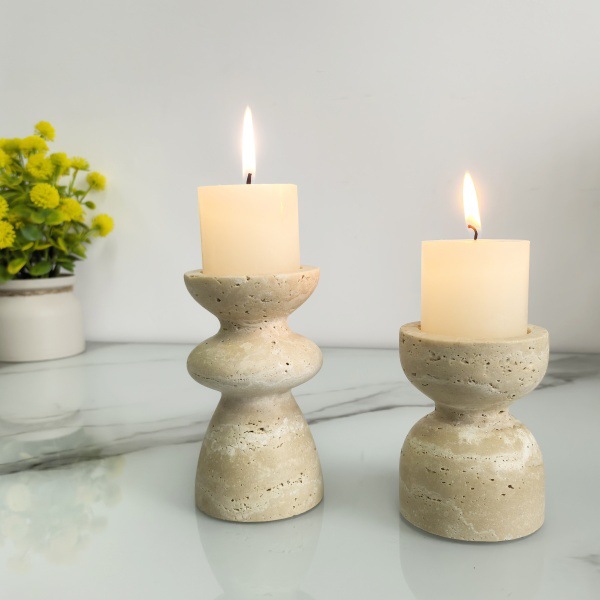
The holder comes in a 12-centimeter height with a 7-centimeter cup, and a 9-centimeter sibling. Separately, each anchors whatever surface it lands on: the tall one on a console beside a mirror, the short one leading toward it along a shelf. Together they form the simplest of all styling moves — the two-step grouping — and because both share the same turned profile, the pair reads as a family rather than a coincidence. Stylists call this rhythm; everyone else just calls it looking right.
Travertine 101
Travertine is limestone born in hot springs, which is why every block carries banding and tiny pores — the fossil record of water moving through stone. Cut and turned, it becomes the warmest-neutral material in the decor palette: beige without cream’s fussiness, textured without roughness, at home with linen, oak, brass, and terracotta alike. Sealed and polished, the surface wipes clean and shrugs off the occasional wax drip; the pores stay visible as texture, which is exactly the point. Each holder is carved from its own slice of the block, so banding varies — yours is a one-off, and it will never look like the neighbor’s.
Where It Lives
- Console table: the classic post — the tall holder on a stacked pair of books, candlelight arriving at mirror height.
- Shelf: unlit, it works as the sculptural object every shelf needs between the books.
- Dining table: a pair flanking the centerpiece, low enough to talk across, warm enough to retire the overhead light.
- Bathroom: one tealight in the cup, and the counter signals spa without a single rearrangement.
Styling With Fire, Safely
Stone buys real margins: it does not scorch, does not melt, and does not tip. Still, three habits keep candlelight carefree. Trim wicks to five millimeters before lighting — tall flames smoke and drip. Burn within sight, and retire a candle when half a centimeter of wax remains. And give the holder a wider clearance than feels necessary: a pillar flame leans in drafts, and stone’s job is to be the safe zone, not to hold curtains back. Follow those and the holder’s whole maintenance routine is one sentence: pop the cooled wax out, wipe with a damp cloth, done.
The Gift Logic
Candleholders fail as gifts when they assume a style; stone sidesteps the problem. Beige travertine is the neutral that flatters every interior currently being lived in, and the turned silhouette reads as inherited rather than purchased — which is the compliment gift-givers are actually fishing for. Two sizes mean two price-friendly moves: one holder for the colleague, the pair for the wedding. Add a good pillar candle, wrap it in the rigid gift box it ships in, and the present is done in a minute and remembered for years of dinners.
A Short History of Holding Fire
Candle holders are older than nearly everything else on a styled table, and the lineage explains the form. Romans clipped tapers into bronze pivots; medieval households drove iron spikes into logs; the Baroque era cast whole candelabra in silver because light was scarce and worth crowning. The constant across all of them: the holder was the stagecraft, the object that made scarce light feel ceremonial. Electric lighting demoted the candle from tool to mood, and the holder’s job changed accordingly — no longer about surviving the night, it became about framing an evening. The mid-century turning wheel belongs to this second act: postwar designers, working in new lathes and old workshops, stripped the candlestick down to its sculptural essence — foot, stem, cup — and let the profile do the decorating. Today’s travertine version completes the arc. The stone carries the warm mineral register the century’s ceramics only pretended to; the turning gives it the era’s silhouette; and the modern interior gives it the job the first holders always had — making light feel like an occasion rather than a utility. Set one on a console and you are participating in roughly two thousand years of the same quiet project: domesticating fire without taming it. The pores in the stone were left by a hot spring; the flame above them is the same technology. Nothing else on the shelf connects that far back, which is perhaps the real reason stone candle holders never quite leave the room.
Pairing Candles to the Stone
The stone sets the palette; the candle finishes it. Cream and ivory pillars are the permanent marriage — tone-on-tone, letting the flame and the stone’s banding do all the visible work. But the beige ground is friendlier to color than people expect: a deep green pillar turns the pairing botanical, burgundy makes it seasonal, black makes it graphic, and a single terracotta shade makes the whole corner look Tuscan without another object added. Width matters as much as color — the cup takes pillars up to seven centimeters, and the widest pillar that fits burns slowest and steadiest, which means fewer trims and longer evenings per candle. Tapers and votives have their own holders; this cup was carved for pillars, and honoring that makes both last longer. Between burns, store the spare candles in the same drawer as the matches and the routine becomes muscle memory: trim, light, and the corner does what it does. Owners who commit to one candle color per season report the holder disappearing into the room’s furniture — the highest compliment a quiet object can be paid.
Frequently Asked Questions
What size candle fits the cup?
Standard pillar candles up to 7cm across sit securely in the ground, sealed cup. Tealights also work placed on a small dish inside the cup.
Will hot candles damage the travertine?
No — sealed stone tolerates candle heat easily, and cooled wax lifts from the polished cup in one piece. Wipe with a damp cloth to finish.
Do the two sizes pair well apart from each other?
Yes — both share the same turned profile, so they read as a family across a room. Stylists place them a hand-width apart so the gap frames the pair.
Bring one home: the Mid-Century Travertine Candle Holder — $39, hand-carved and polished, ships worldwide in a rigid gift box.
Read next: the sculptural holder trend, mid-century edition and pillar candle stands: height and grouping.