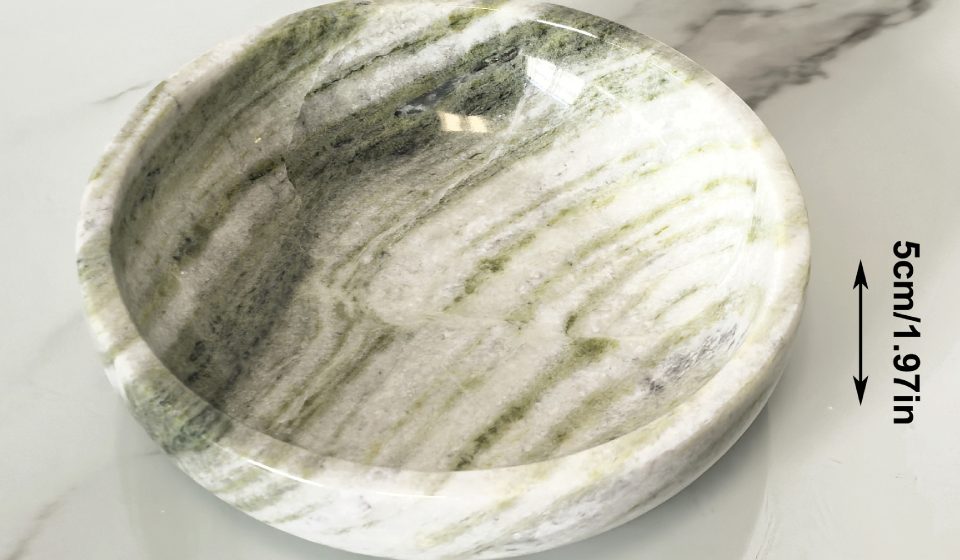

Decorating with a bowl is a decision about what the room is for. A bowl on a coffee table says people sit here. A bowl on an entry console says shoes go elsewhere. A bowl in the bathroom says soap has a home. The right bowl in the right place does the work of three accessories, and choosing well comes down to three variables: the stone’s personality, the size of the surface, and how much you want the room to notice it.
Choosing by Personality, Not Just Colour
The purple bowl is a statement. It asks to be looked at, and it wins the room it sits in. If the rest of the space is restrained — a pale wall, a linen sofa, a wooden floor — a purple bowl creates the focal point you were missing. If the room is already busy with pattern and colour, a purple bowl tips it over the edge; in that case the green bowl is the smarter choice, because its softness absorbs rather than competes.
This is the whole difference between the two stones in one sentence: purple leads, green supports. Decorating is the act of deciding which one your room needs.
Match the Bowl to the Surface
On a large pale rug or a plain floor, a 20-centimetre bowl reads as a sculpture — leave it alone, put nothing beside it, and let it sit slightly off-centre. That treatment suits the purple stone best, because the drama needs empty space around it.
On a narrow console or a small shelf, the same bowl becomes a functional container rather than an object. That is where the green bowl earns its keep: it holds keys and post without demanding attention, and the space around it stays usable. The practical version of the same object.
Building a Cluster That Works
One bowl plus one tall object plus one small object is the reliable formula. The bowl, a vase or candle behind it, and something small in front — a coaster, a key, a sprig of greenery leaning out. Height variation is what makes a cluster read as composed rather than piled.
What does not work: two bowls of similar size side by side (they compete and neither wins), three bowls stacked without height difference (it looks like storage, not styling), and a bowl surrounded by objects of equal height (the eye has nowhere to land). The bowl is the anchor of a composition, not a member of an audience.
A Bowl Through the Year
Spring: bulbs in the bowl, pale and low. Summer: fruit on a table outdoors, the bowl earning its keep daily. Autumn: nuts and a candle, warm tones with the purple bowl. Winter: one sculptural object — a stone sphere, a large shell, a folded linen ball — with the bowl half empty, which is the styling that photographs best in the months when there is nothing to fill it with.
Practical Notes Nobody Tells You
A marble bowl on a wooden table needs a felt or leather pad underneath if the table has a finish you care about; the weight is fine, the contact stain is not. On a bathroom counter, keep it away from the basin edge — a bowl nudged by a wet hand will move, and marble is heavier than it looks.
And a note on pairing stones: do not put a marbled bowl next to a strongly patterned rug or a veined counter. Two busy surfaces argue with each other and the room loses clarity. A plain ground under a veined bowl is the correct order of operations.
Three Setups Worth Copying
The entry console. One bowl at the larger end of the console holding keys, coins and post; one tall object — a lamp, a framed print, a vase with branches — behind it; nothing else on the surface. The bowl becomes the obvious landing place simply because it is the only horizontal object there, which is why entry tables with a bowl always feel calmer than entry tables with a tray and three trays of change.
The coffee table. The bowl stays empty except for three sculptural objects — a smooth pebble, a small carved form, one flower stem in water. The rule is height: the tallest object should reach roughly half the bowl’s height, which is about five centimetres for this size. Shorter than that and the arrangement disappears; taller and the bowl stops being the anchor. Leave the front third of the surface empty so guests have somewhere to put a cup.
The bathroom corner. A small bowl with a bar of soap, a bottle whose label faces the room, and a sprig of eucalyptus laid across the rim for scent. Bathroom styling fails when everything is in a row; this arrangement works because the eucalyptus breaks the row without adding clutter.
Bowl or Tray: Which to Buy First
Buy the bowl if the surface you are styling needs visual weight, if you want a focal object that can hold nothing and still look composed, or if you need something to hold fruit. Buy a tray if the surface is small and narrow, if you need to corral flat objects like keys, letters or jewellery, or if you want a surface beside the sink where a bowl would be in the way.
The practical answer for most homes is one of each eventually, because they do opposite jobs. A bowl holds; a tray organises. But if you can only afford one object, the bowl is the more forgiving starting point: it looks correct on a coffee table, a console, a shelf and a bathroom ledge, whereas a tray on the wrong surface reads as clutter rather than as organisation.
Bowl, Plate or Tray: Three Silhouettes
The three round shapes in stoneware serve visibly different purposes, and choosing the wrong one is the most common styling error in this category. A bowl has depth and a curved interior — it holds loose objects and fruit, and it reads as generous. A plate is nearly flat with a low lip — it displays objects that have their own height, like stacked stones or a candle, and reads as more formal. A tray has a wide flat field with a raised rim — it organises flat things, and it reads as practical.
So: fruit or keys in a bowl, a sculptural object or a candle on a plate, letters and daily objects on a tray. If you are styling a coffee table, the bowl wins, because a plate on a table looks like tableware and a tray looks like a landing zone for things nobody put there.
Gifting a Styled Bowl
If you are giving a bowl as a gift, the styling trick is to include one object with it. A bowl alone reads as an incomplete set; a bowl with a small candle, or a bag of the citrus it was designed to hold, reads as a considered gift. It costs almost nothing to add and changes the impression completely.
Frequently Asked Questions
Should the bowl be centred or offset? Offset reads more designed; centred reads formal. On a coffee table, offset with one tall object behind it.
How do I keep the inside of a purple bowl looking clean? Wipe it dry after use. Purple stone shows water spots more than green, and the simplest fix is a cloth kept next to the bowl.
Can a marble bowl hold hot fruit compote? Briefly, yes, but avoid sugar-heavy or acidic cooked fruit sitting in it for hours — acid and sugar are the two things that dull a polished marble surface over time.
The Green and Purple Marble Bowl 20cm is hand-carved in purple or green marble, shipped cushioned in bubble wrap and a protective carton.
New to marble bowls? Start with the 20cm marble bowl guide for sizes, stones and buying checks.