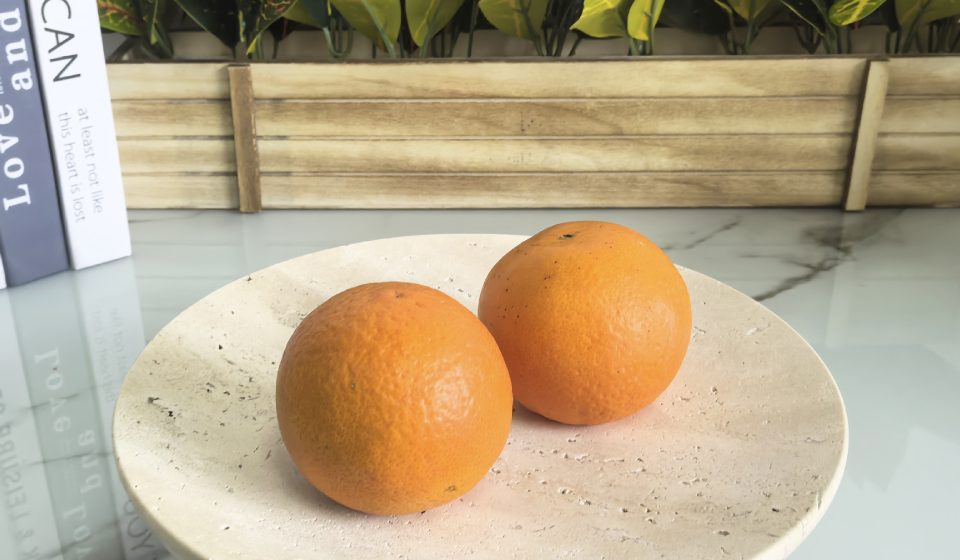

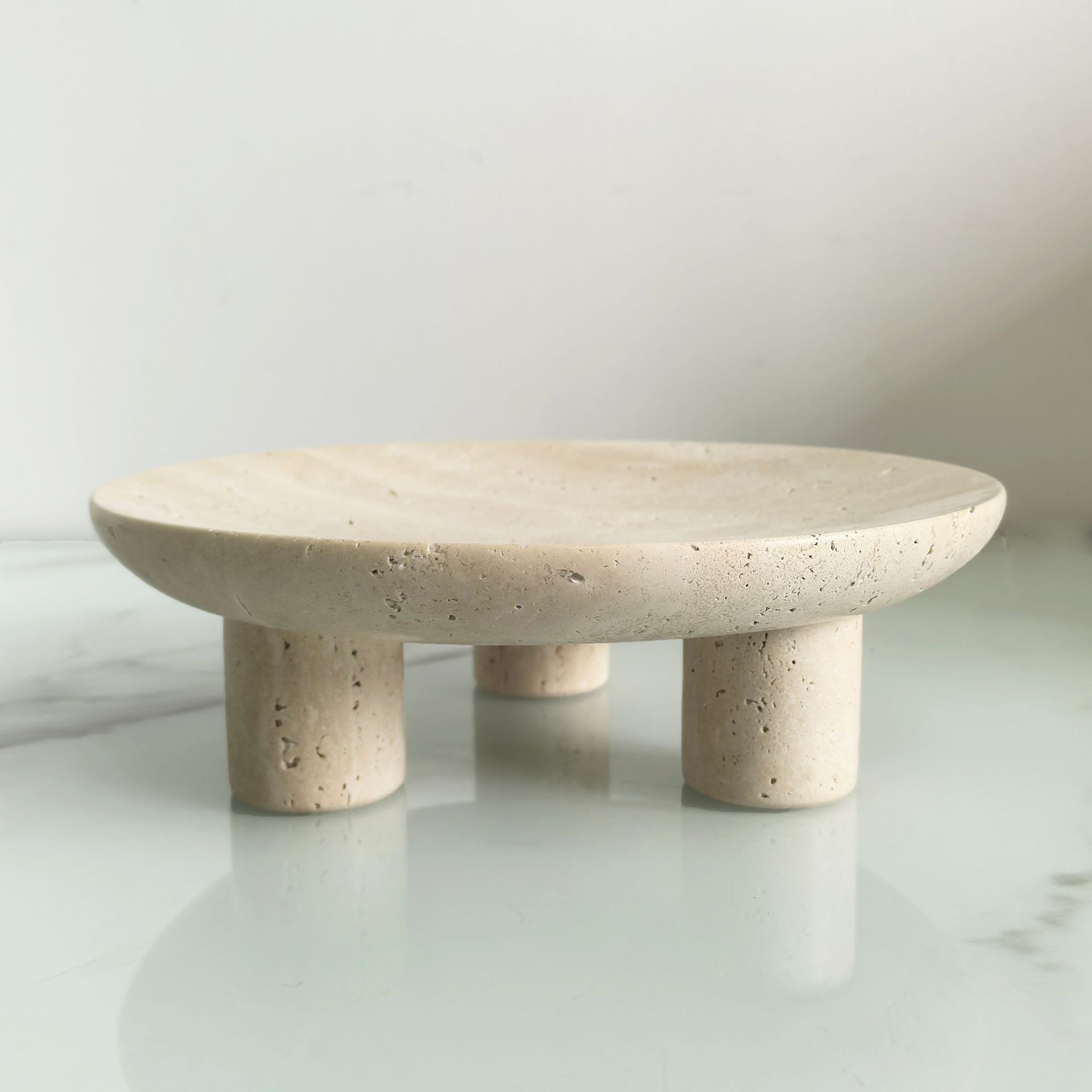
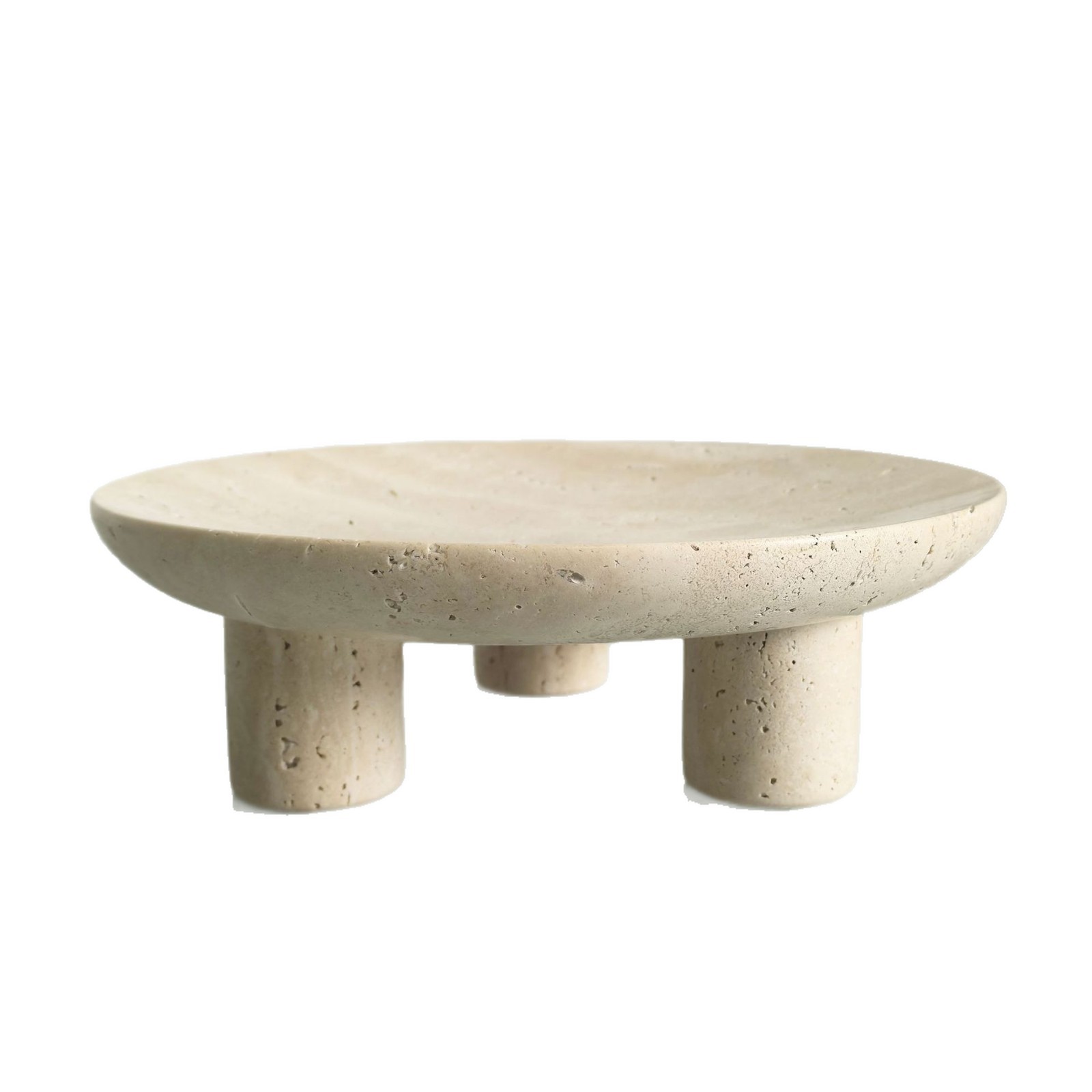
A round tray is the most demanding object in home styling, and the most rewarding. It demands decisions — a circle has no natural front, no long axis to hide arrangement mistakes along — and it rewards them with the one quality rectangles rarely achieve: a composition that reads finished from every angle in the room. The round travertine pedestal tray, 22.6 centimeters across and raised on three carved legs, is a master class in the form, and this guide is the field manual for what goes on it.
Fruit: The Classic, and Still the Best
Oranges in a stone circle have anchored still-life painting for four hundred years, and the reason is color theory as much as tradition: warm citrus against cool beige mineral, both given depth by the stone’s banding. The pedestal height adds the gallery effect — fruit presented at the eye level of a seated room rather than sunk into a table. Practical notes: the raised rim contains rolls and tumbles; the sealed stone rinses clean after any overripe casualty; and because the tray stands on legs, air moves beneath, keeping the table surface dry under condensation. Lemons, clementines, figs, and small pears all mound well; keep the pile to one fruit type for the composed look, mixed only in a kitchen that tolerates charm over order.
The Perfume Carousel
On a vanity, a round tray solves the problem rectangular organizers create: perfume collections are round-shouldered, and circling them feels natural in a way lining them up never does. Arrange five to seven bottles around the dish’s center, tallest toward the middle, and the tray becomes a carousel that presents every fragrance to the room at once. The stone’s coolness is not incidental — it keeps glass and metal at room temperature and the arrangement looking crisp, and the seven-centimeter height lifts the display above the counter’s daily spill zone.
Candles and the Evening Rotation
Round trays were born for candlelight — the circle concentrates it, and the stone’s matte glow doubles the flame without the glare of glass. Three pillar candles of staggered heights, or one statement candle flanked by a match cloche and a small dish, compose the coffee-table classic. The pedestal form adds safety and sense: wax and heat live on stone rather than on the table’s finish, drips land on a surface that cleans with a scraper and a wipe, and the whole arrangement moves as one object when guests arrive. The same station serves diffusers and incense; anything that smokes, drips, or scents belongs on stone.
Keys, Coins, and the Entryway Round
Entry consoles are ruled by rectangles, which is exactly why a round tray there reads as a decision rather than an accident. The dish gathers keys, coins, and the watch that comes off with the jacket; the raised rim stops the key-ring roll; and the circle softens a hallway furniture family that is otherwise all straight legs and hard edges. Styling note: keep the entry tray at half-full maximum. Its job is to look calm at the door, and calm is a matter of what you refuse to let it hold.
The Circle Rules
Four principles compose any round tray, whatever it holds. Triangle, not line: three objects with staggered heights, centers forming a triangle, is the smallest complete composition — add from there in pairs. Off-center the tall thing: a dead-center tower reads birthday cake; an off-center one reads landscape. Leave the rim visible: the stone’s banding is part of the display, and a tray buried to its edge in objects has spent its charm. Match count to distance: three objects for a tray viewed from a sofa, five for one viewed across a room — the eye resolves fewer shapes up close and needs more at range.
The Coffee-Table Still Life
The full coffee-table composition assembles in a minute once the parts exist: the tray with its candles or fruit, offset from the table’s center; a stack of two large books one hand-width away, with a small object — a bowl, a sculpture — on top; and clear space between the islands so each reads alone. The tray’s job in this scene is gravity: three kilograms of carved stone anchors the arrangement, tells the eye where the table’s center of interest lives, and survives the remote control, the feet, and the coffee mug ring that the books never escape. Style it once a month, and the table stays looking managed for the other twenty-nine days.
Size Math: What 22.6cm Actually Holds
The diameter is the sweet spot for real rooms. Twenty-two centimeters takes six to eight perfume bottles, a pyramid of four to six oranges, three candles with their companions, or a full keys-and-sunglasses-and-watch entry load — while staying small enough to lift one-handed, live on a vanity without crowding it, and obey the one-third rule on any table wider than a meter. Bigger serving trays demand whole tables; smaller dishes hold a single object and call it styling. This is the size that does the most composing per centimeter, which is why it is the shape and size to buy first when a surface needs an anchor and the budget allows one stone object.
Stone, Briefly
Beige travertine carries warm banding and honest pores, sealed against daily service and cleaned with a damp cloth; no acids, no dishwasher, a yearly reseal in wet rooms. The legs are carved from the same block, so the banding runs continuous from dish to foot — the fingerprint of real carving. Your tray’s pattern is a one-off, cut from its own slice of the quarry; display it accordingly, and expect it to be the object in the room that guests pick up, turn over, and ask about.
Seasons, Holidays, and the Rotation Habit
A stone pedestal earns its counter space year-round precisely because the stone never changes and the contents always can. The rotation costs one minute per season and keeps the tray feeling new for a decade. Winter: three red or burgundy candles and a sprig of evergreen — the beige stone makes even supermarket candles look curated. Spring: a shallow cluster of lemons or a handful of pale tulip buds in an egg cup. Summer: the fruit months, when the tray does its oldest job and does it best — citrus, stone fruit, a fig season that never lasts long enough. Autumn: miniature pumpkins and one amber candle, the banding in the travertine suddenly looking like it planned the whole thing. Holidays take the same logic further — ornaments under glass, wrapped chocolates for guests — and the pedestal height keeps ceremonial displays above the reach of cats and toddlers alike. Owners in rental and hospitality settings discovered a bonus: guests photograph styled pedestal trays more than almost any other counter object, which is free marketing for a guest room and a quiet compliment for a home. The habit that makes it all work is restraint between rotations: between seasons, add nothing. The tray’s charm is composure, and composure is what the circle does with less.
Frequently Asked Questions
What displays best on a round pedestal tray?
Fruit, perfume, candles, and entryway items — anything mounded or clustered. The circle reads from every angle, so it suits tables people walk around.
How many objects should I arrange on it?
Three minimum as a triangle of staggered heights, then add in pairs. Keep the rim visible and stop before the stone disappears under the display.
Can it hold hot candle jars safely?
Yes — stone tolerates candle heat far better than wood or plastic, and wax pops off the sealed surface once cooled. A trivet under anything oven-hot.
Bring one home: the Round Travertine Pedestal Tray 22.6cm — $99, hand-carved and polished, ships worldwide in a rigid gift box.
Read next: the pedestal tray: why three legs never wobble and travertine in the bathroom.