
A marble tray is not furniture. It does not store anything. It does not fold, does not close, does not operate. It simply holds. And that, more than any other quality, is why a well-made marble tray ends up in every room — the entryway, the bedroom, the bathroom, the desk, the coffee table, the dresser. It migrates. It adapts. It gathers what the room tends to scatter.
We call this the Natural Marble Tray. Fourteen stones. Two sizes. One shape. $39. If that sounds like too many combinations for a simple rectangle of polished stone, stay with us. The reason there are fourteen stones is that a tray in Carrara White does a different thing in a bathroom than a tray in Nero Marquina does on a dark walnut desk. The stone is never neutral. It sets the temperature of the room.
Four places a marble tray belongs
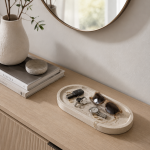
The entryway. Keys land on the console. Coins pile up. Mail arrives. A marble tray, 25×12cm, placed against the wall, catches all of it. The tray does not organise the mess — it contains it. A month’s worth of pocket debris on a stone tray looks intentional. The same debris on bare wood looks like a problem.
The vanity. Perfume bottles multiply. A candle burns low. Cotton rounds scatter. A marble tray on the bathroom vanity defines a territory: this rectangle, and only this rectangle, is where the bottles stand. The polished stone catches the light from the mirror and softens it. If the stone is Bulgari Pink or Cherry Blossom Pink, the warm tone bleeds into the room. If it is Emerald Green, the tray reads as a small garden of stone, even with nothing on it.
The dresser. Jewelry does not belong in a drawer. A drawer hides what should be seen. A marble tray on the dresser — rings in one row, earrings in another, a bracelet coiled at the edge — turns daily dressing into a ritual. The tray is the jewellery’s stage. The 30×15cm size is better for dressers: wider, more generous, more room for a watch laid flat or a necklace unclasped.
The desk. A desk without a tray is a desk that will collect paper. A desk with a tray is a desk that will collect only what belongs on the tray: a plant, a pen cup, a small photograph, a candle. The tray says “this space is curated.” Everything outside it is work. Everything inside it is you.
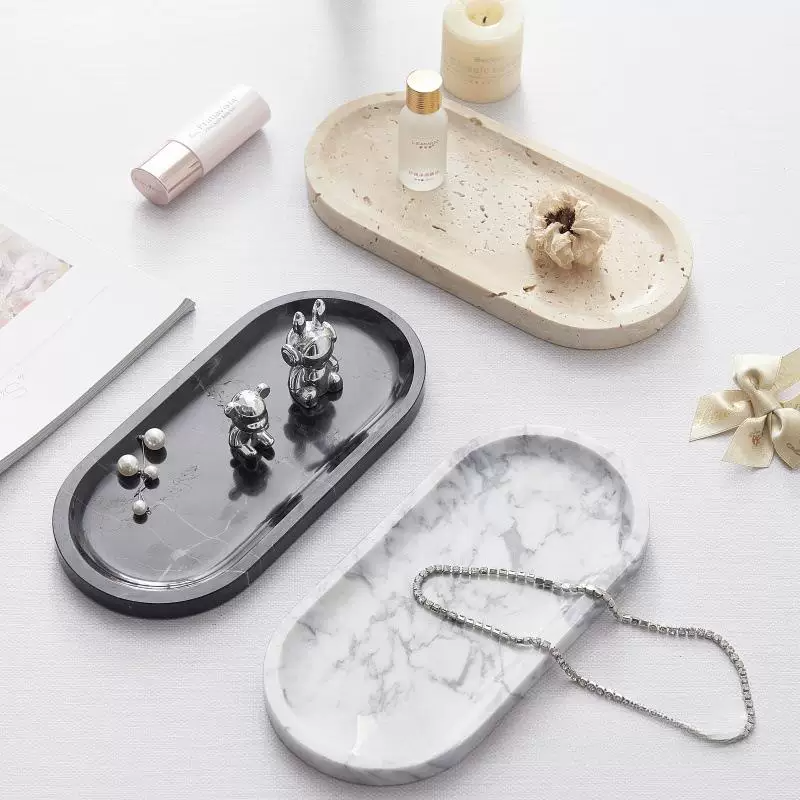
The fourteen stones: a taxonomy
We do not sell one marble tray in fourteen colours the way a paint company sells one paint in fourteen swatches. Each stone is a different slab from a different quarry. Cutting Carrara White is not the same as cutting Travertine — the hardness varies, the grain direction shifts, the polish takes differently. Here, briefly, are the stones and what they bring to a room:
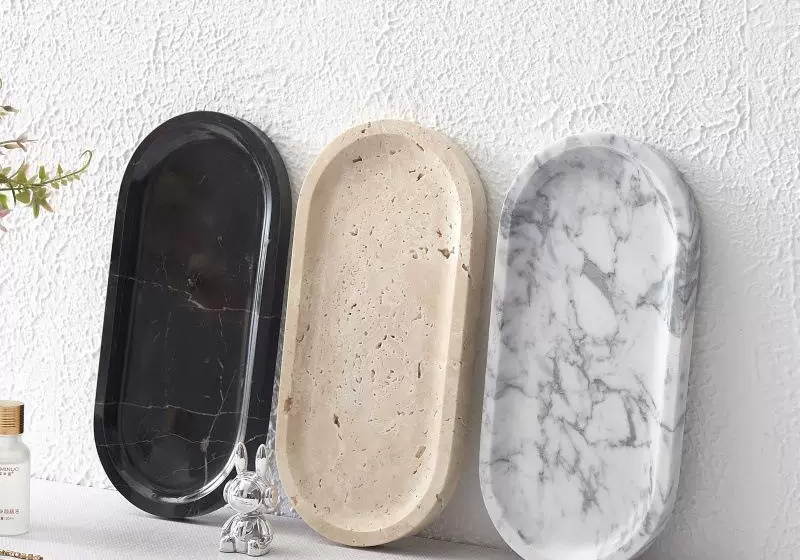
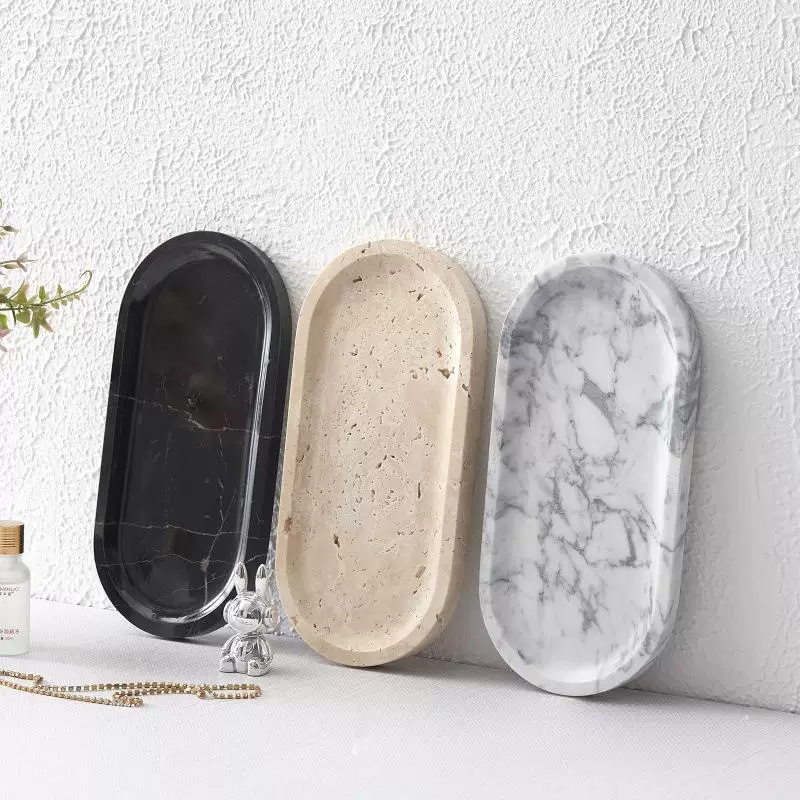
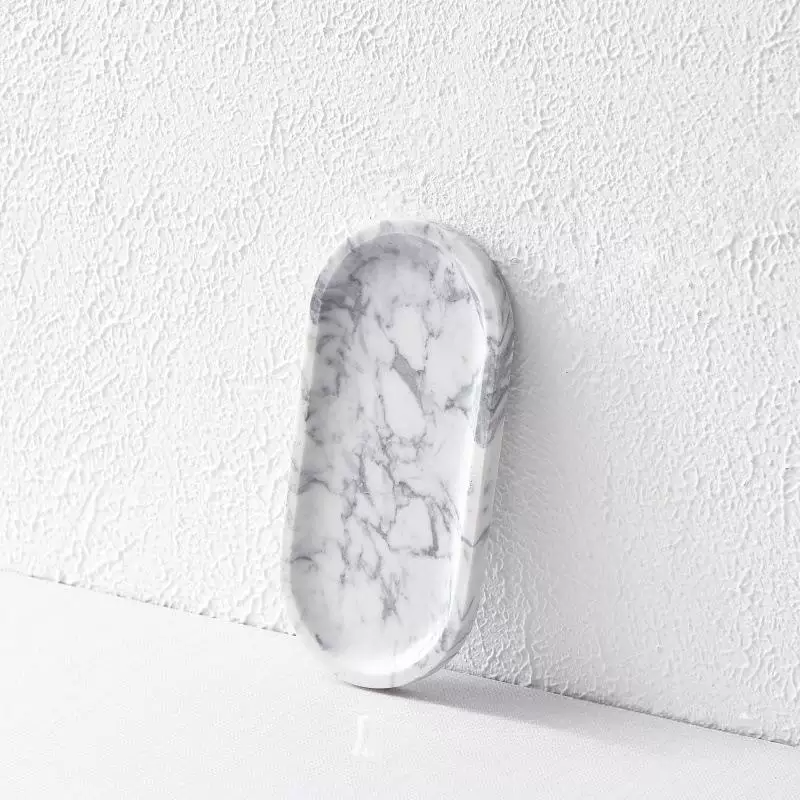
- Carrara White: The classic. Soft grey veins on a white ground. Cool, clean, architectural. Works in bathrooms and modern desks.
- Travertine: Warm beige with natural pitting. Reads as Mediterranean. Pairs with terra cotta and olive green.
- Nero Marquina: Deep black with sharp white veins. Dramatic, formal, the most commanding stone on the list.
- Cherry Blossom Pink: Soft pink with faint grey marbling. Feminine without being sweet. Beautiful on a white vanity.
- Snowflake Green: Pale jade-green with white flecks. Tranquil. A tray that makes a bathroom feel like a spa.
- Bulgari Pink: Warmer and deeper than Cherry Blossom — a rose-gold marble from Bulgaria.
- Bulgari White: Cream base with golden veins. Luxurious, warm, the stone for a candle-lit entryway.
- Emerald Green: Deep green with white and black veins. A tray that reads as a jewel on the table.
- Wave Grey: Flowing grey strata. Modern, minimalist, the stone for a Scandinavian desk.
- Ink Wash: Black and grey swirls like ink dropped into water. A painterly stone — every tray is a different composition.
- Ice Gold Coffee: Warm brown with golden crystalline veins. Earthy, rich, the most tactile stone in the collection.
Two sizes, and why they matter
The smaller tray — 25×12×1.8cm — is an entryway tray, a perfume tray, a coffee-table catchall. It fits on a narrow console and does not dominate a small surface. The larger tray — 30×15×1.8cm — is a dresser tray, a jewelry display, a desk organizer. It holds more, and in a room with generous surfaces, it reads as properly scaled. Both are 1.8cm thick: heavy enough that a sleeve will not knock them off the table, thin enough that they do not look like a butcher block.
How we make them
Each tray begins as a rectangular slab cut from a larger block of marble with a diamond blade. The slab is then ground flat on both faces, edge-profiled with a small radius so the corners are soft to the touch, and polished with a sequence of diamond pads from 50-grit to 3000-grit. The final step is a thin application of clear stone sealer, which deepens the colour and protects the surface from water rings and perfume spills.
The entire process takes roughly 45 minutes per tray. Most of that time is polishing — the difference between a tray that catches the light and a tray that merely reflects it is four passes on the diamond pad. We do not skip passes.
Why $39
A mass-produced resin tray at a home goods store costs $12 to $18. A handmade marble tray from a specialty stone workshop costs $60 to $120. In the middle sits $39 — enough to cover the stone, the labour, the polish, and the transport, without pretending the tray is an heirloom. It is not. It is a well-made object from natural materials, priced at what it costs to make plus what it takes to keep the workshop running. That is the equation. That is always the equation.
Find your stone among the fourteen. Choose the marble tray that belongs on your entryway, your dresser, or your desk.
Frequently Asked Questions About Marble Trays
Q: What is a marble tray and what is it used for?
A marble tray is a flat rectangular or square tray cut from natural marble stone. It serves as a catchall on entryway consoles, a jewelry display on dressers, a perfume organiser on bathroom vanities, and a desktop decor piece. Its weight and polished surface give it a luxury feel that resin or wood trays cannot replicate.
Q: Is marble suitable for a bathroom vanity tray?
Yes. Marble is naturally cool to the touch and waterproof when sealed. A polished marble tray resists water rings from perfume bottles and condensation from bathroom humidity. We recommend sealing once every six months with a stone-safe sealer for bathrooms with heavy steam.
Q: How do I choose the right marble tray size?
For entryways and large dressers, choose 30×15cm. For vanities and narrow consoles, 25×12cm works best. Measure your surface width — the tray should occupy roughly 40-60% of the available depth. A tray that is too large crowds the surface; one that is too small disappears.
Q: How do you clean and maintain a marble tray?
Wipe with a damp soft cloth. Avoid acidic cleaners (vinegar, lemon juice, harsh bathroom sprays) as they can etch the polished surface. For tough stains, use a pH-neutral stone cleaner. Re-seal every 6-12 months depending on usage frequency.
Q: Can I cut food directly on a marble tray?
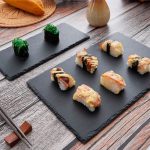
While marble is technically food-safe, cutting directly on polished marble will scratch the surface and dull your knives. Use the tray for serving — not as a cutting board. For food preparation, our slate serving plates are a better choice.
Quick Facts: Natural Marble Tray
- Material: 100% natural marble (14 stone types available)
- Sizes: 25×12×1.8cm and 30×15×1.8cm
- Weight: Approximately 1.2kg (25cm) / 1.5kg (30cm)
- Finish: Polished to 3000-grit, sealed with clear stone protector
- Edge: Soft radius profile — safe to touch, won’t chip
- Care: Damp cloth wipe. Re-seal every 6-12 months. No dishwasher.
- Shipping: Worldwide. Tray shipped in protective foam packaging.