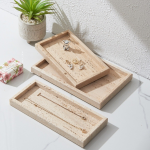

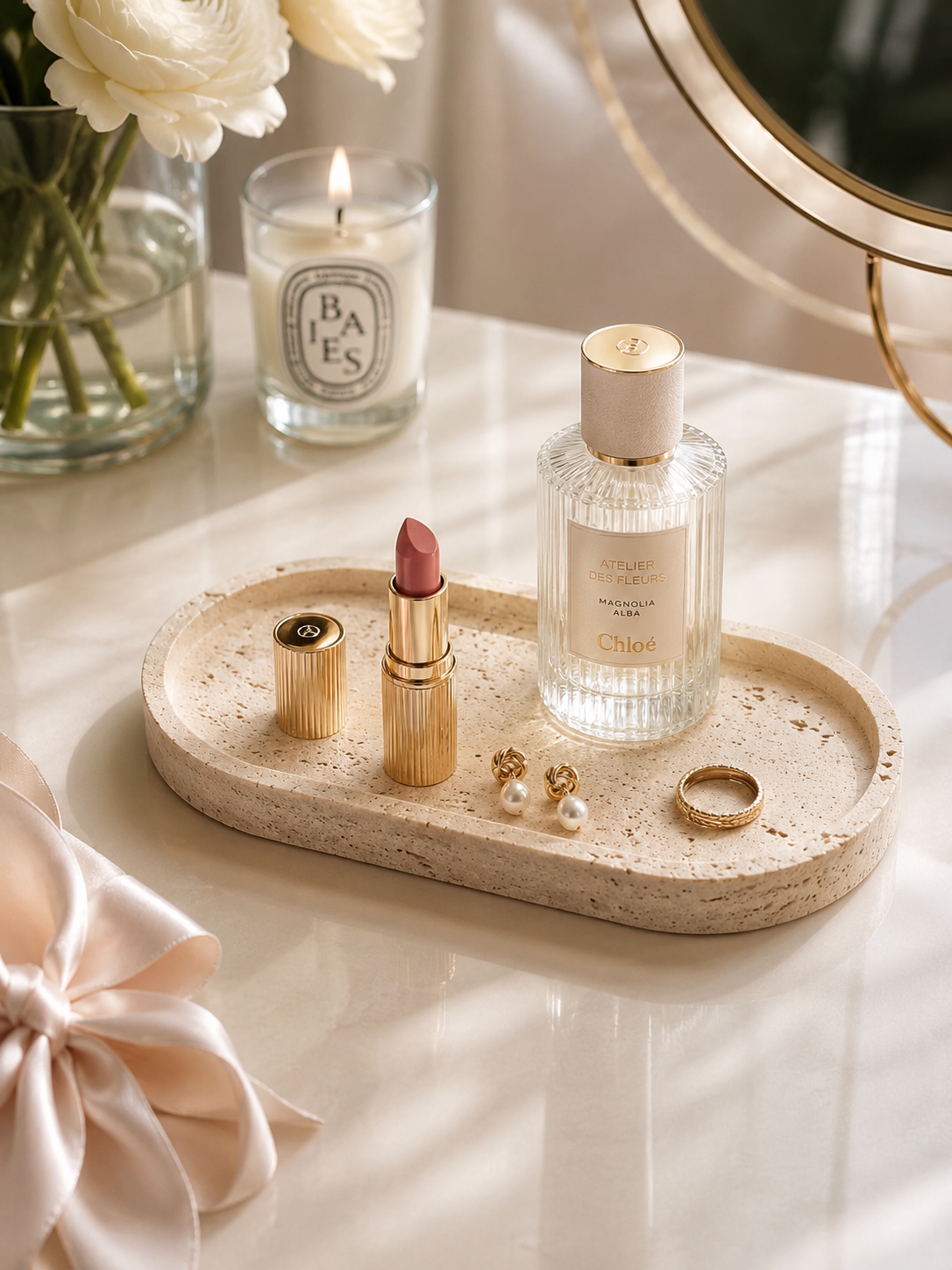
Walk into a well-designed bathroom and you will notice, almost always, a tray. Not a plastic organiser. Not a wire basket. A tray. On it: two perfume bottles, a candle, a small dish for cotton rounds, perhaps a single stem in a bud vase. The tray is not the decoration. The tray is the ground on which the decoration stands. And when the ground is marble, the whole arrangement rises.
This is not an accident of interior design. It is a principle borrowed from retail merchandising, from gallery curation, and from the Japanese practice of kanso — simplicity through subtraction. A natural marble tray on a surface says: everything on this tray belongs. Everything off it does not. The tray organises by exclusion. It is the most efficient organiser you will ever own because it does not actually organise anything. It just makes the mess look wrong.
The psychology of the tray
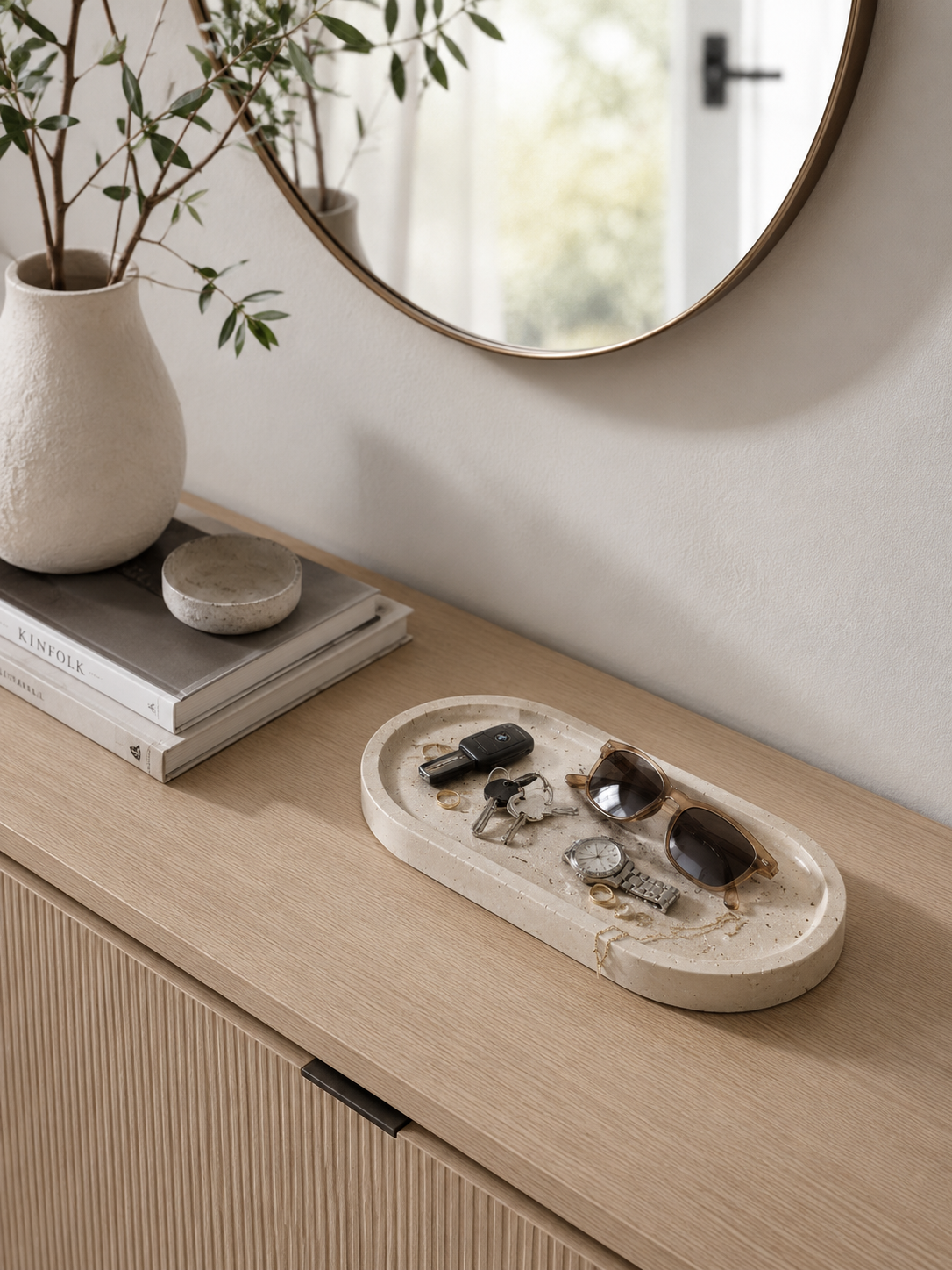
Why does a tray work? The answer is boundaries. A surface without boundaries — an empty countertop, a bare dresser — invites clutter. Objects multiply across it. A surface with a boundary — the rectangle of a tray — constrains the clutter to a single zone. The tray is the gate. Everything inside it is curated. Everything outside it is clutter. This is not opinion. This is spatial psychology, and it has been studied in retail environments for decades. Shoppers buy more from a display on a tray than from the same items scattered on a shelf. The tray signals intention.
Choosing the right stone for your room
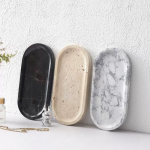
The stone is not an afterthought. It communicates temperature. A white marble tray — Carrara White or Bulgari White — cools a room. It reflects light up into the face of whoever stands at the vanity. It makes a small bathroom feel larger. A dark marble tray — Nero Marquina or Ink Wash — warms a room by contrast. Set on a light wood surface, it anchors the eye. A pink marble tray — Cherry Blossom or Bulgari Pink — softens a room. It reads as intimate, personal, almost private.
The rule is simple: light stone on dark wood, dark stone on light wood, and any stone on white marble or white quartz. If your vanity top is white, you can choose any of the fourteen stones and it will work. The tray will read as an object placed on a ground, not as part of the ground itself.
Aromatherapy, jewelry, and the art of the daily arrangement
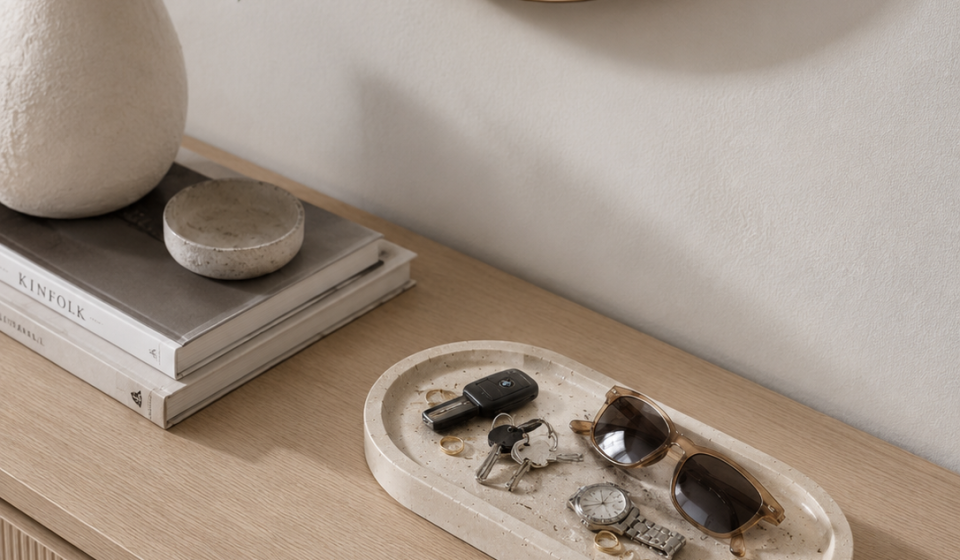
The tray is the easiest piece of interior design you will ever use because it does not ask you to buy anything new. You already own the objects that belong on it. The perfume bottles are already on the vanity — they are just scattered. The rings are already on the dresser — they are just in a pile. The keys are already on the console — they are just in three different places. The tray does not add objects. It groups them.
For aromatherapy, the tray grounds the ritual. A diffuser, two essential oil bottles, and a small candle arranged on a marble tray become a station. The cool stone under the heat of the candle creates a small thermal contrast — the marble stays cool, the candle warms the air above it. The scent disperses in a column rather than dissipating sideways. This is physics, not aromatherapy marketing, but it works.
For jewelry, the tray is a stage. Rings placed in a row on polished marble catch the light twice — once from the metal itself, once from the reflection in the stone. A gold ring on Carrara White reads cool. The same ring on Ice Gold Coffee reads warm. The stone changes the metal. This is why jewelers display on velvet. Marble is the harder, cooler, more permanent version of the same principle.
The craft: polishing as a conversation with the stone
Polishing marble is not like sanding wood. Wood yields. Marble resists. Each grit of diamond pad — 50, 100, 200, 400, 800, 1500, 3000 — removes the scratches of the previous grit. If you skip a grit, the scratches remain, invisible until the sealer is applied. Then they appear as a haze across the surface, like fog on a mirror. We do not skip grits. Each tray passes through all seven pads, by hand, by feel, by eye. The polisher knows when the surface is ready because it reflects a clear image of the workshop window. When the window is sharp, the tray is done.
The fourteen stones at a glance
We offer the marble tray in fourteen stone types because one stone cannot serve every room. Carrara White is for the modern bathroom. Travertine is for the warm kitchen. Nero Marquina is for the formal entryway. Cherry Blossom Pink and Bulgari Pink are for the feminine vanity. Emerald Green and Snowflake Green are for the spa-like bathroom. Wave Grey is for the Scandinavian desk. Ink Wash is for the artist’s studio. Ice Gold Coffee is for the leather-and-wood study. Two sizes — 25×12cm and 30×15cm — let you scale the tray to the surface. The larger tray belongs on dressers and generous desks. The smaller tray belongs on narrow consoles and compact vanities.
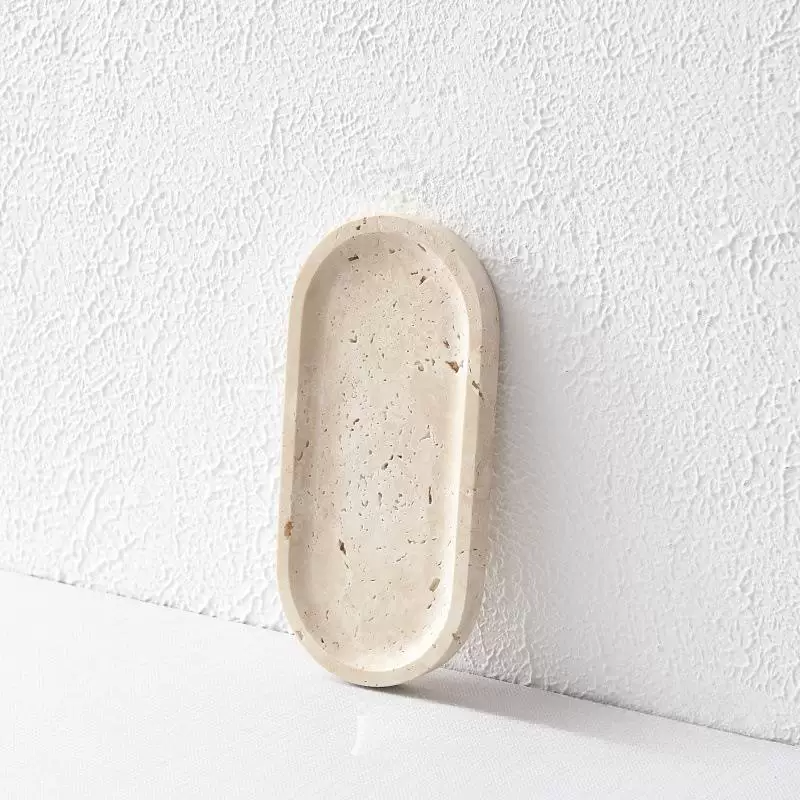
A tray is the smallest piece of furniture you will ever buy, and the one you will use the most. Choose your natural marble tray — fourteen stones, two sizes, one $39 rectangle that will organise your room without saying a word.
Frequently Asked Questions: Marble Vanity Trays
Q: Why do interior designers put trays on bathroom counters?
A tray creates a defined zone on a surface. On a bathroom vanity, it groups perfume bottles, candles, and cotton rounds into a single intentional arrangement rather than scattered items. Psychologically, a tray signals that everything inside it is curated — everything outside it is clutter. This is a principle used in retail merchandising and gallery curation.
Q: What size marble tray fits a standard bathroom vanity?
For a standard 60cm-wide vanity with a single sink, a 25×12cm tray fits comfortably between the sink and the wall. For a double vanity, use two trays — one on each side — or a single 30×15cm tray in the centre if space allows. Always leave at least 10cm of clear counter space around the tray for daily use.
Q: Will perfume and essential oils stain marble?
Perfume contains alcohol, which can strip the sealant if spilled repeatedly. Essential oils can penetrate unsealed stone and leave dark rings. Our trays come pre-sealed. For added protection, use a small glass or ceramic coaster under perfume bottles that tend to drip. Wipe spills immediately with a dry cloth.
Q: How do you style a marble vanity tray?
The rule of three works best: one tall object (perfume bottle or candle), one medium object (small vase or diffuser), and one low object (ring dish or cotton round holder). Leave negative space between items. The stone is part of the arrangement — don’t cover the entire tray.
Q: Can a marble tray be used as a jewelry display?
Yes. The dark, polished surface makes metal jewelry — gold, silver, rose gold — appear more luminous by contrast. Rings placed in a row on marble catch light both from the metal and from the reflection in the stone. This is the same principle jewelers use when displaying pieces on black velvet.
Quick Selection Guide: Choosing a Marble Tray Stone
- White/light bathroom: Carrara White or Bulgari White for a clean, spa-like feel
- Warm/beige bathroom: Travertine or Ice Gold Coffee to match earth-toned decor
- Dark/modern bathroom: Nero Marquina or Ink Wash for dramatic contrast
- Feminine/romantic: Cherry Blossom Pink or Bulgari Pink
- Spa/zen: Emerald Green or Snowflake Green for a nature-inspired calm
- Minimalist/Scandinavian: Wave Grey or Carrara White