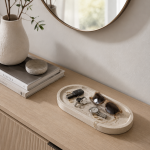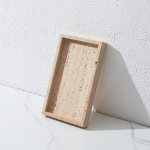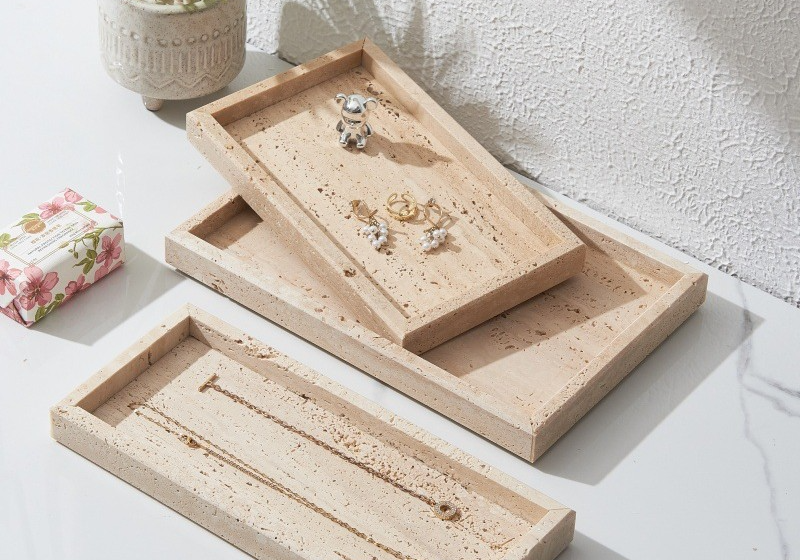

A beige travertine tray sits on the console of a model room in Shenzhen. The developer’s interior designer placed it there three days before the open house. It holds nothing but a single ceramic vase. Three hundred potential buyers walk past it over the weekend, and not one of them mentions the tray. They mention the room. How warm it feels. How the light settles differently here than in the unit two floors up. They do not know that the tray is the reason. They just feel it.
This is the silent function of a luxury travertine tray. It does not decorate. It anchors. A room without a stone surface at eye level feels untethered — everything floats. A room with a stone tray on the console, on the entryway table, on the vanity, feels grounded. The tray is a small slab of geology, 30cm of ancient seabed compressed into a rectangle, and it tells the room: you are standing on earth. The rest is just furniture.
Why travertine — and why beige
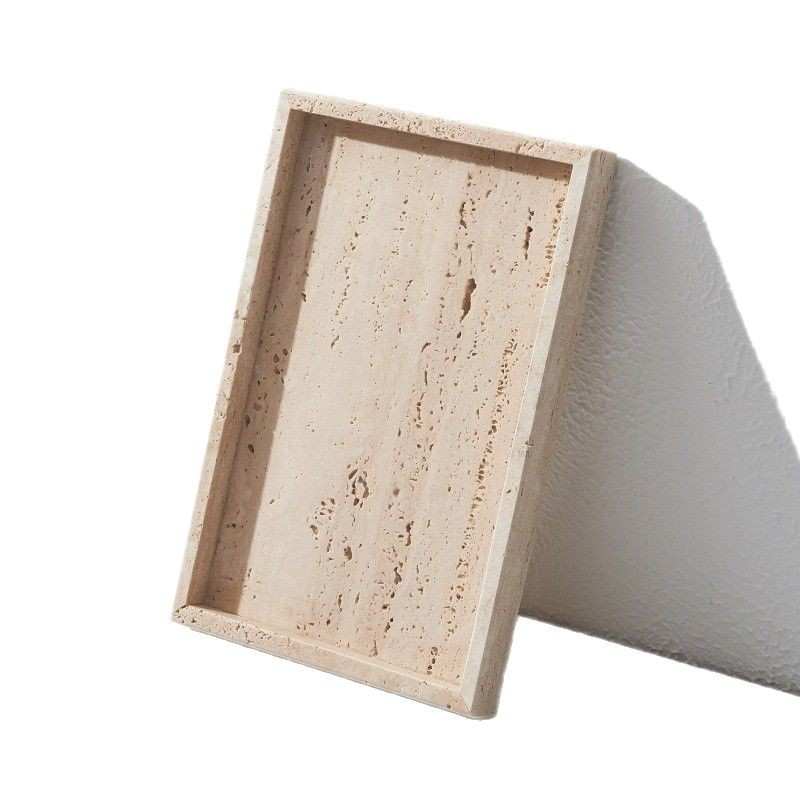
Travertine is not marble. Marble is metamorphic — it has been cooked and compressed deep in the crust. Travertine is sedimentary — it formed at the surface, from mineral springs and limestone deposits, layer by layer, over tens of thousands of years. The result is a stone that is warmer to the touch than marble, softer in colour, and visibly layered. You can see the strata in a travertine tray the way you can see tree rings in a slab of walnut. Each line is a season, a spring flood, a dry spell — a small geological event preserved in beige and cream.
Beige, contrary to its reputation, is the most versatile colour in interior design. It reads as warm without being yellow, neutral without being grey, and it pairs with every wood tone from blonde ash to dark walnut. A beige travertine tray on a mahogany console looks intentional. The same tray on white quartz looks architectural. The same tray on a glass table looks like the one solid object in a room of transparency.
Three sizes, three rooms
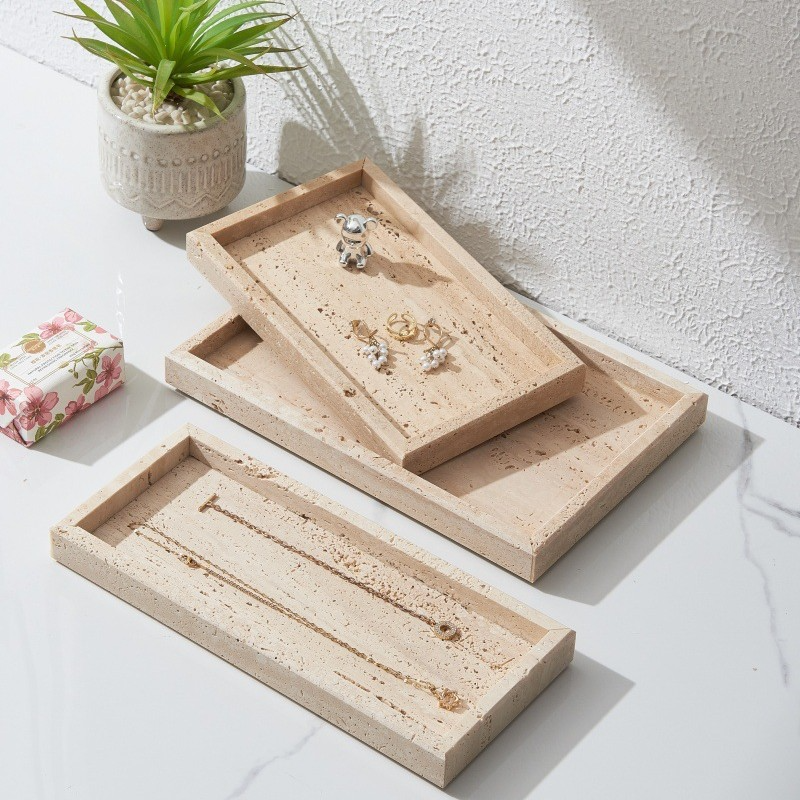
The 30×20×3cm tray is the statement piece. It fills a hotel lobby console. It holds a stack of three art books, a ceramic bowl, and a small sculpture. It is the tray you think of when you think of a luxury entryway — generous, grounded, commanding.
The 30×13×3cm tray is the vanity tray. Long and narrow, it fits between a sink and a wall, or along the back of a dresser, holding perfume bottles in a single row. The proportion — long and slim — reads as elegant. It does not crowd the surface. It defines a zone on it.
The 25×15×3cm tray is the personal tray. The nightstand tray. The desk tray. It holds a watch, a ring, a phone, a small candle. It is the tray you reach for in the dark, the tray that catches pocket contents at the end of a day, the tray that feels like yours.
The model room effect
Walk through ten model rooms in any major city and you will find, almost without exception, a stone tray on a console, a vanity, or a coffee table. The reason is not that stone trays are fashionable. The reason is that a stone tray communicates permanence. A model room, by definition, is temporary — it will be dismantled when the units sell. But everything in it must feel permanent. The tray is the shortcut. One slice of geology on the console, and the room reads as settled, established, lived-in. The illusion works because the stone is real.
How we cut and polish travertine
Travertine is softer than granite but harder than limestone. It cuts cleanly on a diamond blade, but the natural pitting — the small cavities left by gas bubbles in the original spring water — must be filled. We use a colour-matched resin filler, applied by hand, sanded back, and polished. The result is a surface that is smooth to the touch but visually textured — the pits are filled, but the edges of the strata are still visible. The stone does not feel manufactured. It feels finished.
Each tray is cut from a single block. The veins run continuously from one edge to the other. If you order two trays of the same size, the veining will differ — we do not book-match. Each tray is the stone it was cut from. Nothing more, nothing less.
Place a beige travertine luxury entryway tray on your console, your vanity, or your nightstand. In three sizes. $39. Let the stone do what the designer knew it would do.
Frequently Asked Questions About Travertine Trays
Q: What is travertine and how is it different from marble?
Travertine is a sedimentary stone formed by mineral springs, while marble is metamorphic — formed deep underground under heat and pressure. Travertine is warmer in colour (beige/cream tones), naturally porous with visible strata, and softer than marble. It has been used in architecture since ancient Rome (the Colosseum is built from travertine). For trays, travertine offers a softer, more organic aesthetic than polished marble.
Q: Why do interior designers use travertine trays in model rooms?
Travertine communicates permanence and natural luxury. In a model room — which is temporary by nature — a heavy stone tray anchors the space and makes it feel established. The warm beige tone pairs with virtually every interior palette, from warm woods to cool greys. It is the designer’s shortcut to making a staged room feel lived-in.
Q: Is travertine durable enough for daily use?
Yes. Travertine rates 3-4 on the Mohs hardness scale — softer than granite (6-7) but harder than limestone (2-3). For a tray that sits on a surface and holds objects, this is more than adequate. The natural pitting is filled with colour-matched resin, creating a smooth, durable surface that resists chipping and staining when properly sealed.
Q: What size travertine tray should I choose?
30×20cm: For large entryway consoles and lobby tables — holds multiple objects.
30×13cm: For vanities and narrow dressers — long and slim, fits between sink and wall.
25×15cm: For nightstands and small desks — the personal tray for watch, phone, and ring.
Q: How do you clean a travertine tray?
Wipe with a damp microfiber cloth. Use pH-neutral stone cleaner for deeper cleaning. Never use vinegar, citrus cleaners, or abrasive sponges. Apply a stone sealer every 12 months to maintain the protective layer. Unlike marble, travertine is less prone to etching from mild acids, but it should still be treated with care.
Travertine Tray: Key Specifications
| Specification | Detail |
|---|---|
| Material | 100% natural Italian travertine |
| Sizes | 30×20×3cm / 30×13×3cm / 25×15×3cm |
| Colour | Warm beige with cream strata lines |
| Finish | Honed & filled — smooth to touch, naturally textured visibly |
| Edge | Soft radius, hand-finished |
| Weight | 1.8–2.5kg depending on size |
| Origin | Central Italy |
| Care | Damp wipe, pH-neutral cleaner, seal annually |