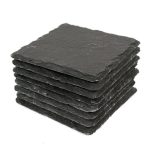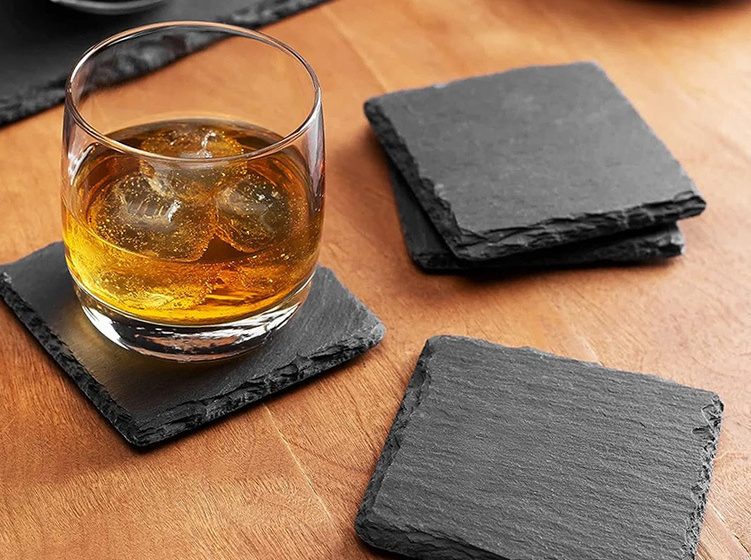

You pour a whiskey at 9pm. You set the glass down. You do not hear the glass touch the table.
That silence is the entire point.
There are objects in a home that announce themselves — the marble tray that says “look at me”, the glass vase that says “admire the light”, the lacquered box that says “open me”. A natural slate coaster does the opposite. It says nothing. It does the small, unglamorous work of protecting the table while making the drink feel more like a drink.
The first change: the sound disappears
Try this. Set a whiskey glass directly on a wooden table. You will hear a soft “tok”. Set the same glass on cork. You will hear a duller “tok”. Set it on marble. A faint ring, almost musical. Set it on slate. Almost nothing. The glass meets the stone and the room does not know.
That quietness is a luxury. In a home where every object competes for attention — the playlist, the candle, the conversation — a coaster that contributes nothing to the noise lets the drink itself carry the moment. You notice the whiskey because there is nothing else competing.
The second change: the chill moves faster
Slate is denser than wood and softer than marble. Its thermal mass draws heat downward into the stone quickly. When you place a room-temperature whiskey glass on a slate coaster that has been sitting in a 21°C room, the bottom of the glass chills within thirty seconds. The drink does not get colder — it stays the temperature you poured it — but the bottom of the glass does. That micro-chill at the base of the glass, transmitted through the lip of the tumbler to your lower lip when you sip, is the difference between a casual drink and a considered one.
The same effect, oddly, helps with cold drinks. Set an iced glass on slate. The condensation that would normally pool on the table is drawn slightly into the stone. The puddle that forms under a glass on a wood table simply does not form on slate. You can leave a sweating tumbler on a slate coaster overnight and the coaster will be damp but the table beneath it will be dry.
The third change: the coaster becomes a placemark
A coaster, used nightly, becomes the place where the drink lives. On a square table with a square coaster, that placemark is exact. On a round table with a round coaster, it is centered. On a round table with an irregular slate shape, the placemark is whatever you decide it is — the slate does not impose a geometry.
After a few weeks, you will find yourself reaching for the coaster without thinking. Your hand will know where it is. The drink will not need to be placed. The ritual will close.
The fourth change: you start noticing the glass
A coaster that is bright or patterned draws the eye down. A coaster that is shiny reflects the room. A slate coaster, being matte and dark, does neither. It sits under the glass and gets out of the way. This sounds like a small thing. It is not.
When the coaster stops competing, you start looking at the glass. The cut of the crystal. The level of the liquid. The colour of the whiskey against the room light. The matte charcoal of the slate beneath the glass becomes a quiet frame. Your eye uses it as a baseline. The glass appears more luminous than it would on a lighter surface. This is a designer’s trick as old as still-life painting — a dark, neutral ground makes a single object on top of it look more present.
How the three shapes read differently in use
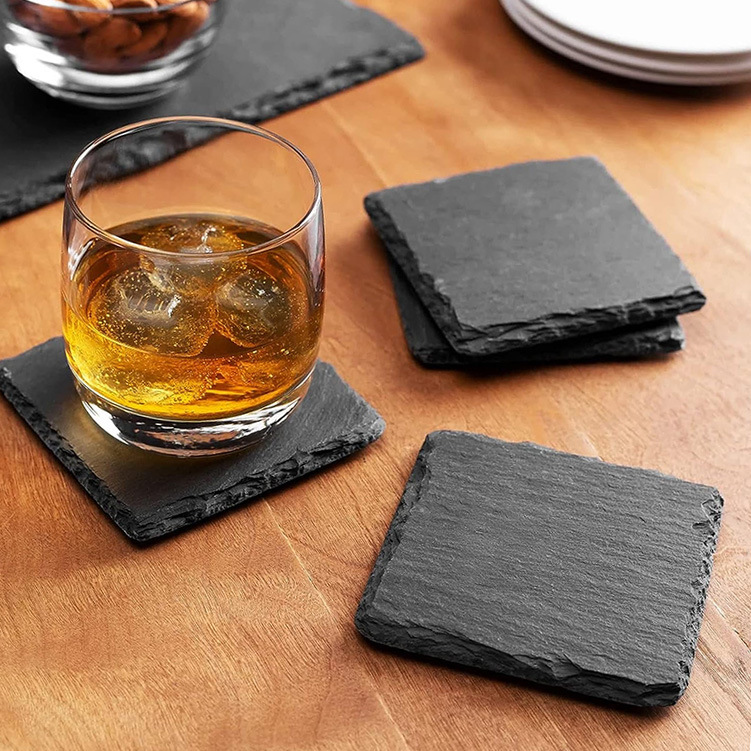
The square 10×10cm coaster reads as the most architectural of the three. On a walnut bar cart, four of them in a row look almost like a tiled floor. The square edge echoes the rectilinear geometry of most modern rooms — window frames, picture rails, table edges. If your home is mid-century or Scandinavian, the square is the more obvious choice.
The round 10cm coaster reads softer. Set on a round wooden side table under a lamp, it becomes a small moon. The geometry disappears into the room. If your table is round, or your drink is a snifter with a curved base, the round slate echoes the silhouette without trying.
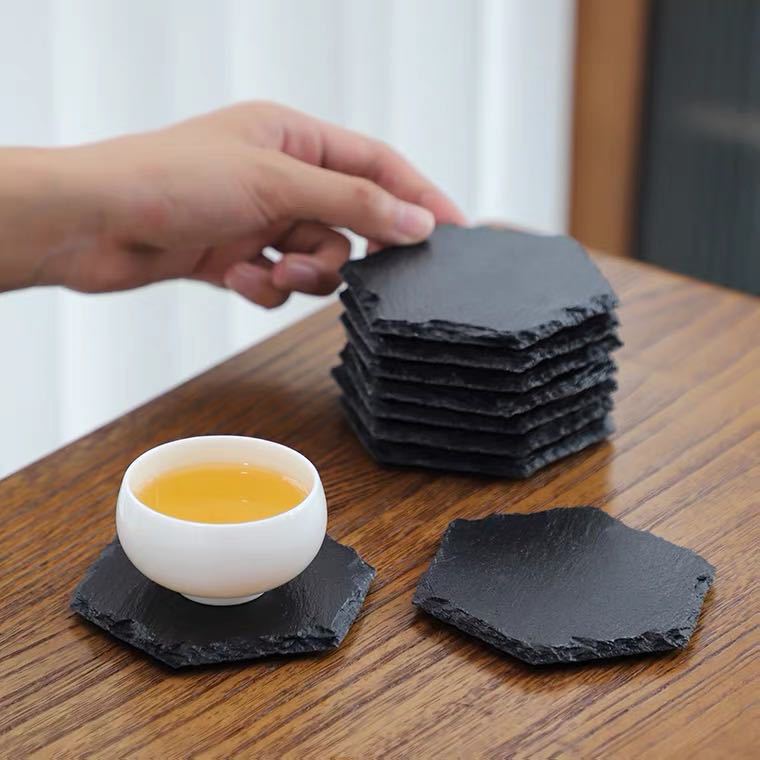
The irregular 10cm coaster reads as a found object. It is, in fact, a found object — we let the slate break along its own cleavage. Two irregulars in the same set will not be the same shape. They are stones, not coasters. If you keep one on your desk under a coffee mug, and you have a colleague visiting, they will ask whether you bought it from a market. The answer is: sort of. From our workshop’s slab pile.
Caring for a slate coaster
Slate is the easiest coaster material to maintain. It does not need sealing. It does not need polishing. Wipe it with a damp cloth when it gets dusty, or rinse it under a tap and set it back down. If you want to remove a coffee ring or a wine mark, a little baking soda on a damp cloth will lift it. Avoid oils — they will darken the stone unevenly.
Over years, the coaster will develop a soft patina where glasses tend to sit. That patina is not damage. It is the stone recording your evenings. We have coasters in our own kitchen that are five years old. The edges are slightly polished where the hand has lifted them. The surface has a faint glossy oval where the glass sits. They are the most-used objects on the table.
One stone, three shapes, the same ritual
A coaster is a small object. It does not transform a room. It transforms the moment you set the glass down. The slate does not need to be looked at. It needs to be used. And once you have used one for a week, you will notice that other coasters feel theatrical by comparison.
We make the natural slate coaster in three shapes for $9.90 each. Pick the one your table is asking for, pour a whiskey at 9pm, and let the silence do the work.