
Most coasters make a sound. Cork scratches the lacquer. Felt absorbs. Plastic squeaks against glass. Marble rings, faintly. Wood warms but never quiets.
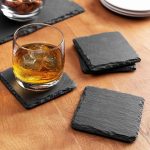
Slate, by contrast, is silent. It does not announce itself, does not insulate, does not decorate. It receives. A glass placed on slate lowers onto something that has no opinion about holding it. That, more than anything, is why we keep coming back to this stone. It is the most honest coaster material we have ever worked with.
Slate is not marble — and that is the point
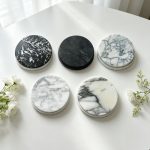
Our collection has always leaned on marble: Bulgari gold, charcoal slate, river-veined Carrara. Each of those stones has a voice. Marble wants to be looked at. The Bulgari wants to be remembered.
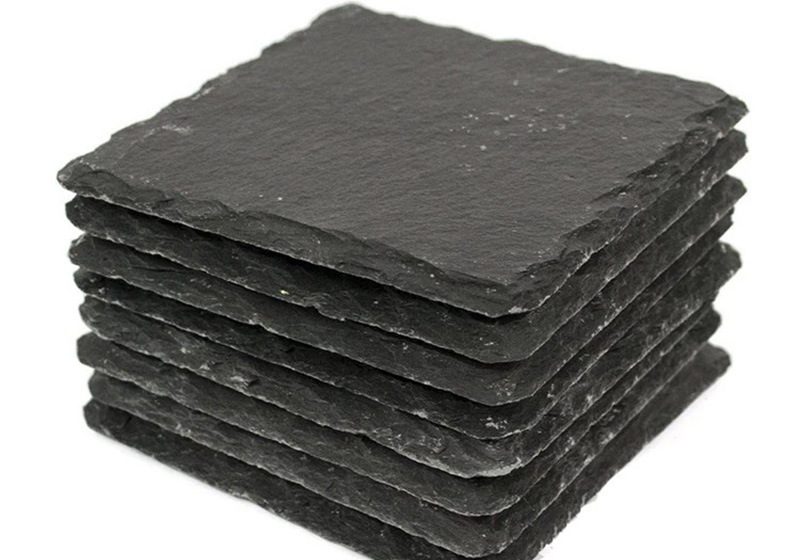
Slate, by contrast, comes from a different part of the earth and a different part of the designer’s vocabulary. It is a metamorphic rock formed under low-grade pressure — fine-grained, dense, dark. It cleaves, rather than cuts, into plates. The chisel leaves a soft, mineral edge that catches the light obliquely. There is no shine on slate; there is only a flat matte that takes whatever the room gives it.
Why we made this coaster
When we sourced the black slate for this collection, we made three deliberate decisions. First, we wanted a coaster that did not pretend to be marble — the same way we did not want our wood trays to pretend to be stone. Honesty is a quiet brand value, and it is easier to honour when the material is already honest.
Second, we wanted a coaster that would not scratch the table. Marble is harder than most woods and softer than glass. Slate is softer than marble. At a 3–4 on the Mohs scale, it sits below the typical dining table lacquer, which means the coaster wears the table and the table does not wear the coaster. Over months of daily use, the slate will lightly polish at its corners. The table will not.
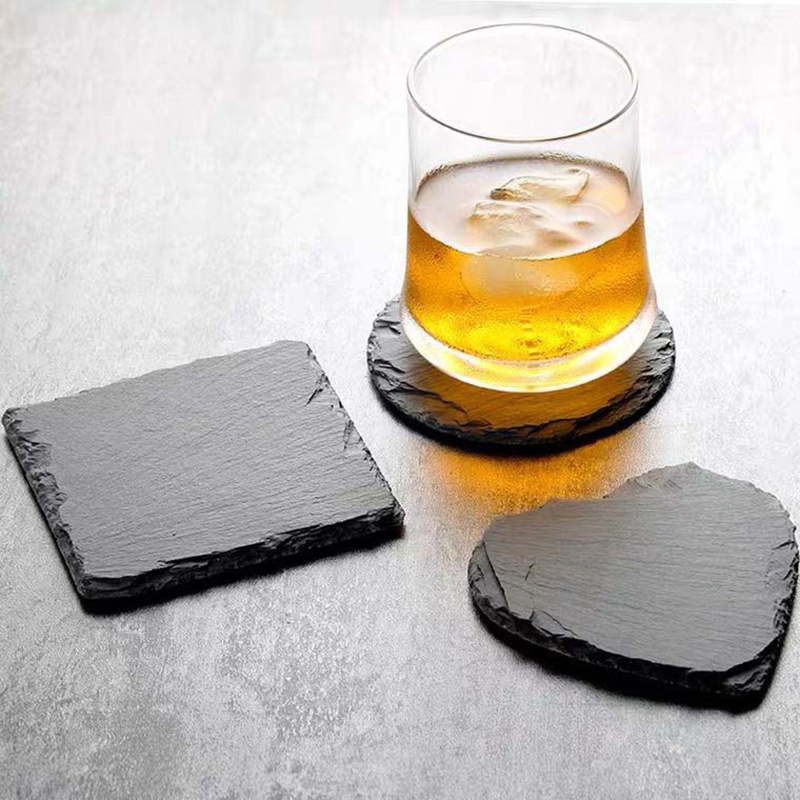
Third, we wanted three shapes from the same stone. Not three different materials, not three price tiers — three silhouettes. A square, for the architecturally-minded bar; a circle, for the round table where everything curves; and an irregular shape, for the people who think perfect circles are a little too polite. Each one is 10cm. Each one costs $9.90. Each one is the same stone, just cut differently.
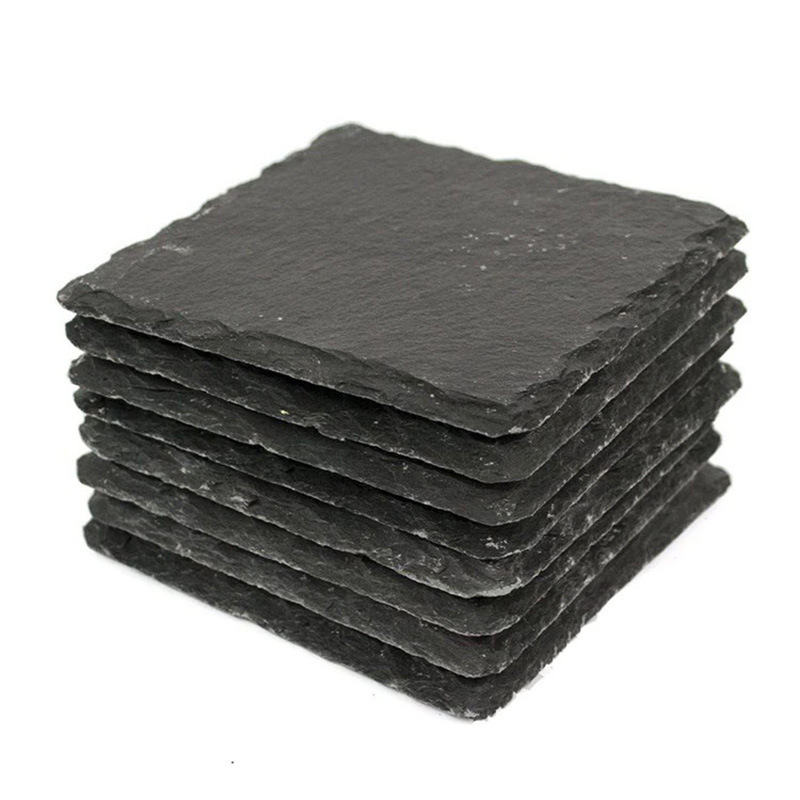
How slate is cut — by hand, in our workshop
The slate arrives from the quarry as roughly 2cm-thick slabs. We do not waterjet or laser-cut it. We score it. The artisan lays a straightedge along the drawn line, runs a tungsten scribe once across the surface, and then — with a small hammer and a soft wooden dowel — taps the slab from the underside. The stone cleaves along the scribe. The break is sharp, but the edge is rough.
That rough edge is intentional. We do not grind it flat. We do not chamfer it. We leave the chiseled silhouette as it is, because the slight irregularity of a hand-cut edge tells you that a person made this object, not a machine. A square from this batch will be 9.8cm on one side and 10.2cm on the other. The deviation is what you paid for.
For the irregular shape, we do not score at all. We let the stone break along its own cleavage planes. Two irregulars in the same set will never look exactly alike, and they are not supposed to.
Where this stone comes from
Our slate comes from a small region in the northern part of the slate belt — the same geological zone that has produced roofing slates for centuries. The beds run for tens of kilometres and dip at angles determined by tectonic events millions of years old. The colour is consistent: charcoal to black, with the occasional fine line of grey where a slightly different mineral layer ran through the original sediment.
What matters for a coaster is not provenance in the way it matters for wine. What matters is that the slate splits cleanly, that the grain is fine, and that no iron pyrite veins run through it. Iron pyrite, in a coaster, will rust when wet and stain your table. We reject any slab that shows visible pyrite. The slab you hold has been culled at least once.
What slate does at the table
A glass of iced water on slate will sweat slightly more than it would on marble, because slate is a poorer conductor of heat — the stone does not pull warmth from the glass, so the ice melts a fraction faster. A whiskey glass on slate will chill faster on the bottom because the slate draws heat quickly downward once the glass is placed, then holds the chill.
The matte surface also catches condensation. A water ring does not bead and roll off slate the way it does off marble. The slate drinks the water. Over years, a frequently-used coaster will develop a slightly darker patina where glasses tend to sit. That patina is the coaster remembering you.
Why $9.90 — and why not less
A natural slate coaster, hand-cut and culled at the slab, costs roughly twice what a cork coaster costs at retail. We could have sold it at $6.90. We chose not to. The reason is not margin — the reason is that the price tells you how much work went into the object. At $9.90, you can imagine the artisan, the chisel, the slab, the cull. At $3, you cannot.
This is the same logic we apply to all of our coasters. A marble coaster at $9.90, a slate coaster at $9.90, a Bulgari coaster at $9.90 — three materials, three quarries, three cutting traditions, all at the same price. We do not believe the slate is “less than” the marble. We believe the slate is different.
Choose your shape
We made the square for people who like their bar cart to look like a small library — even, repeated, geometric. The circle is for those who put a candle in the middle of the table and prefer that their coasters echo it. The irregular is for people who would rather have one rock on the table than four coasters stacked. All three are 10cm. All three are $9.90. All three are cut from the same slab, by the same hand, in the same week.
Order the natural slate coaster set and let the table tell you which shape belongs there.