
Most trays are cut from one slab and finished. A mosaic tray is built: dozens of small tiles of natural marble — deep green, veined black, quiet grey-purple, warm beige — cut by hand, set into a checkerboard, ground flush, and polished into a single plane. The mosaic marble catchall tray is that object at twelve centimeters, in round or square, and it reads handmade for the simplest possible reason: it is. This guide covers what makes a stone mosaic different from a printed pattern, what the tray actually holds, and how to choose between the four colors and two shapes.
Why Mosaic Beats Print
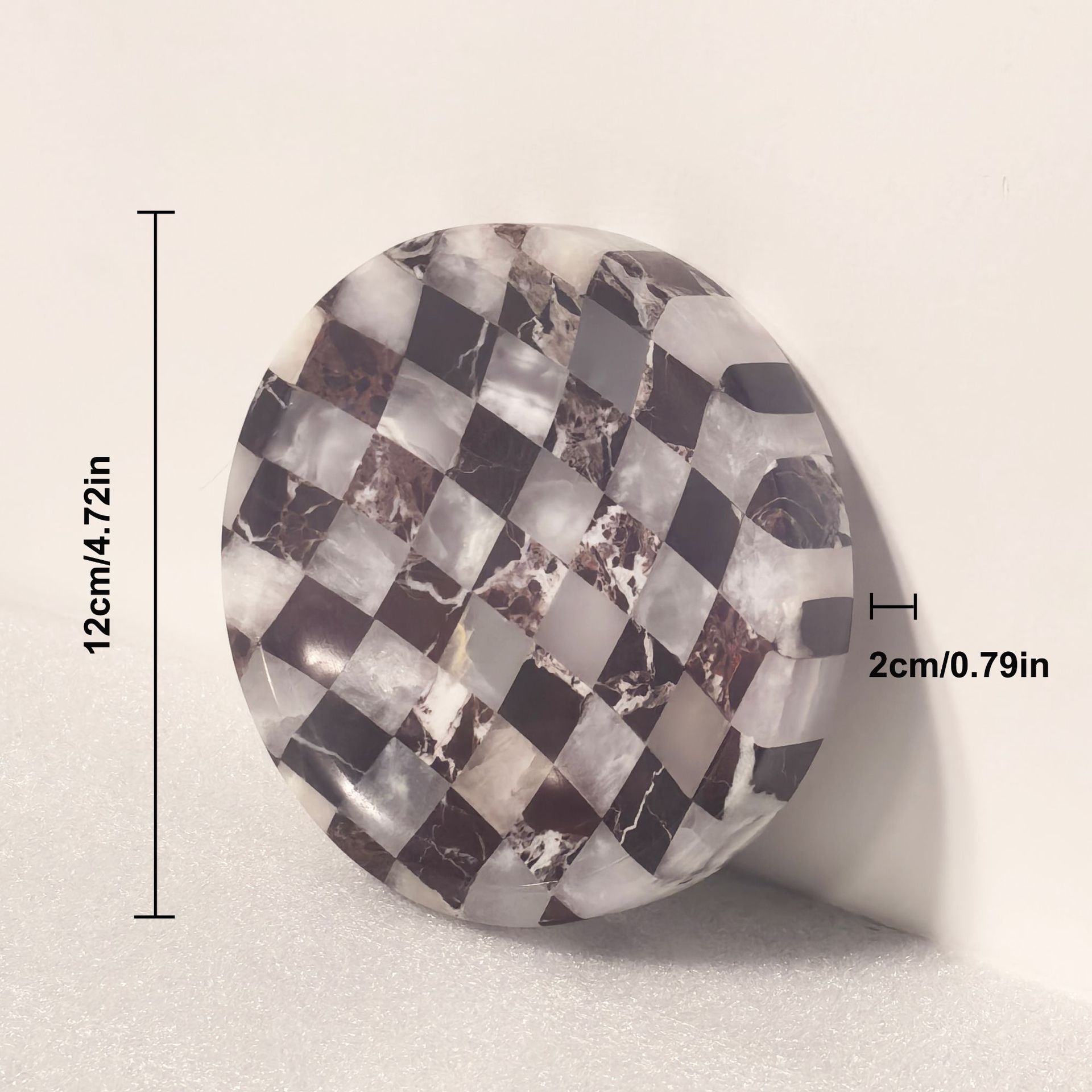
Printed checkers are flat; a mosaic has relief. Each marble tile is a separate cut of real stone with its own veining and depth, set beside its neighbors with visible handwork, and the whole board is ground and polished afterward into one even surface. Run a finger across it and the tiles read as fields of subtle texture; catch the light at an angle and the surface throws a grain no printed ceramic can fake. Because the veining of each chip decides the rhythm of the pattern, no two trays share the same map — the checkerboard is a format, not a fingerprint. The polish-after-assembly step is what turns the tray from decorative to practical: rings do not snag on grout lines, soap drains cleanly, and a candle sits perfectly square. The grout-and-grind construction also means the tray is genuinely solid marble all the way down — it chips the way stone chips, not the way glaze peels.
Four Colors, Two Shapes, One Decision
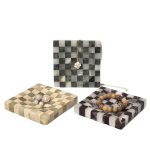
The tray comes in purple, green, black, and beige, each a mosaic of natural marble chips rather than a dyed imitation. The green reads deep and botanical — the strongest choice against wood and brass. The black-and-white board is the graphic one, at home on white counters and modern vanities. The purple leans grey-violet and quiet — the rarest note, and the one that flatters silver and cool lighting. The beige is the warm neutral, closest to the travertine family most stone households already own. Shape follows use: the round board softens the straight lines of desks and consoles and has no corners for small items to pool in; the square aligns with tile, shelves, and book stacks, and tucks into corners the round one wastes. Both are twelve centimeters across and two thick — the footprint of a coaster set, the presence of an object three times the price.
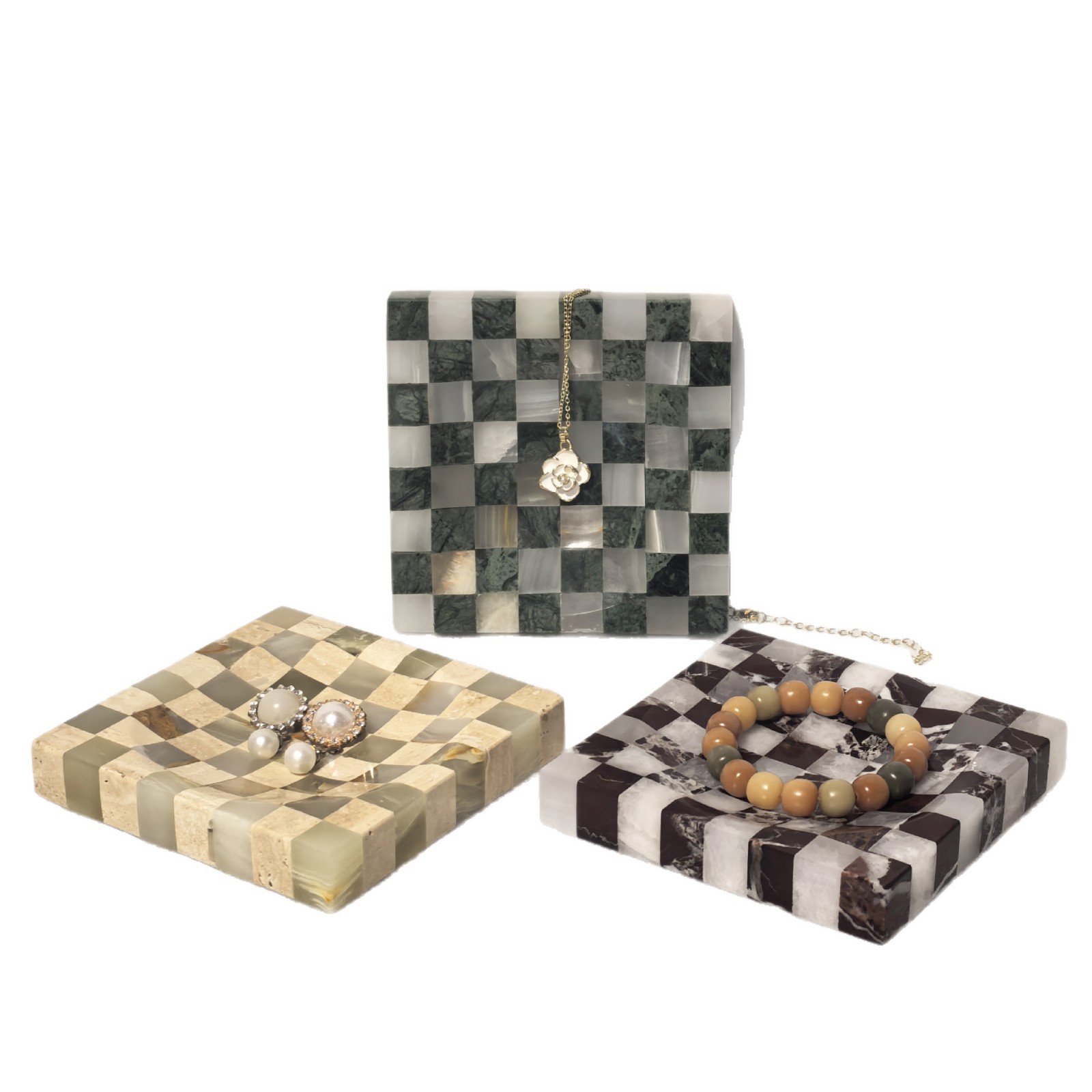
The making process deserves a closer look, because it explains both the price and the permanence. Each board starts as a tray blank of solid marble; the tiles are sawn from offcuts of larger projects — green from Indian green blocks, black from veined Nero-family stone, purple from the grey-violet family, beige from cream marble — sized to the pattern, then set by hand into the checkerboard with adhesive and grout. The whole board then goes back to the grinding wheel: the tiles and grout are ground down together until the surface is one continuous plane, after which the entire face is polished. That grind-and-polish stage is what separates a stone mosaic from a craft-project mosaic — it is why the board is flat enough for a candle and smooth enough for a watch strap. It is also why the pattern is permanent: the checkerboard runs through the full thickness of the board, so wear cannot expose a printed base, because there is no printed base. The tray is the material, all the way down.
What a Twelve-Centimeter Board Holds
- Soap dish: a bar rides above the surface, drains, and lasts visibly longer — the tray wipes clean in one pass.
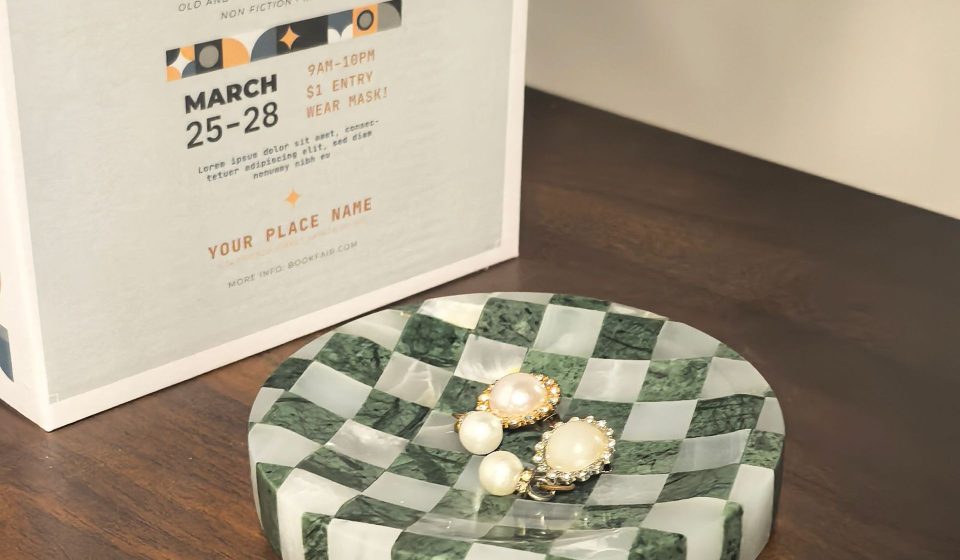
- Jewelry and watch tray: rings, studs, and the daily watch stay visible overnight; stone cannot snag a chain.
- Key catchall: by the door, the board becomes the exit ritual — and the marble deadens the clatter ceramic amplifies.
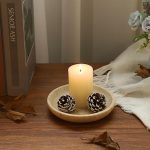
- Candle coaster: a pillar candle on the checkerboard is the styling move that makes the tray look like decor rather than storage.
The two-centimeter thickness is doing quiet work in every role: it gives the board real mass, so it stays put when keys drop in, and it casts the soft shadow in photographs that makes flat objects look dimensional. Size-wise, twelve centimeters fits nightstands, desk corners, and bathroom counters that a thirty-centimeter tray would crowd — it is the smaller sibling in a tray family, priced for gifting and sized for permanence.
There is a weight conversation worth having before the gift conversation, because weight is the property that sells the board faster than the pattern does. Lift the tray once and the specifications resolve into a feeling: solid marble, dense for its size, with the planted authority of an object that will not skate across the desk every time a key lands in it. That mass is not incidental — it is the reason the catchall habit survives contact with real life. Light dishes migrate, tip, and end up in the drawer they were meant to replace; a board with real mass accepts the daily toss and stays exactly where it was placed. The weight also reads before it is touched. Visitors register mass visually, the way they register it in a marble tray or a stone ashtray: here is something chosen once and chosen well. And when the board does travel — desk for winter, vanity for summer, guest room when people come — the weight that anchors it is the same quality that makes moving it feel deliberate rather than messy.
The Gift Argument
The tray ships in bubble wrap inside a rigid box, and it is the rare present that works without explanation: weight, material, and finish are all legible in the hand. Housewarming, weddings, employee gifts, business favors — the board reads expensive because the material is expensive, and the four-color range means there is a board for every interior: green for the plant-filled desk, black for the monochrome apartment, purple for the collector, beige for the japandi living room. Gift-givers report the pattern that all stone objects follow: they get kept where decorated novelties get re-gifted, because nothing about them requires explanation and nothing about them dates. The checkerboard pattern itself is the oldest motif in the decorative canon — it has survived five centuries of fashion without ever going out of it.
Care: One Minute a Month
The care routine is deliberately short. Wipe with a damp cloth and a drop of mild soap; towel-dry. Keep lemon cleaners, vinegar, and bleach off the surface — acids etch marble’s polish, the same caution every natural-stone object carries. The tray is sealed before shipping; an annual water-drop test tells you when it wants a fresh coat (beading means another year, soaking means an afternoon with stone sealer). Soap, cosmetics, and keys are the tray’s daily diet and none of them needs more than a rinse. Treated this way, the mosaic outlives the room it starts in — and because every board is assembled by hand from real chips, the tray that ages on your counter is one nobody else owns.
Frequently Asked Questions
Are the checkerboard tiles real marble?
Yes — each tray is assembled by hand from cut tiles of natural marble, then ground and polished into one plane. The pattern is a format, not a print: no two boards share the same veining map.
Round or square — how do I choose?
Round softens desks and consoles and has no corners for small items to pool in; square aligns with tile, shelves, and book stacks. Both are 12 cm across and 2 cm thick.
Which color suits a small bathroom?
Beige flatters warm neutrals and travertine households; black reads sharpest against white porcelain; green brings the botanical note; purple suits cool lighting and silver fixtures.
Bring one home: the Mosaic Marble Catchall Tray 12cm — $69, hand-finished and sealed, ships worldwide in a rigid carton.
Read next: the checkerboard tray: gift and desk decor and the travertine catchall bowl guide.