
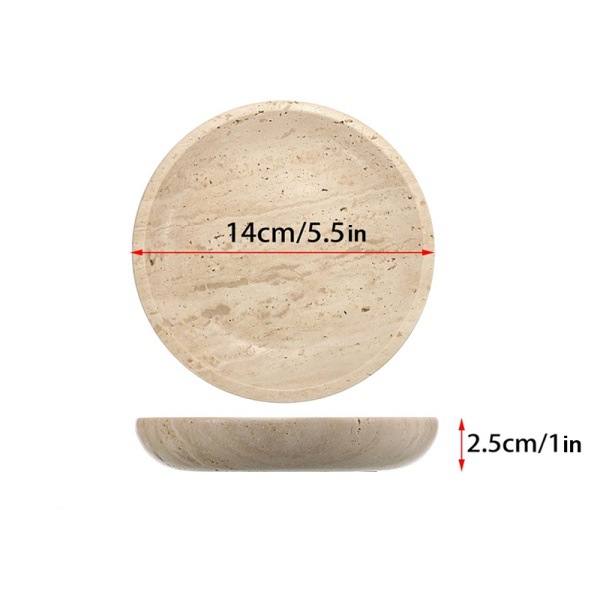
There is a size of object that interior stylists quietly rely on and almost nobody names: the small stone bowl between ten and fifteen centimeters across. Big enough to hold a day’s worth of small things, small enough to live on any surface without negotiating for space. The travertine catchall bowl is that object carved from a single block of beige stone — fourteen centimeters wide, two and a half deep, with the soft mineral pores that make travertine the calmest member of the marble family. This guide covers what it holds, why the size works, and how one bowl earns its place in four different rooms.
What a Catchall Bowl Actually Does
A catchall is not storage; it is a landing zone. Storage asks you to decide, open, and put away — three steps that fail by the second week. A catchall asks nothing: it stands where hands already empty themselves, and small things land in stone instead of on the counter edge. The bowl shape adds one thing a flat tray cannot: depth with visibility. Walls two and a half centimeters tall keep a pocket’s contents — keys, coins, a folded mask, the earbuds case — from sliding off, yet everything stays readable at a single glance. That balance is the whole design: deep enough to hold, shallow enough to see. Psychologists who study habit formation call it the path of least resistance; hotels, which must reset a surface perfectly every day, learned it a century ago and built the brass tray industry on it. The residential version simply needs to be heavy enough to survive the same traffic, and two centimeters of solid stone does not move unless you move it.
Why Travertine Suits the Small Stuff
Travertine is a limestone born in mineral springs, and its signature is a soft field of natural pores over a warm cream ground. On a small bowl those pores are the entire show — you read the surface the way you read suede, and each bowl carries a map no other piece repeats. The beige family is the most forgiving color in the stone palette: beside chrome it softens the metal, beside oak it holds its own, against painted walls it reads as a quiet matte object that never demands attention. Weight matters more at this scale than buyers expect. A resin bowl skates across the counter every time a key drags across it; solid travertine accepts the toss and stays put, and the habit only works if the dish does. The bowl is polished after carving into one even plane — smooth enough that rings do not snag and soap drains, textured enough that it never reads as glass.
Four Jobs for One Fourteen-Centimeter Bowl
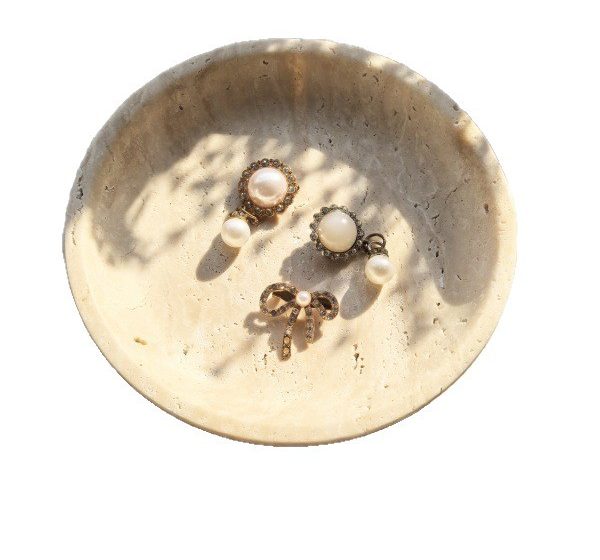
- The jewelry bowl. Rings off at the sink, earrings off at the mirror, watch off at the desk — the bowl catches all three and keeps them visible until morning. Stone is smoother than fabric-lined boxes and cannot snag a chain.
- The entryway catchall. By the door it becomes the exit ritual: keys, coins, transit cards, the spare AirTag. The low walls keep small metal from escaping; the stone deadens the clatter ceramic amplifies.
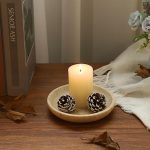
- The candle base. A pillar candle on stone is a classic for a reason — the bowl catches stray wax, tolerates the warmth, and turns a plain candle into a styled vignette.
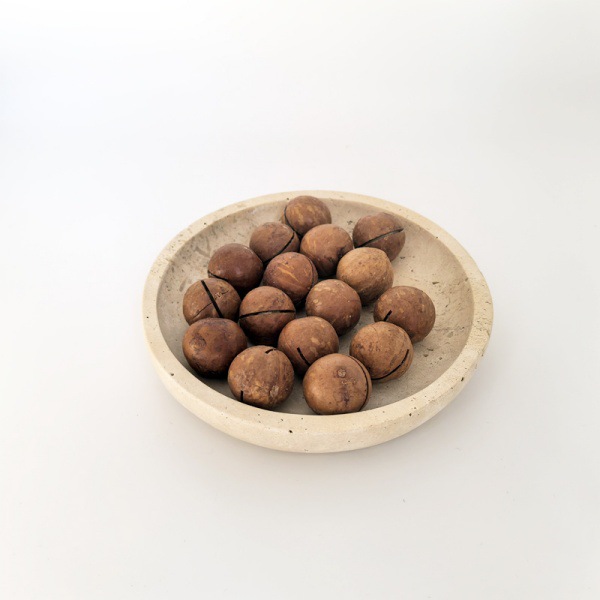
- The snack dish. Nuts, dates, or clementines served straight from stone; the mineral holds the evening’s cool longer than ceramic, and cleanup is a rinse.
Against the rest of the stone shelf, the bowl occupies a deliberate middle position. Polished black marble reads formal and shows every water spot; heavily veined white marble photographs beautifully but argues with patterned tile; travertine does neither — its matte, warm ground flatters its neighbors instead of competing with them, which is why designers reach for it when a surface already has one statement piece. The beige tone also solves the small-bowl’s real styling problem: at fourteen centimeters, the object is too small to carry a room and must instead disappear gracefully into one. A dark bowl on a dark wood nightstand vanishes; a white bowl on white tile disappears differently, by blending. The beige bowl does neither — it reads as an object without reading as an event, which is exactly what a surface that already holds a lamp, a book, and a life requires. That is the understated talent of neutral stone: it stops being about the stone and starts being about the things it holds.
The Size Argument: Fourteen by Two and a Half
Bowl sizing is a small industry of mistakes, and the fourteen-centimeter mark is where most of them resolve. Under twelve centimeters and the bowl holds three rings and looks empty by Thursday; much over sixteen and it starts to dominate the surface it was meant to serve. Fourteen centimeters takes a full pocket’s contents, a complete jewelry set, or a modest pile of fruit, with the shallow wall keeping everything visible from across the room. On the surface, the footprint is roughly a dessert plate — the one volume of space every nightstand, console, and bathroom counter already reserves. The proportion also photographs well: wide enough to style with props, low enough to never block a faucet or a mirror’s reflection.
Where It Lives: Four Rooms, One Bowl
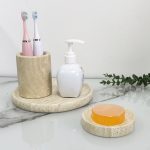
The nightstand is where the bowl earns its name — watch, rings, and earbuds deposit at night, withdraw in the morning, and the stone glows under the lamp’s warm light. The entry console gives it the traffic role: one bowl, positioned where the bag changes hands, and leaving the house becomes a single gesture. The bathroom converts it to a soap or sponge dish, where the sealed stone shrugs off steam that would swell a wooden bowl. The coffee table gives it the most photogenic job: a pillar candle framed by the bowl’s rim, catching wax and shadow in equal measure. One bowl, four rooms, no re-purchase — which is the quiet economics of buying solid stone once: it migrates for years without ever looking displaced.
Caring for Sealed Travertine
The routine is deliberately short. Wipe with a damp cloth and, if needed, a drop of mild soap; towel-dry and the bowl air-dries in minutes because stone does not hold water the way wood does. Keep lemon cleaners, vinegar, and bleach off the surface — acids etch limestone’s finish the same way they etch marble. The bowl is sealed at the workshop, and the annual test takes one minute: drip a little water on the rim, and if it soaks in within minutes instead of beading, the stone is asking for a fresh coat. Jewelry, keys, and dry snacks are the bowl’s daily diet, and none of them needs more than a rinse. Treated this way, the bowl outlives the room it starts in — stone objects move house more often than they wear out.
Frequently Asked Questions
What fits in a 14 cm bowl?
A full day’s pocket contents, a complete jewelry set, a bar of soap, a pile of nuts or clementines, or a pillar candle up to about 10 cm across — with the 2.5 cm wall keeping everything visible.
Will it stain from soap or cosmetics?
No — the bowl is sealed and soap or skincare is exactly its intended diet. Rinse with water and mild soap; just keep acidic cleaners off the surface.
Is every bowl identical?
No two share the same pore pattern — travertine’s texture is a mineral event, and each bowl carries its own map. The photos show the stone family, not one fixed look.
Bring one home: the Round Travertine Catchall Bowl 14cm — $29, hand-finished and sealed, ships worldwide in a rigid carton.
Read next: a jewelry bowl that earns the nightstand and mosaic marble trays: checkerboard in stone.