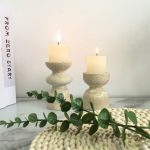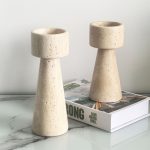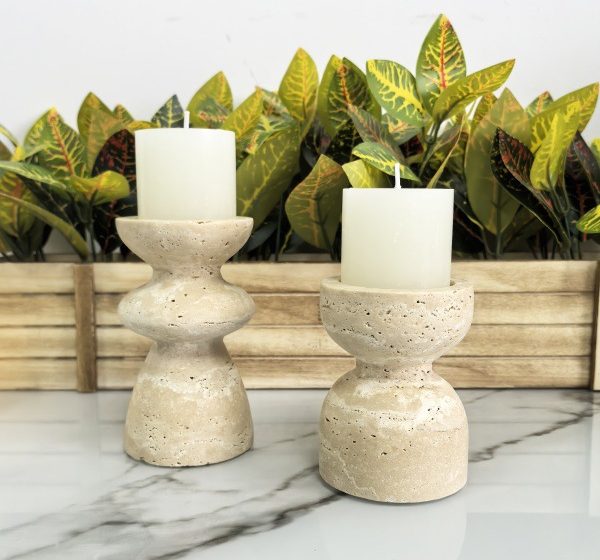

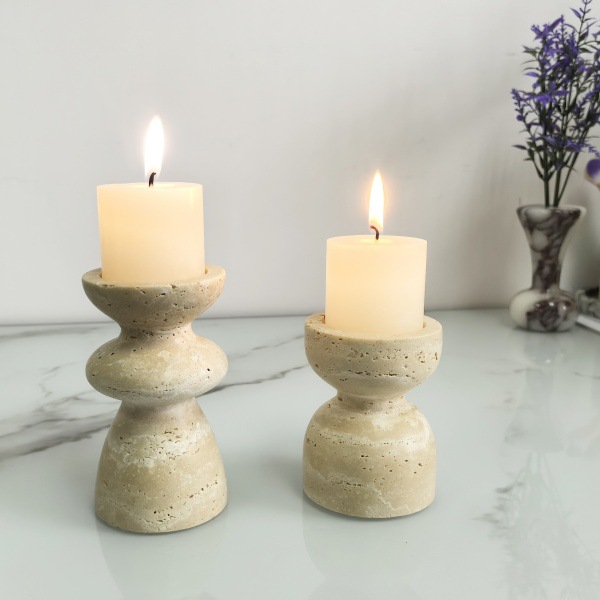
Every few years a shape comes back from the middle of the last century and suddenly every styled interior has one. Right now it is the turned candle holder — that stack of soft bulges your grandmother’s sideboard knew well — and the comeback is not nostalgia so much as correction: rooms got very flat and very rectangular, and the turned silhouette is the fastest antidote on a shelf. The mid-century travertine candle holder is the stone-carved version of the trend, and this is how it works in a modern room.
Why the Turned Shape Reads as Designed
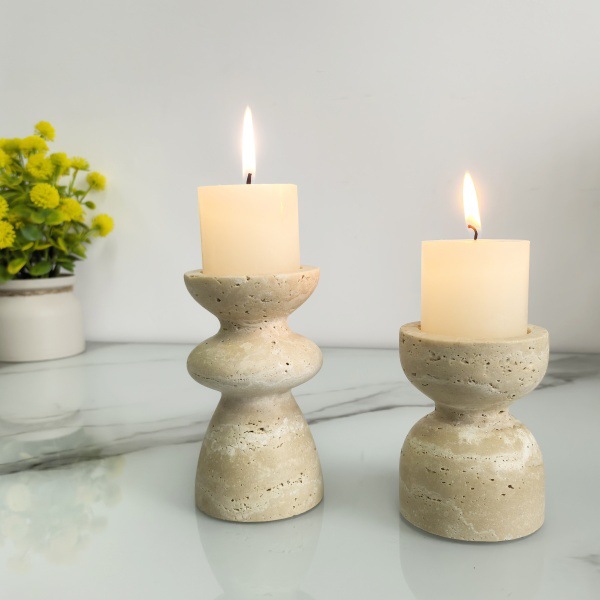
A lathe can only make round things, and round things carry a peculiar confidence: no corners to choose, no edges to align, just a profile rising and falling like a line of music. Mid-century designers exploited this endlessly — turned lamp bases, turned planters, turned everything — because a single curved object relaxes an entire surface of straight lines. The effect is measurable in yourself: put one turned stone holder on a rectangular console and the console immediately looks arranged rather than furnished. Unlit, the holder is a sculpture with a job; lit, the flame crowns it and the whole composition starts earning the word vignette.
Travertine Makes It Modern Again
The original turned holders were ceramic, often glazed in avocado or mustard — colors that time-stamp them. Cutting the same silhouette from beige travertine detaches the shape from its era and hands it to the present: warm-neutral stone, honest pores, no gloss to date it. Stone also adds weight that ceramic never had — over a kilogram for the tall size — so the piece sits like furniture rather than decor, and it survives the shelf-editing every home eventually performs. Trends rotate; a carved stone object simply changes jobs from candleholder to sculpture and back.
Where the Trend Lives in a House
- The console: holder on books, small mirror above — the entryway composition that survives every repaint.
- Open shelving: one holder between book clusters breaks the vertical lines and adds a curve to the rhythm.
- Mantel: a pair stepping in height, candles unlit by day, doing their sculptural work in daylight.
- Bedside: the short size holding a candle you light for the last ten minutes of the day — ritual, not reading light.
Pairing With What You Already Own
Mid-century shapes pair generously because their geometry is neutral. With walnut and teak, the holder’s curves echo the era natively — add brass and the 1960s are fully in the room. With modern minimal interiors, the stone’s texture does the work: one soft, porous object among hard flat surfaces reads as curation, not clutter. With the cottage and japandi looks that share shelf space with the trend, travertine’s matte calm bridges both — it is beige enough for linen countries and sculptural enough for concrete ones. The only genuine clash is gloss: keep lacquered and mirrored objects at a distance, and let the matte stone carry the surface.
The Two-Size System
The holder ships in a 12-centimeter tall size and a 9-centimeter short one, and the system beats the single: staggered heights are what make small groupings look composed, and two turned forms in the same profile do it without a third object. Style them a hand-width apart — the gap is part of the composition — and resist filling the space between; the negative area is what makes a pair read as intentional. On wider consoles, separate them by a book stack each and let the room’s eye travel from one to the other. By the second week you will stop noticing them individually and start noticing the corner of the room they improved.
Lit Rules and Unlit Life
Burn pillar candles in the cup, wicks trimmed short, never leaving a flame alone with a room. Between burns, the holder keeps working: it is the stone object on the shelf that guests pick up, weigh in the hand, and ask about — which is the quiet test of decor that is actually made of something. Maintenance is a sentence: cooled wax lifts from the sealed cup, a damp cloth finishes the job, no chemicals ever needed. Real stone, turned by hand, carries no finish to peel and no trend to expire — it just changes what it holds.
The Collector’s Angle: Mixing Eras on One Shelf
The turned holder’s real talent is conversation with objects that are not its relatives. On a shelf of modern hardbacks, the curves interrupt the verticals and the shelf instantly has a foreground and background. Beside terracotta and rattan, the travertine’s matte pores make the woven pieces look intentional rather than beachy. Next to brass — the mid-century partnership that never fails — the stone’s cool matte grounds the metal’s shine, and suddenly the 1960s are visiting without moving in. Even minimal concrete-and-steel interiors accept it, precisely because beige stone is the warmest neutral that exists: it reads as geology, not as a color choice someone will regret repainting around. The mixing rule that keeps it all coherent is material, not era — matte with matte, one gloss per surface. A glazed vase is fine beside the stone; a lacquered candlestick is not. And because the holder works unlit as pure sculpture, it earns its shelf space in daytime hours when no flame is burning: most owners report theirs gets moved less often than any other small object in the house, which is the collector’s quiet metric for a piece that has stopped being trend and started being furniture. Buy one and watch where it refuses to leave; buy the pair and the second one will find its own room.
Buying One Versus Buying the Pair
The honest answer depends on what the holder is replacing. If the shelf or console currently has nothing vertical and sculptural on it, one tall holder solves the problem in a single move — it is the stronger standalone object, over a kilogram of carved stone with a profile that reads from across the room. If, however, the surface already has a vase or a lamp providing height, the short holder is the better first buy: it fills the mid-level of the composition without competing with what is there. The pair, staggered, is the endgame most interiors arrive at eventually — two heights in one profile is the smallest complete grouping styling recognizes, and the two sizes were carved as a family for exactly this reason. Gift math follows the same lines: one holder plus a good pillar candle is a complete present; the pair in its rigid box is the wedding-grade version. There is no wrong order to acquire them in, and no deadline — stone objects are unusual among decor purchases in that they wait patiently on a wishlist without going out of production or out of fashion. The lathe-turned silhouette has been waiting out trends since the 1950s and has outlasted every one of them; it can certainly outlast a decision measured in months.
Frequently Asked Questions
Is the holder heavy enough to feel substantial?
Yes — the tall size weighs over a kilogram of solid travertine. It sits like furniture, does not tip, and survives shelf edits for decades.
Does the beige color suit grey or cool interiors?
Yes — warm beige against cool grey is a deliberate contrast, one soft porous object among hard flat surfaces reads as curation.
Can it hold candles other than pillars?
Tapered candles need a spike holder, but tealights and small pillar candles all sit well in the cup — anything up to 7cm across.
Bring one home: the Mid-Century Travertine Candle Holder — $39, hand-carved and polished, ships worldwide in a rigid gift box.
Read next: travertine candle holders: stone that frames a flame and the candlelit table, styled simply.