
Round trays photograph well and square trays stack neatly, but the rectangle is the shape that actually fits your house. Look at the surfaces where clutter collects — the vanity ledge, the console behind the sofa, the shelf beside the bathtub, the strip of countertop between the sink and the mirror — and you will notice they are all long and narrow. A 30-by-15-centimeter rectangle matches them exactly, which is why the rectangular marble vanity tray has become the quiet workhorse of our stone collection.
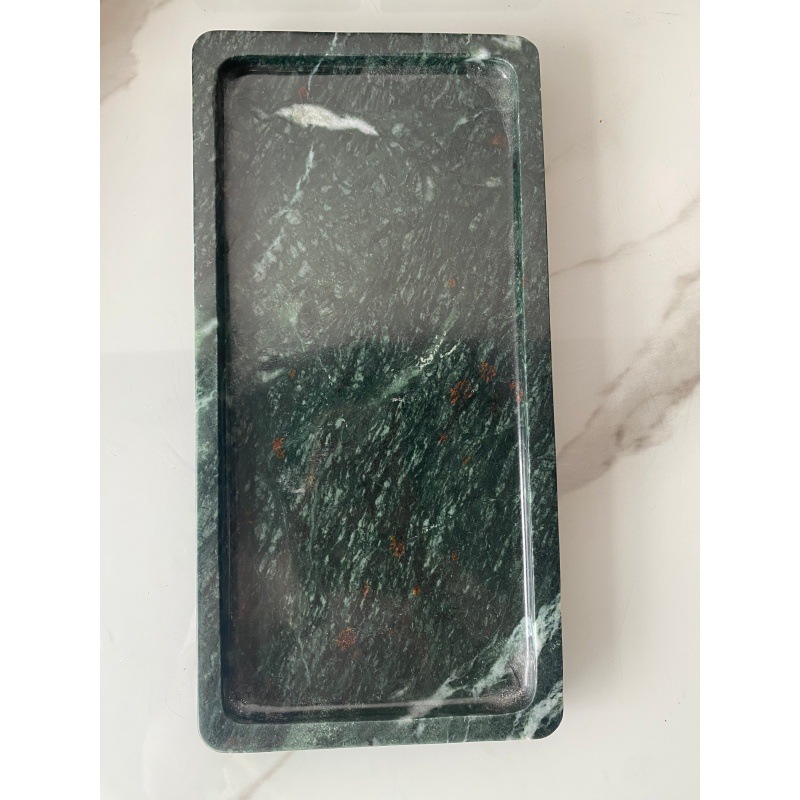
The geometry does half the work. Thirty centimeters is long enough to hold a full perfume collection, a row of candles, or the everyday carry that otherwise migrates across three rooms — and fifteen centimeters is narrow enough that the tray never dominates the surface it sits on. The raised lip, about a centimeter high, keeps everything contained: bangles do not roll, keys do not slide, and the one peanut that always escapes the bowl stays put.
Four Stones, Four Temperaments
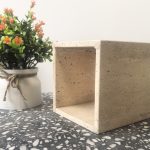
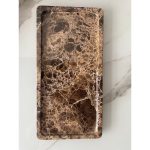
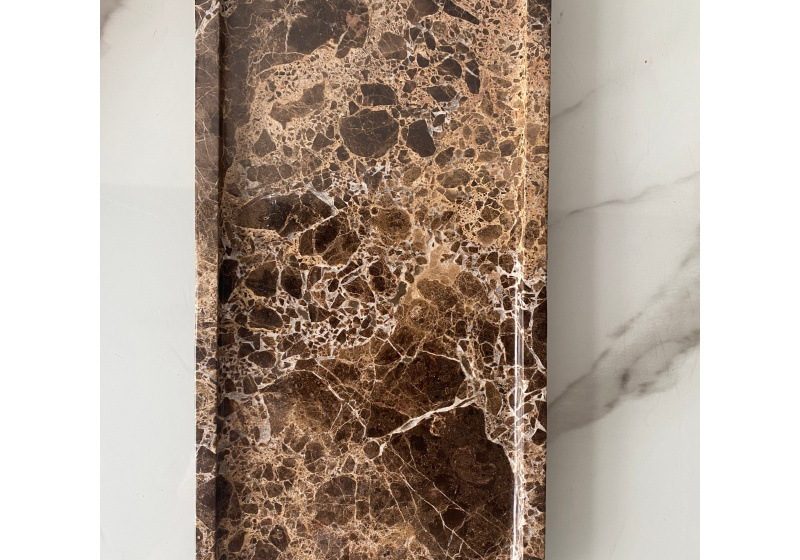
The tray comes in four genuinely different stones, and the choice matters more here than in small objects, because thirty centimeters of marble is a visible commitment. Emperador Brown is the warm anchor: dense coffee-dark cells over a caramel ground, at home against walnut, leather, and brass. India Green is the deep one — a green so dark it reads almost black until daylight hits the veins, the stone equivalent of a forest at dusk. Rosso Levanto brings the drama: wine-red crossed by white lightning, the marble that Renaissance sculptors fought over. Beige Travertine is the quietest, its sandy surface full of tiny mineral pores, made for linen, oak, and rooms that do not want to shout.
Pick by the surface it will live on, not by the stone you like best in isolation. On a white quartz vanity, Rosso Levanto becomes the single point of color in the room. On a busy walnut dresser, travertine whispers where Emperador would compete. There is no wrong answer, but there is a best one for your counter.
Why Stone Beats Every Other Tray Material
Wood warps in a bathroom and stains under perfume. Acrylic yellows. Ceramic chips at the exact lip that makes a tray useful. Marble sidesteps all of it: it is cool to the touch, which matters more than people expect when the tray holds cosmetics; it is heavy, roughly two kilograms, so it never slides when a hand reaches over it; and its polished, sealed surface wipes clean of every substance a tray actually encounters — sunscreen, hand cream, ring marks, the ring of a condensing candle jar.
The weight deserves its own sentence. A tray’s whole job is to anchor a surface, and a tray that skates defeats itself. Two kilograms of carved stone does not move. You will notice this most at the entryway, where a drop-zone tray gets bumped by bags and elbows daily — stone absorbs all of it without shifting a millimeter.
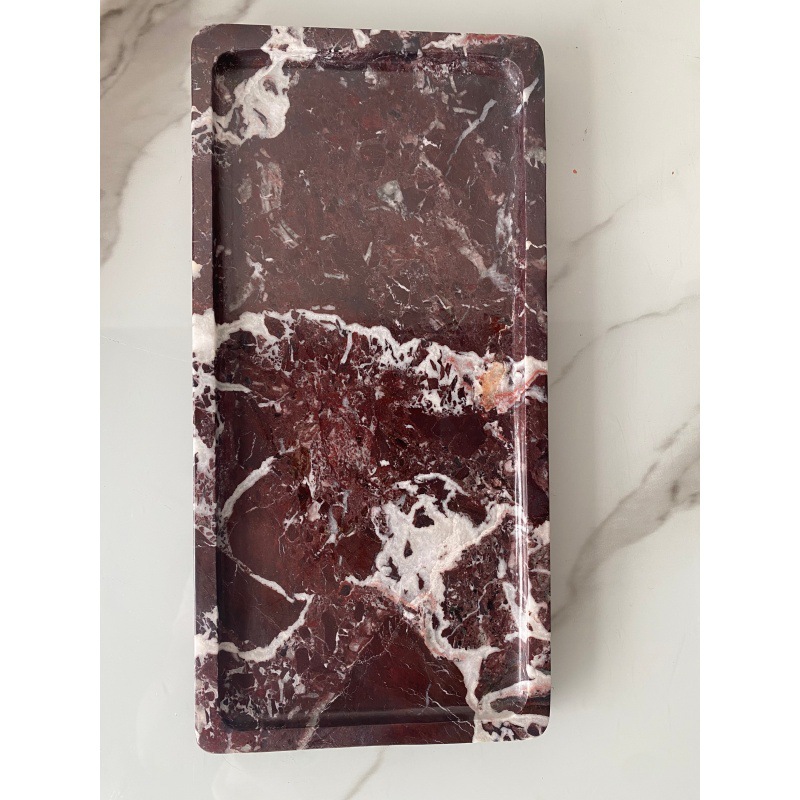
Three Surfaces, Styled
The vanity: perfumes in a row along the back edge, jewelry in front, and the tray’s rectangle turns a scattered counter into a deliberate composition. The entry console: keys, wallet, and sunglasses land in one line; guests read it as furniture, not storage. The bathtub shelf: soap, a folded towel, and a candle — the hotel trick that costs one tray. In each case the marble does the styling for you; the objects it gathers look chosen rather than abandoned.
Care That Matches Real Life
Wipe with a damp cloth for daily upkeep; the sealed surface shrugs off everything except acid, so keep citrus juice and vinegar cleaners off it. No dishwasher, no abrasive powders. Once a year, a coat of stone sealer returns the polish to factory sheen. Because the tray is carved from one block — no seams, no glued tiles, no lining — there is nothing to peel, trap grime, or fail. Hand-carved veining varies from piece to piece; the pattern on yours is yours alone.
Sizing It to Your Surfaces
Before choosing a stone, measure the ledge. The tray’s thirty centimeters need breathing room on both sides — as a rule, leave at least five centimeters of empty surface at each end, so a 40-centimeter vanity or console is the comfortable minimum. On longer surfaces, the tray works as the anchor of a group: place it off-center, lean a framed print behind it, and put a lamp or a vase at the far end. What you should never do is center it perfectly with matching objects symmetrically arranged; that is the display-home look that makes a real house feel like a waiting room. Slightly off-balance, with the tray carrying the small objects and one tall element carrying the vertical, is the proportion real rooms are styled around.
Depth matters too. The tray’s well is deep enough to hold a soap bar clear of standing water and a row of jewelry without overlap, but it is not a bowl — think of it as a stage with a low lip, not a container. If you need to corral deep clutter, pair it with a small stone bowl on the same surface and let the two share the palette.
Pairing With the Rest of the Room
Marble gets along with almost everything, but a few neighbors flatter it. Warm metals — brass, antique gold, champagne — pull out the warm undertones in Emperador and Rosso Levanto. Matte ceramics in oat, clay, and charcoal make the stone’s polish read even deeper by contrast. Glass and chrome cool the whole arrangement toward contemporary, which suits India Green’s near-black depth. What to avoid is more stone immediately beside it: two marble objects compete for the same attention, and neither wins. Textiles — a linen runner under the tray, a leather valet beside it — add the softness that makes hard materials look expensive rather than cold.
Gifting the Rectangle
The long tray solves the gifting problem that flowers and candles cannot: it is permanent, personal, and used daily without ever being thought about. For weddings, it is the couple’s first piece of “grown-up” table decor; for housewarmings, it arrives before the clutter does and defines the surfaces; for the parent who claims to need nothing, it organizes a decade of accumulated pockets in one afternoon. Choose the stone by the recipient’s rooms rather than your own taste — Emperador for warm, wood-heavy interiors; travertine for the minimalist; Rosso Levanto for anyone whose wardrobe already contains one dramatic coat. It ships in a rigid box without risk, wraps without sizing, and needs no card explaining what it is for; the moment it is set down, the tray explains itself.
Frequently Asked Questions
What fits on a 30x15cm tray?
A full perfume row, three candles, or the whole everyday-carry set — keys, wallet, watch, and sunglasses in one line. The 15cm width fits vanities and console tables that round trays overwhelm.
Will the marble stain from perfume or sunscreen?
Not with normal use. The tray is sealed; wipe spills the same evening and the surface stays clean. Only acidic liquids left for days pose a real risk.
Are all four stones the same size and weight?
Yes — every stone is carved to the same 30 x 15 cm footprint, roughly two kilograms. Only the veining and color differ, and each piece varies slightly because it is real stone.
Bring one home: the Rectangular Marble Vanity Tray 30x15cm — $89, hand-carved and polished, ships worldwide in a rigid gift box.
Read next: the entryway tray for keys and rings and the scalloped marble tray and its wavy edge.