
Most people who smoke regularly own one object that collects ash, and it is usually the wrong shape for the job. A conventional ashtray is a shallow dish with notches cut into the rim — it is designed to receive a stub, not to hold a cigar. Put a lit cigar down in one and it lies nearly flat against the bottom, the burn line drops out of level, and the wrapper starts to pick up whatever the tray already contained.
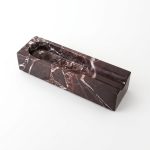
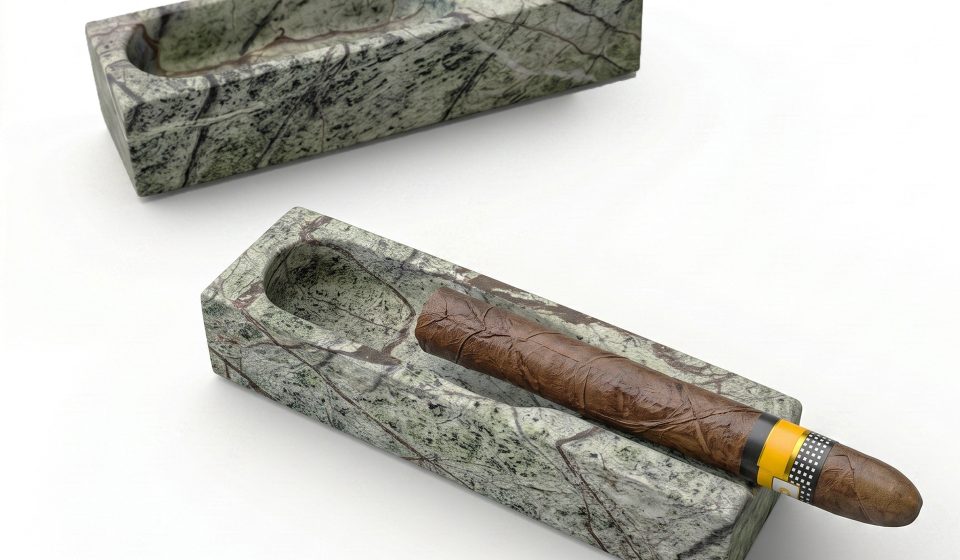
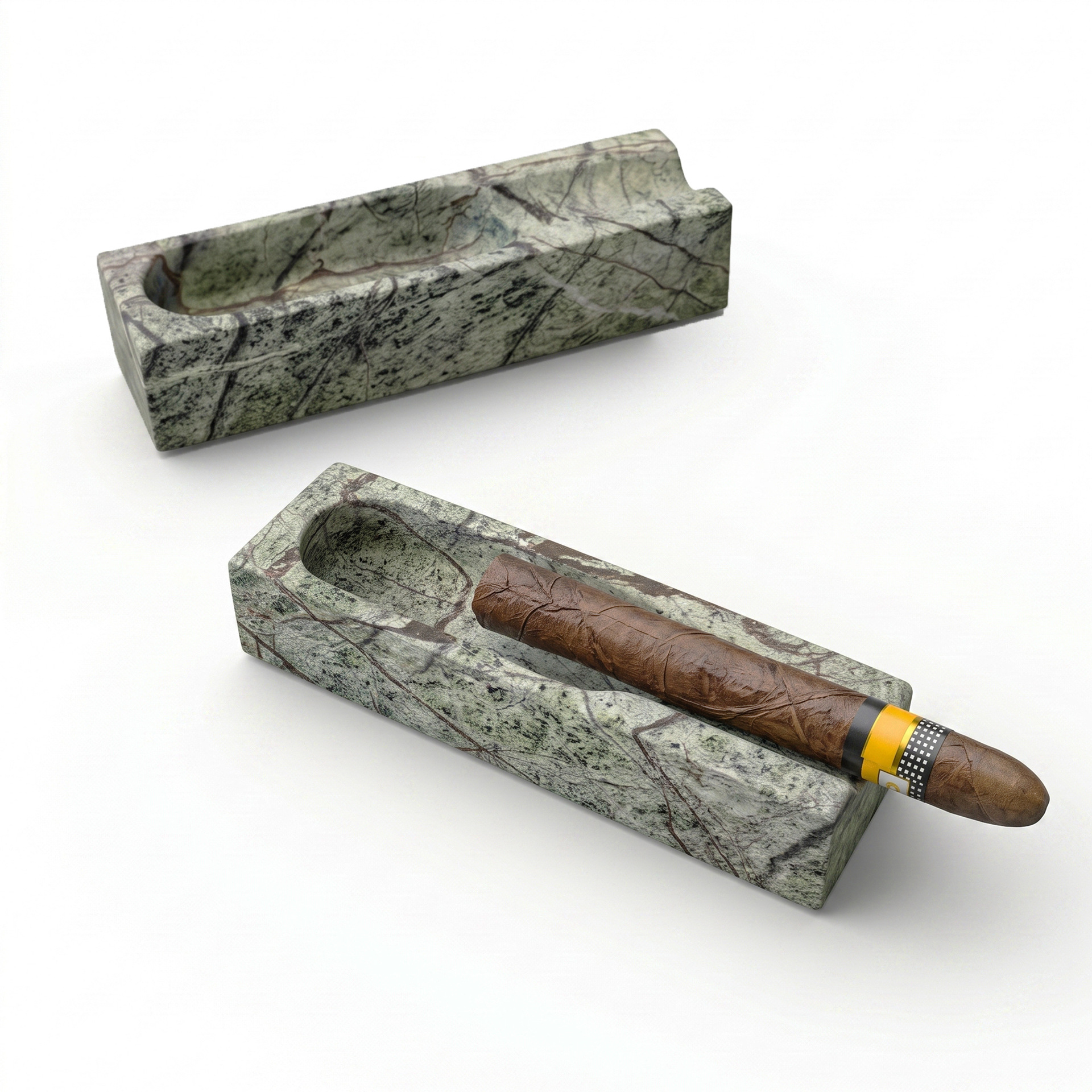
That is the whole argument for a cigar rest. The Natural Marble Long Cigar Ashtray is 17 x 5 x 3.5cm with a deep bowl at one end and a grooved cradle running along the other — one continuous piece of polished stone that does both jobs without the compromise of a rim notch. Here is why the shape matters more than the material, and where the material still earns its place.
What a cigar rest actually does
A cigar rest is a support. Its only obligation is to hold a lit cigar at a slight angle, clear of the table, in a position where the burn stays even and the ash can fall away on its own. That is a mechanical problem, and it has three parts.
The first is elevation. A cigar lying on a flat surface has one side in contact with the surface, which means one side burns slower. Over a few minutes the burn line goes visibly crooked, and a crooked burn needs correcting — which means relighting, which means the flavour sharpens. Lifting the cigar even a centimetre off the surface removes the problem entirely.
The second is the groove. A notch cut into the rim of a round ashtray will hold a cigar, but only at the angle the notch happens to be cut. A long, shallow channel is more forgiving: the cigar finds its own resting place along its length, and the ash sits in the trough rather than spreading across the surface.
The third is stability. A rest that slides or tips is worse than no rest, because you will not trust it, and you will end up holding the cigar permanently. This is where a heavy stone body stops being decorative and starts being functional.
Why the length matters
Cigar rests come in two sizes, and the small ones are a false economy. A 8–10cm rest supports the middle of a cigar and lets the ends overhang, which is fine for a short smoke and awkward for anything longer. A robusto is roughly 12cm; a toro runs past 15cm. On a short rest, a long cigar becomes a lever — the foot lifts, the head drops, and the balance is wrong from the first draw.
Seventeen centimetres is deliberately chosen to clear the whole range. The bowl occupies the first third, the cradle runs through the remaining two thirds, and a full-length cigar sits with both ends supported rather than pivoting on a single contact point. The 5cm width gives the cradle enough volume that ash collects in the trough instead of rolling off the side, and the 3.5cm height keeps the centre of gravity low enough that a knock will not tip it.
It is worth being precise about what those numbers mean in the hand, because they read smaller on a page than they feel on a table. Seventeen by five by three and a half centimetres is a solid block roughly the size of a large phone, and it weighs like stone rather than like ceramic. How the two stones differ covers the appearance; the weight is much the same for both.
Why stone, and not wood, ceramic or metal
Every material has a failure mode, and for a smoking accessory the failure modes show up quickly.
Wood is warm and light, and it absorbs. Ash dust works into the grain, a dropped cigar leaves a permanent scorch mark, and the piece slowly takes on the smell of everything it has held. It also moves with humidity, so a wooden rest that sits level in summer can rock slightly by winter.
Ceramic is the most common choice and the most fragile. It is fired, so it chips at the rim, and a chip in a glazed surface is where resin collects and never comes out. Thin ceramic also transmits heat fairly quickly, which is why cheap ashtrays get warm to hold.
Metal — brass, stainless — conducts heat fastest of all. A metal rest sitting in sun on a balcony gets genuinely hot, and it will scorch a wooden table through a thin felt foot.
Marble inverts most of that. It conducts heat poorly, so it stays close to room temperature and takes heat away from the ember slowly; it does not absorb odour, so it can be wiped clean; it is hard enough that ash and a dropped cigar leave nothing behind on a polished face; and its density makes it heavy enough to stay exactly where it is put. The trade-off is the one every stone object has: it is heavy, and it will not survive being dropped on a tile floor.
Two stones, two very different objects
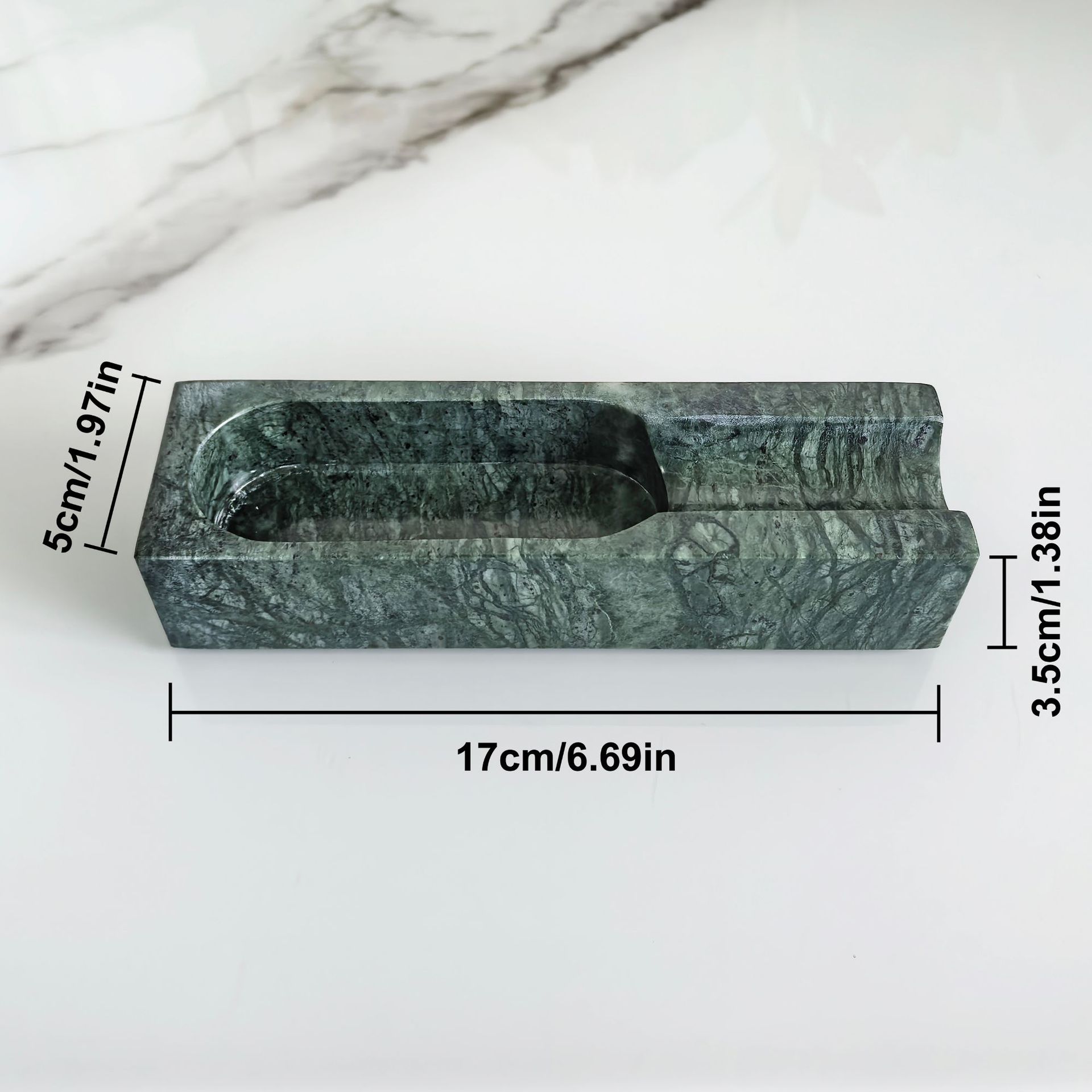
The piece is cut in two marbles, and the choice changes what the object is more than you might expect.
Rainforest Green is the quiet one. A soft, cool green threaded with pale mineral veining, and a surface that reads matte even though it is polished, because the veining breaks up the reflection. On a pale oak table or a white marble balcony surface, it settles in and stops asking for attention — which is what you want if the rest lives outdoors and is expected to weather into its surroundings.
Purple does the opposite. A deep plum-burgundy ground cut through with bold white and rust-coloured veins, closer in colour to the last inch of a glass of wine than to anything you would call a colour. It reads as an object in its own right, and it is the better choice on a dark surface or in a room where the accessories are already doing work — a study, a cigar lounge, a bar cart.
Where it belongs
A balcony or terrace table. This is where stone wins on the merits rather than on looks. Ceramic goes brittle in frost, wood swells in humidity, and a light tray becomes a sail in any breeze. A kilogram of marble does not move.
Beside a reading chair. The bowl takes the ash and the cradle holds the cigar up out of the way of a book, which is the specific problem a round ashtray cannot solve. A low side table is the ideal height.
A study or home office. Where one or two cigarettes are part of the working day rather than a social event, a long rest behaves like desk equipment: it stays in one place, it collects the ash in one place, and a single wipe at the end of the day resets it.
A cigar lounge or hotel room. Deep bowls matter here for a practical reason. A shallow tray on a soft or upholstered surface is a liability; a heavy stone block with a 5cm-wide trough contains the ash even if it is knocked.
Living with polished marble
Polished stone is a sealed face, which makes it easy to keep clean and slightly less forgiving of the one thing people do wrong: cleaning it with the wrong bottle. Our everyday stone care guide covers the routine in full; the short version is three habits.
Wipe with a soft dry cloth rather than an abrasive pad — the polish is a surface, and a scouring pad removes it. Blot rather than rub, so nothing is driven into the tiny surface openings. And dry after cleaning, because standing water is the single most common cause of marks on polished calcium-based stone, on light and dark marble alike.
Keep acidic liquids away from it. Vinegar, lemon, wine and most bathroom sprays etch calcium-based stone, and the dull patch that follows cannot be wiped off; it has to be repolished. That matters more than usual on an object designed to sit next to a drink. If a glass does spill on it, tilt and blot rather than wiping the liquid across the whole face — the wider you spread an acid, the larger the etch.
Ash itself is harmless to the surface. It is mildly alkaline, and it will not mark polished marble even if it sits for a few days. Resin is the thing that needs attention: it bonds to the surface as it cools, so wipe the cradle while the stone is still cool rather than waiting until the residue has set.
Frequently asked questions
Do I need a cigar rest if I already have an ashtray?
They solve different problems. An ashtray collects ash and stubs; a cigar rest holds a lit cigar between draws so it does not lie flat against a surface. Most people who smoke regularly end up wanting both, and a combined piece like this one covers the two jobs in a single object.
Is a marble ashtray safe for a lit cigar?
Yes. Marble is non-combustible and a poor conductor of heat, so it does not scorch, warp or hold heat the way resin, plastic or thin ceramic can. Let the cigar rest in the grooved cradle rather than stubbing it hard against the bowl wall.
How do I clean ash and resin out of polished marble?
Tip the ash out and wipe with a soft dry cloth while the surface is still cool. For resin build-up, use warm water with a pH-neutral stone soap and a soft cloth, then dry the surface immediately. Never use vinegar, citrus or abrasive pads on calcium-based stone.
One piece of stone, two jobs. The Natural Marble Long Cigar Ashtray comes in Rainforest Green and Purple at 17 x 5 x 3.5cm — and if you are still deciding between the two stones, this comparison is the faster read. You can also browse the full marble ashtray range.
The ashtray in this article
Natural Marble Long Cigar Ashtray — 17 x 5 x 3.5cm, polished natural marble with a deep bowl and a grooved cigar cradle, in Rainforest Green and Purple.