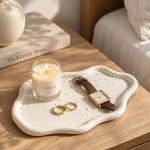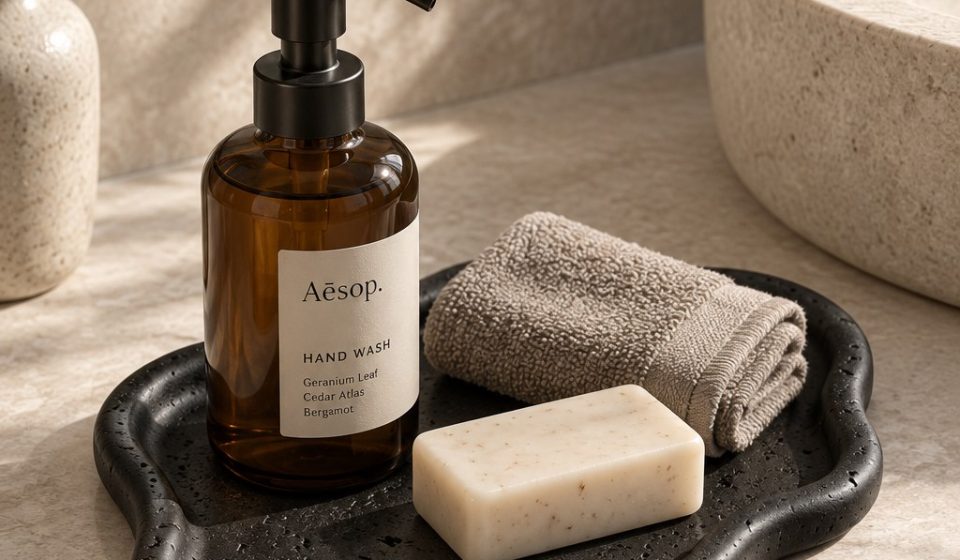

Three trays, one shape, one price. The only decision left is which stone. That sounds like a purely aesthetic question, and mostly it is — but the three travertine tones behave differently in daily use, and one of them will suit a given room better than the other two. Here is how they actually differ.
All three are available on the Wabi-Sabi Travertine Catchall Tray, a 19.5 x 13.3 cm organic-edged tray finished honed rather than polished. The shape and the surface are identical across the range; only the stone changes.
What travertine is, and why it has pores
Travertine is a sedimentary stone, not a metamorphic one. It forms where mineral-rich water — usually from hot springs, rivers or limestone caves — deposits calcium carbonate layer by layer. Over long periods those layers compress into a solid stone, but they trap air and organic material as they go. Our beige travertine guide goes deeper into the stone itself.
The trapped voids are what become the pores you see on the surface. On a polished travertine, those holes are filled with resin or cement so the face reads flat and glossy. On a honed travertine, they are left open. That is the finish used here, and it is why the surface has texture you can see without touching it.
It also explains why travertine is warmer under the hand than marble. Marble is denser and cooler; travertine has more air inside it, so it comes to room temperature faster and feels less like glass.
Beige travertine: the warm neutral
Beige is the tone most people picture when they hear the word travertine, and it is the safest of the three. It runs from pale sand to a soft wheat colour, with darker speckling where the pores sit. Nothing about it is stark.
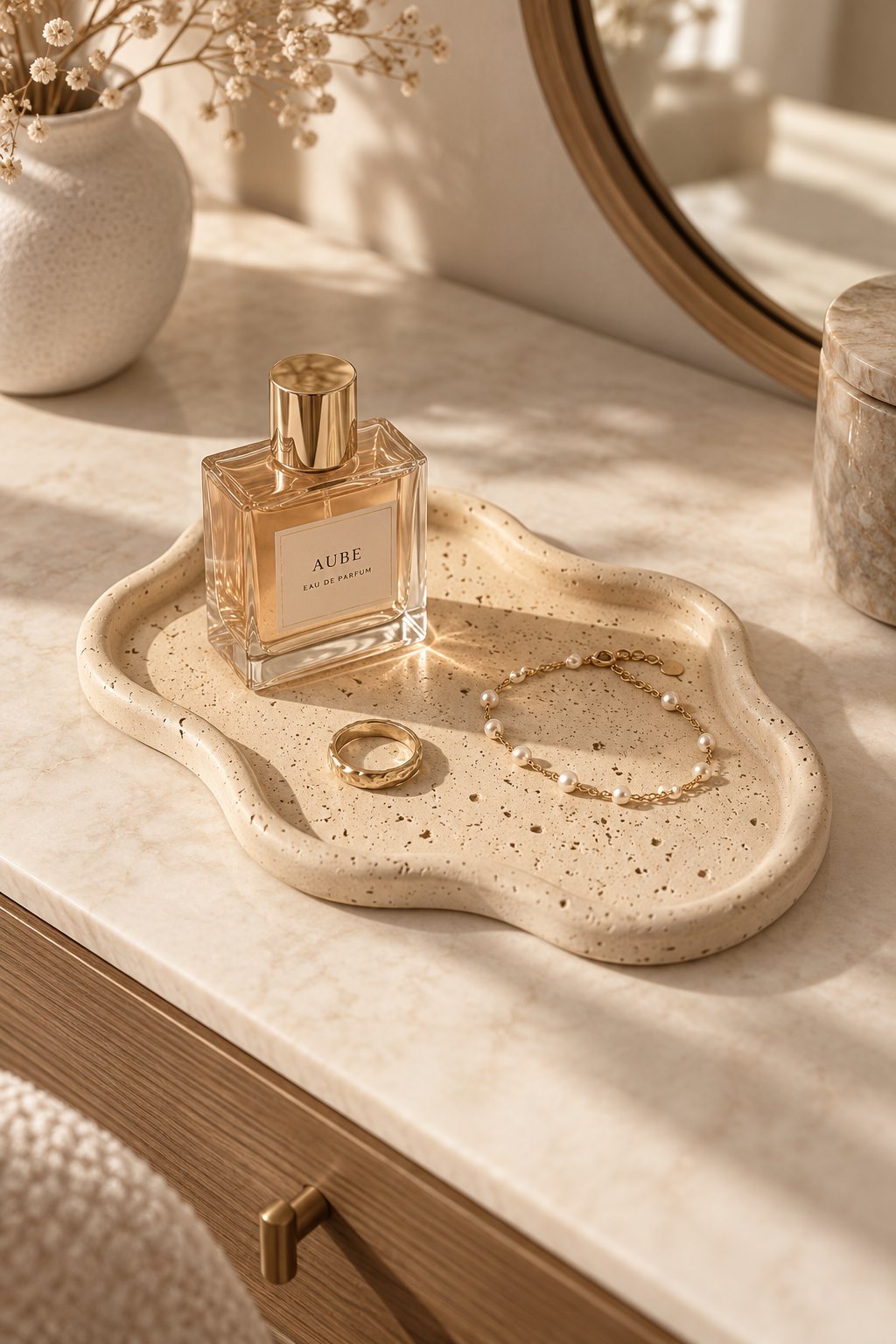
That warmth is the reason it disappears into a room rather than announcing itself. On a wooden dressing table, next to amber glass and brass, it looks like it was always there. Against cream plaster or limestone-look walls it blends rather than contrasts. If you want the tray to be furniture — a surface, not a statement — this is the one.
The trade-off is contrast. On a table of similar tone, the tray’s edge can be hard to read at a glance, which slightly softens the organising effect you bought it for.
White travertine: the cool, quiet one
White travertine is paler and cooler, with fine mineral speckling rather than broad veining. In daylight it reads almost chalk-white; under warm interior lighting it takes on a slight ivory cast.
It is the strongest choice for a bathroom. A white tray on a pale stone or white porcelain counter keeps a small space feeling open, and it does not fight the white of towels and bottles. It is also the cleanest-looking option in photographs, which matters if the tray is going to appear in listing images for a property or a hotel room.
Because the tone is light, marks show less than on black but more than on beige. Soap residue, in particular, is easier to miss on white and easy to find later. A three-second wipe after each use solves it.
Black travertine: the one that shows everything
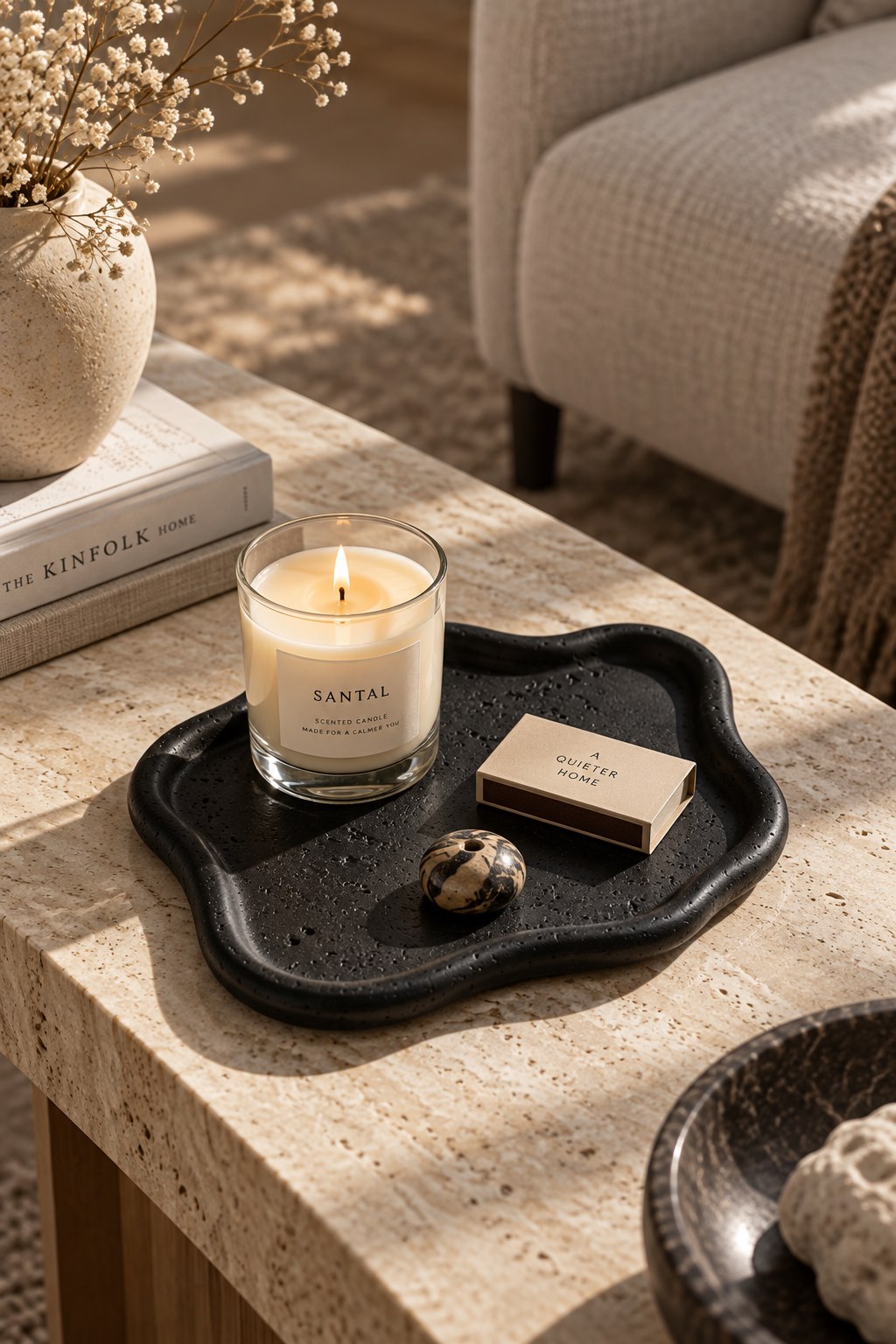
Black travertine is the most graphic of the three. The base is a deep, near-black grey, and the open pores catch light as small bright flecks, so the surface never looks flat. On a pale counter or a light oak table it becomes the focal point immediately.
It is also, unambiguously, the highest-maintenance finish. Dust, dried water marks and fingerprints all register sooner on dark stone than on light. That is not a reason to avoid it — it is a reason to know what you are buying. If you keep a dry cloth beside it and use it, the tray stays even and the effect is worth the extra second.
Where it wins is against pale surfaces. On a white vanity, a white marble counter or a light travertine coffee table, black is the one stone that gives the tray a defined silhouette without any ornament at all.
Matching the stone to the room
A simple rule covers most cases. Match the tray to the element you want it to relate to, not to the wall. Wood surfaces take beige most naturally, because warm tones sit together without effort. Pale stone, porcelain or white marble take black, because the contrast is what makes a small object register. Grey, cool or high-glare surfaces take white, which calms them.
If a room contains more than one candidate, choose the stone that appears least already. A beige tray on a beige counter will organise the surface but will not improve it visually. A black tray on the same counter does both.
And if you are buying two — one for the bathroom and one for the entryway — mixing stones is a reasonable choice rather than a mistake. The shape ties them together; the stone lets each one belong to its own room.
Care is the same for all three
The finish does not change with the colour, so the routine does not either. Wipe with a soft cloth and a pH-neutral stone cleaner. Blot spills rather than rubbing them, so nothing is driven into the open pores. Dry the surface after wiping — standing water is the single most common cause of marks on travertine, on dark and light stone alike.
Keep acidic cleaners away from it. Vinegar, lemon, wine and most bathroom sprays etch calcium-based stone, and the dull patch they leave cannot be wiped off. If something does etch the surface, our complete marble and stone care guide covers what can be done about it and what cannot.
Finally, accept the variation. Each tray is cut from a different part of the stone, so the pores, the speckling and the exact curve of the edge will differ from the photograph and from one another. That is what buying quarried stone means, and it is why no two trays look quite the same once they are on a table.
Frequently asked questions
Which of the three is the most durable?
All three are the same stone with the same honed finish, so durability is effectively identical. The practical difference is visibility of marks: black shows them first, white second, beige last.
Does the colour fade over time?
Natural travertine does not fade the way dyed or printed materials do. Prolonged direct sunlight is best avoided for the same reason it is avoided with any stone surface, but normal indirect daylight will not change the tone.
Can I mix stones in one order?
Yes. Each tray is priced individually, and ordering two different stones gives you two pieces that share a shape and finish but read differently in their own rooms.
Still deciding? Browse the Wabi-Sabi Travertine Catchall Tray, or start with the styling perspective in five places this tray earns its keep.