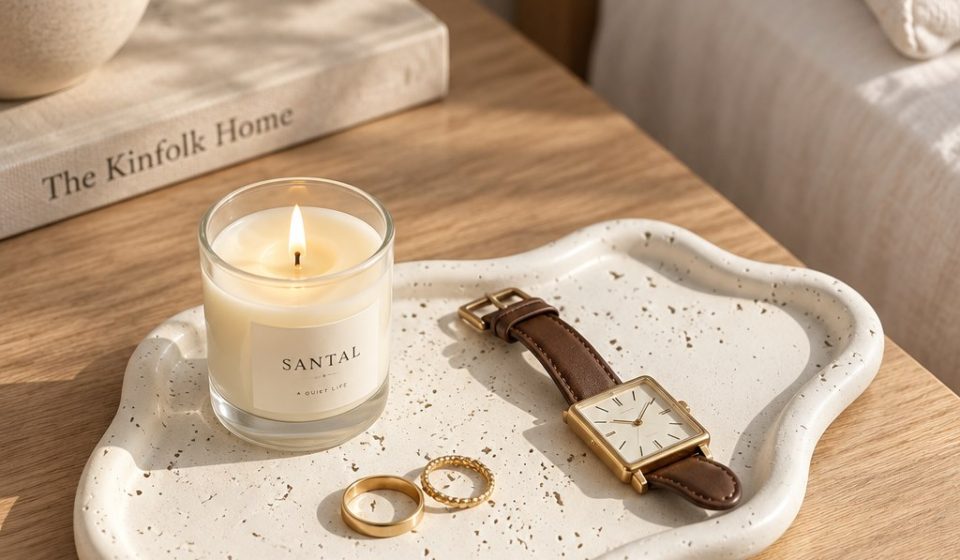

There is a particular kind of calm that comes from a small, heavy object sitting exactly where it should. Not styled, not arranged — just placed. A travertine catchall does that work quietly: it gives the loose things in a room a home without asking for attention in return.
The Wabi-Sabi Travertine Catchall Tray measures 19.5 x 13.3 cm and comes in beige, white or black travertine. It is small enough to belong on a nightstand, wide enough to hold a perfume bottle, a dish of rings and the watch you take off at night. Below are five places it earns its keep, and why each one works.
What wabi-sabi actually means in a room
The phrase gets used loosely, so it is worth being precise. Wabi-sabi is not a colour palette or a style of furniture. It is an attitude toward imperfection: the acceptance that something made from natural material will change, vary, and never repeat exactly.
In practice that means a wabi-sabi object is one whose irregularities are the point rather than a defect. A travertine tray is a good example. The stone forms layer by layer from mineral-rich water over geological time, which is why its surface carries small pores and why its tone shifts across the piece. Those pores are not damage. They are a record of how the stone formed, and they are what make it feel warm rather than slick — the full story is in our beige travertine guide.
1. The dressing table: perfume, pins and the watch you take off
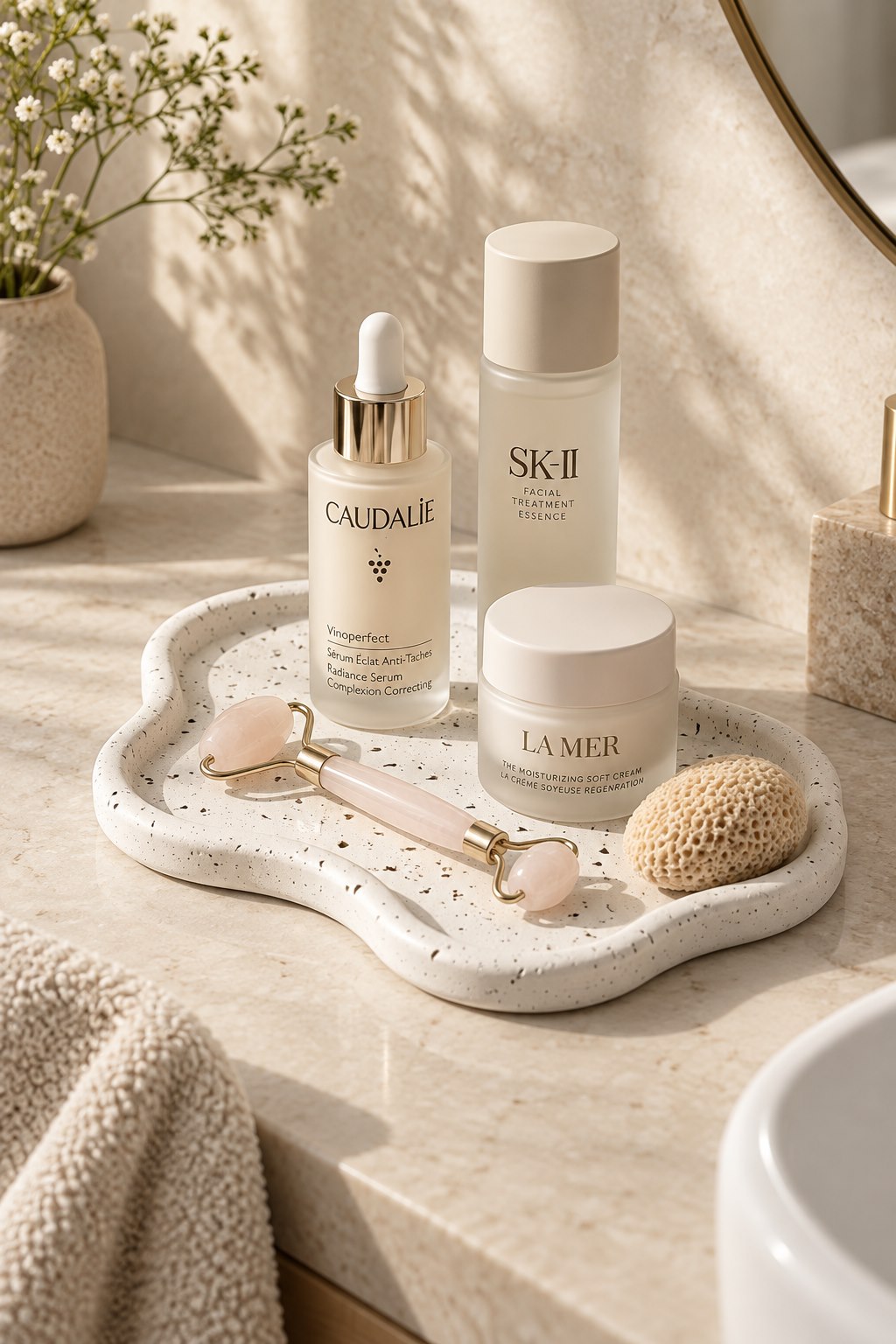
A dressing table accumulates objects in a specific order. First the things you use standing up — perfume, a serum, a spray. Then the things you remove — a ring, a bracelet, the watch that comes off before skincare. Without a defined boundary, all of it spreads outward until the surface looks like a spill rather than a station.
A catchall fixes that with a single line. Everything inside the tray is in use today; everything outside it belongs somewhere else. The 19.5 x 13.3 cm footprint is deliberately modest: it holds a full routine without turning a dressing table into a display case.
Beige travertine is the natural choice here. Its sandy, warm tone sits comfortably next to amber glass, gold-toned caps and wood, which is most of what a dressing table already contains. If the surface itself is grey or black, consider the white instead — see how the three travertine tones differ.
2. The entryway: keys, sunglasses and the end of the working day
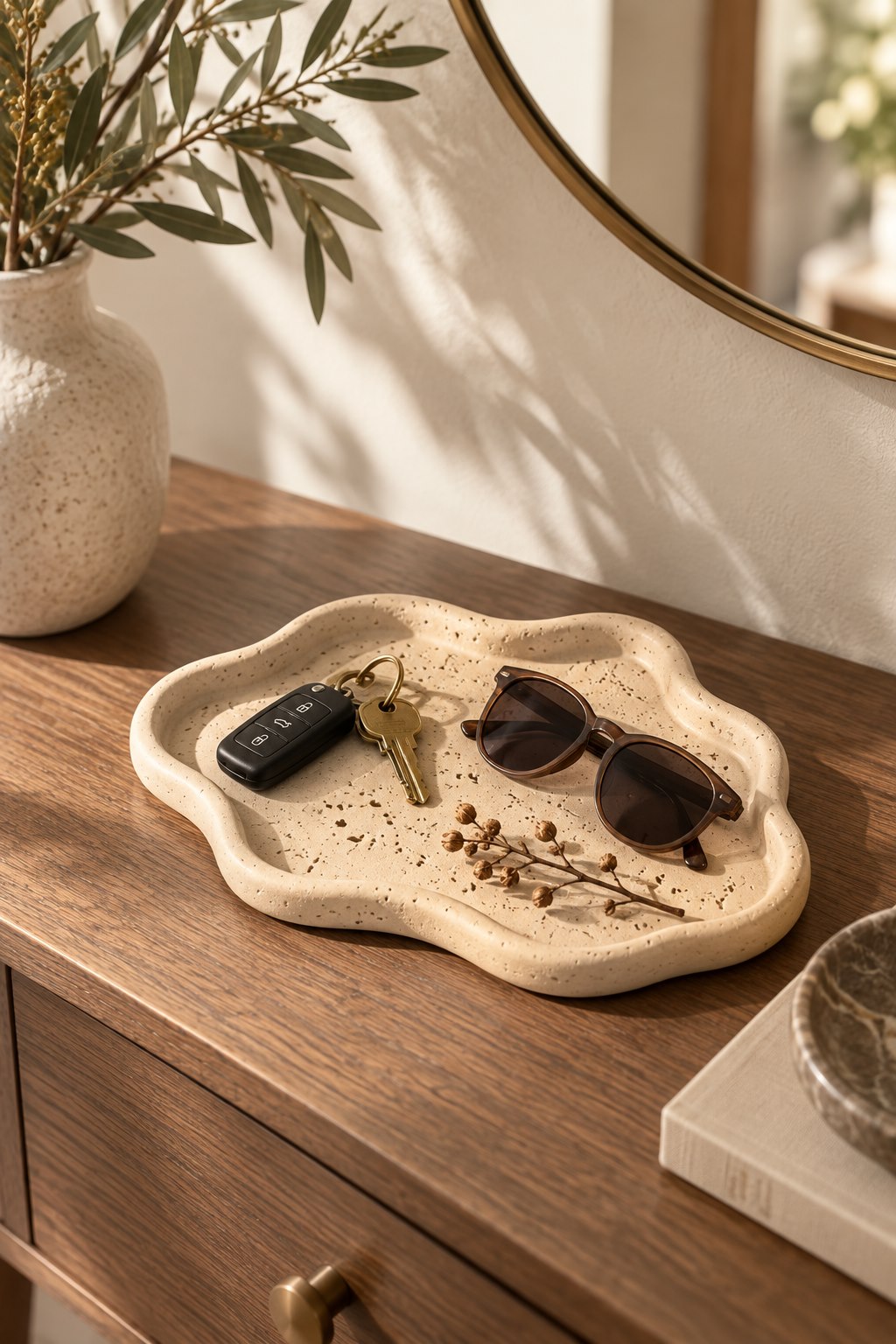
The entryway is the hardest-working surface in a home and the one most often ignored. Keys land, then a wallet, then sunglasses, then the receipt you will never look at again. Within a week the console has become a pile.
Placing a low catchall by the door gives those objects a landing zone with edges. Keys and a key fob in one half, sunglasses in the other, and nothing rolls off onto the floor. Because the wall is low, the tray still reads as a flat surface — it does not look like a bowl sitting on a console.
This is also where black travertine earns its place. Against a pale wall, a dark stone tray becomes the anchor point of the whole vignette, and it hides the marks that keys inevitably leave behind.
3. Beside the basin: soap, towels and a counter that stays dry
Anyone who has lived with a shared bathroom knows the problem: a bar of soap left directly on the counter leaves a ring, and the ring becomes a stain. A small stone tray introduces an inch of separation between the soap and the surface, which is usually the difference between a counter that wipes clean and one that does not.
Nineteen and a half centimetres is enough for a bar of soap, a bottle of hand wash and a folded cloth. The matte, honed surface helps too: water does not bead and run off the edge the way it does on polished stone, so the tray stays where it is put.
4. The bedside table: a candle and the last thing you look at
Bedside surfaces are small, which makes them the best test of any tray. A lamp takes one side. A book takes the middle. That leaves a narrow margin for a glass of water, a candle, a ring, a watch and whatever you were reading on your phone.
A catchall consolidates the small items into one object, which visually frees the table even though nothing has been removed. It also prevents the specific irritation of waking up to find an earring on the floor. Push the tray slightly back from the front edge so it sits inside the frame of the lamp rather than competing with it.
5. The coffee table: one object instead of five
Styling a coffee table usually goes wrong in the same way: too many small objects, each one individually tasteful, none of them related. A single tray resolves it by definition. If it fits on the tray, it stays; if it does not, it goes.
The effect is strongest with a candle, a matchbox and one object with texture — a small stone, a dried stem, a piece of brass. The tray’s edge does the framing, so the arrangement needs no further composition. Black travertine is unusually good at this because the candle flame reads clearly against it.
Living with travertine: pores, patina and care
Travertine is softer and more open than marble, and it behaves accordingly. It will not scratch from a set of keys, but it will hold a spill in its pores if you let one sit. That is not a flaw to be sealed away; it is the reason the stone looks the way it does. Our marble and stone care guide covers the detail.
Three habits keep it looking new. Wipe with a soft cloth rather than an abrasive pad. Blot a spill instead of rubbing it, so nothing is pushed deeper into the surface. And dry the tray after wiping it — standing water leaves marks on dark and light stone alike. Use a pH-neutral stone cleaner; acidic bathroom sprays and citrus cleaners will etch the surface over time.
Expect the piece to differ from the photograph. The veining will not match, the speckling will not match, and the curve of the edge will not match exactly. That is the trade-off for owning something quarried instead of moulded, and it is the same reason no two pieces look quite the same on a table.
Frequently asked questions
Is a catchall tray meant for one room, or can it move?
It moves. The same tray works on a dressing table, an entryway console, a bathroom counter, a bedside table or a coffee table. Many people buy a second one once they see how much surface it reclaims.
Will the tray scratch furniture underneath?
Honed travertine is smooth on the underside, but stone is hard and heavy. On a polished, lacquered or veneered surface, a set of felt pads is the safe habit.
Does the low wall keep things from falling off?
It helps, but this is a shallow tray rather than a box. It comfortably holds keys, jewellery, a watch, soap and small bottles; it is not designed to carry a full drink across a room.
One tray, five surfaces. See the Wabi-Sabi Travertine Catchall Tray in beige, white and black — and read how to choose between the three stones before you decide.