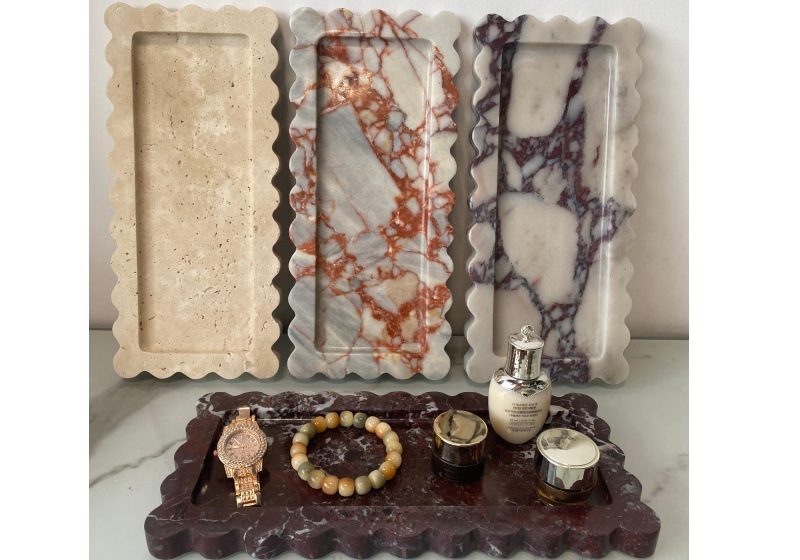

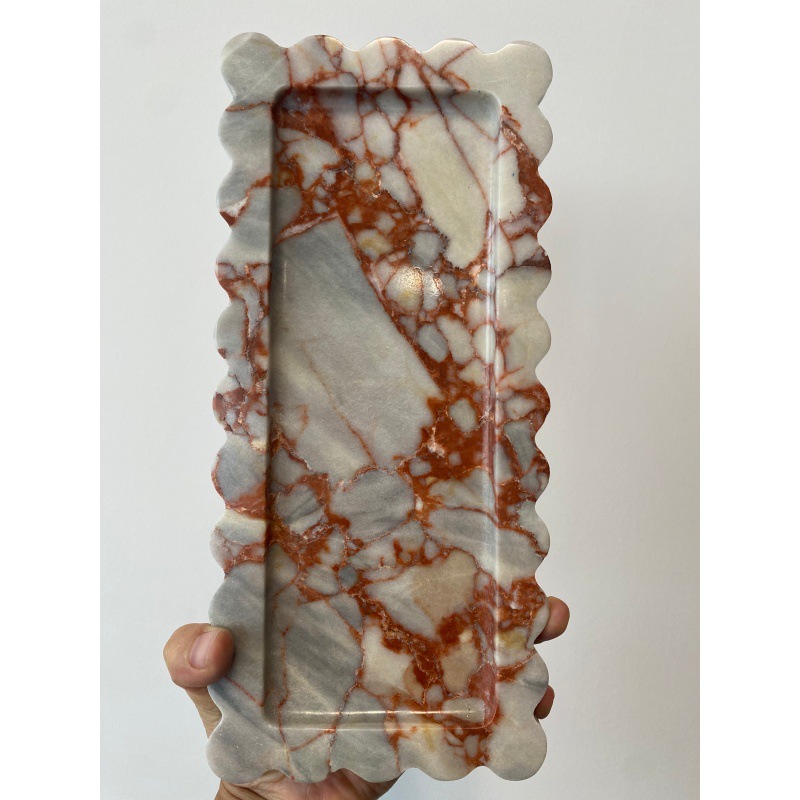
Styled rooms have a secret, and it is smaller than people expect: a handful of objects that organize other objects. The marble tray is the cleanest example — one item that corrals a surface’s worth of clutter into a single composed footprint. The scalloped marble tray does this better than any flat rectangle we have carried, because its wavy edge is itself decoration: the tray styles the room even when it is empty.
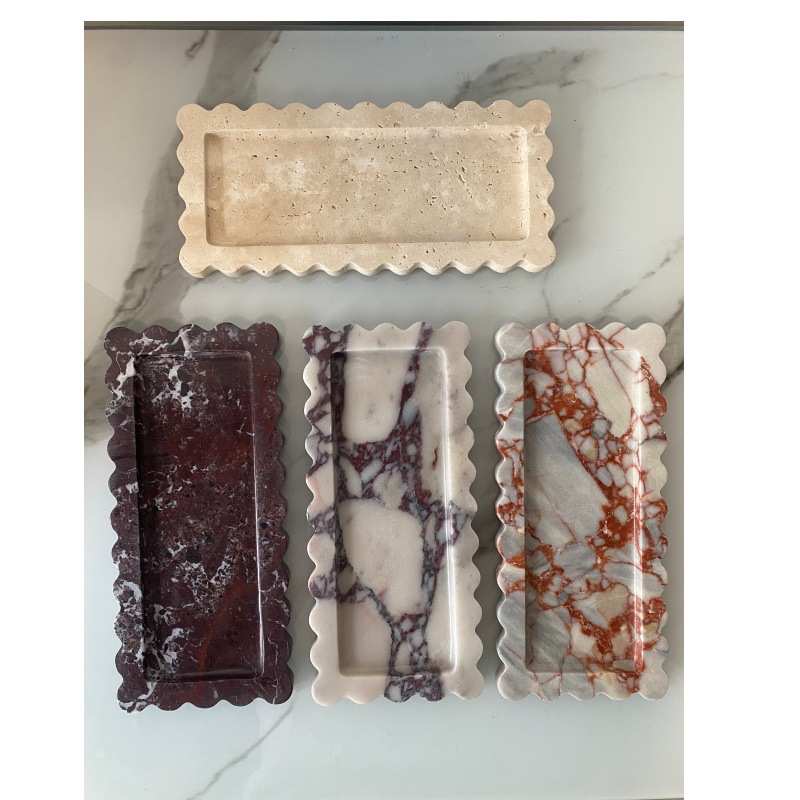
What follows is the room-by-room method our stylists use with the twenty-by-twelve-and-a-half-centimeter tray, in four stones: Bulgari Purple, Bulgari Red, Rosso Levanto, and Beige Travertine. None of it requires buying anything else; every suggestion works with what a normal house already owns.
The Nightstand: Three Objects and a Tray
A nightstand gathers exactly three categories of object: things for the body (lip balm, hand cream), things for the morning (watch, glasses, rings), and things that came in the door (a receipt, a hair tie). Give each category the tray and the surface, and the stand never reverts to chaos: the tray holds the pocket-sized category, the surface holds the lamp and the book. Choose travertine in a sunlit, linen-dressed bedroom, or Rosso Levanto in a darker, moodier scheme — the tray is the one object on a nightstand allowed to carry pattern.
The Vanity: The Two-Zone Rule
Perfumes back, jewelry front — the tray’s twelve and a half centimeters of depth enforces the line automatically. On a shared vanity, one tray per person ends the whose-ring-is-this conversation permanently. Bulgari Purple earns its cult status here: against a white or grey counter, the violet web is the single point of drama, and gold jewelry looks better resting on it than on any ceramic dish ever made.
The Coffee Table: A Tray Within Reach of the Sofa
On a coffee table, the scalloped tray does two jobs at once: it holds the remotes and the coasters that otherwise drift, and it adds the curve that a table full of straight-edged books and boxes needs. Stylists call this contrast — one wavy object among rectangular ones reads as intentional design. Bulgari Red is the pick for rooms dominated by neutrals; the orange-red veining works like a throw pillow in stone form.
The Bathroom: Hotel Logic at Home
Hotel counters feel calm because nothing on them is loose. A scalloped tray beside the sink holds the soap bar, the small perfume, and the pair of earrings that come off before washing the face — and because the tray is sealed stone, the humidity that ruins wicker and warps wood does nothing to it. Wipe it dry like any stone surface, keep it out of direct shower spray, and it looks unchanged for years.
For Content Shoots and Show Flats
The tray has a second life behind the camera. From above, the wavy edge frames flat-lay contents — jewelry, stationery, cosmetics — and photographs as pure geometry with texture. In staging, one scalloped tray on a bathroom counter or nightstand signals finished to buyers without saying a word, and it is the rare prop that works equally in an all-white minimal flat and a maximal, patterned one. Choose travertine for warmth in sunlight, Bulgari Purple for a hero object, Rosso Levanto for depth, Bulgari Red for energy.
Care, Briefly
Damp cloth, no acid, no dishwasher; reseal yearly in wet rooms. The scallops are hand-polished like every other surface, so nothing snags. Real veining varies piece to piece — your tray is a one-off, which is the entire point of stone.
The One-in-Three Rule for Surfaces
If you remember one styling principle from this article, make it this: at most a third of any surface should be covered. The scalloped tray, at twenty by twelve and a half centimeters, occupies roughly a third of a standard nightstand and a fifth of a normal coffee table — sized, in other words, to obey the rule on almost any surface in the house. The discipline matters because surfaces breathe in the empty two-thirds; that emptiness is what makes the filled third look chosen. The most common styling mistake is not choosing the wrong objects but filling the whole surface with right ones. Place the tray off-center, keep the nearest object a hand-width away, and let the surface’s emptiness frame the group.
The rule also solves the buying question. If a surface already carries a lamp and a stack of books, the tray is the third element and enough. If a surface is bare, the tray anchors it and one tall object — a vase, a candlestick, a framed print leaning against the wall — completes it. Nothing else is coming to improve the composition later, because nothing else is needed.
Seasonal Rotations Without New Purchases
Stone trays reward restyling more than replacing, and the calendar provides the schedule. In winter, the tray holds a candle and matches, and its cool surface makes the fire-warm room feel balanced. Spring wants a sprig of something living — the tray holding a small bud vase with the jewelry moved to a dish nearby. Summer is citrus season: a scalloped tray of lemons on a kitchen counter is the oldest trick in Tuscan kitchens and still the cheapest. Autumn gathers what summer scattered — the tray by the door collecting sunglasses at noon and scarves at dusk. Through all four seasons the stone never changes; only the arrangement does, which is the quiet economic argument for buying one beautiful tray instead of four seasonal decorations.
Three Mistakes That Undo Good Styling
The tray makes styling easy, but three habits quietly undo it. First, treating the tray as storage rather than display: once fifteen objects pile in, the eye reads clutter with a border, and the wave disappears under it. The fix is a standing rule — if a new item lands, an old one leaves. Second, hiding the edge: the scallop is the decoration, so books or boxes stacked against the tray’s walls block the very feature that earns the tray its place; keep the border visible all the way around. Third, matching too hard: a marble tray flanked by a matching marble bowl and a matching marble candle holder turns a styled surface into a product photograph. One stone object per surface, supported by ceramics, textiles, or glass, is the proportion that reads as a home rather than a shop. Break these three rules and no stone in the world will save the surface; follow them and even the simplest tray carries the room.
A final note on patience: styled surfaces look sparse on the first day and correct by the third. The instinct to add one more object back fades faster than expected, usually within a week — and once it passes, most people find they cannot remember what the surface held before. That amnesia is the sign the edit worked. The tray remains, the surface breathes, and the room reads as the sort of place where a designer was involved, when all that happened was a stone tray, a third of a surface, and the willingness to leave it slightly empty.
Frequently Asked Questions
Where should a scalloped tray go first?
The nightstand or bathroom counter — the two surfaces where small objects accumulate fastest and where one tray visibly finishes the room.
Can it hold a soap bar in a bathroom?
Yes — sealed stone shrugs off a humid counter. Keep it out of direct shower spray, wipe it dry like any stone surface, and reseal once a year.
Which stone for an all-white room?
Bulgari Purple if you want one dramatic object; Beige Travertine if you want the tray to disappear into the palette. Both photograph beautifully against white.
Bring one home: the Scalloped Marble Vanity Tray 20×12.5cm — $89, hand-carved and polished, ships worldwide in a rigid gift box.
Read next: why the wavy edge wins and the entryway tray for keys and rings.