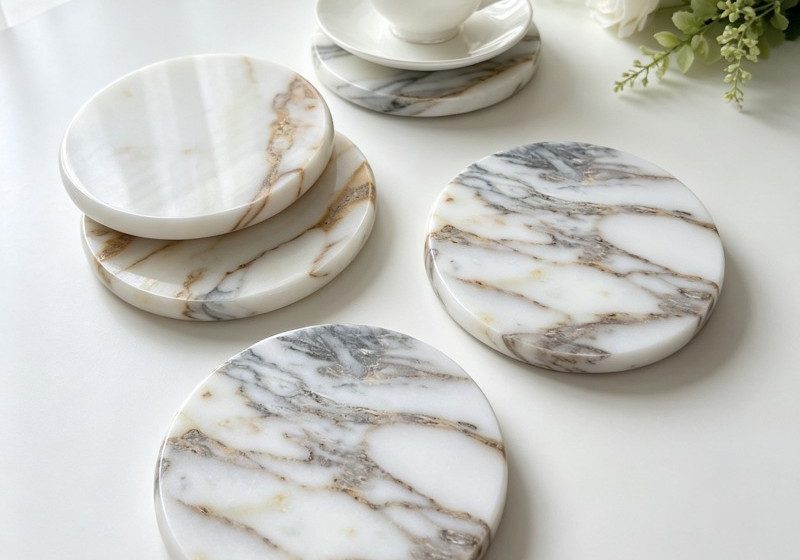

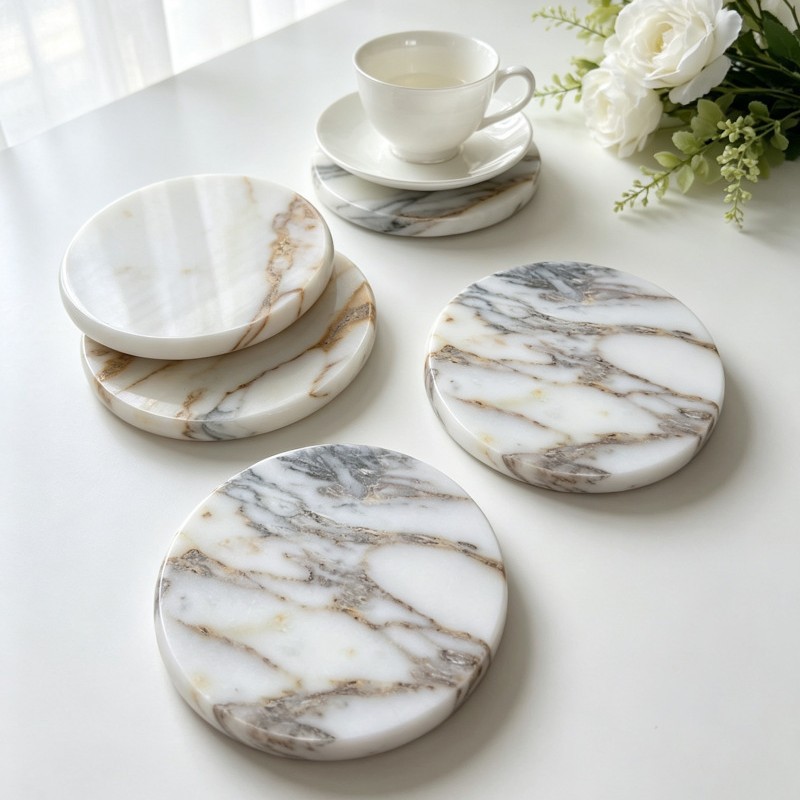
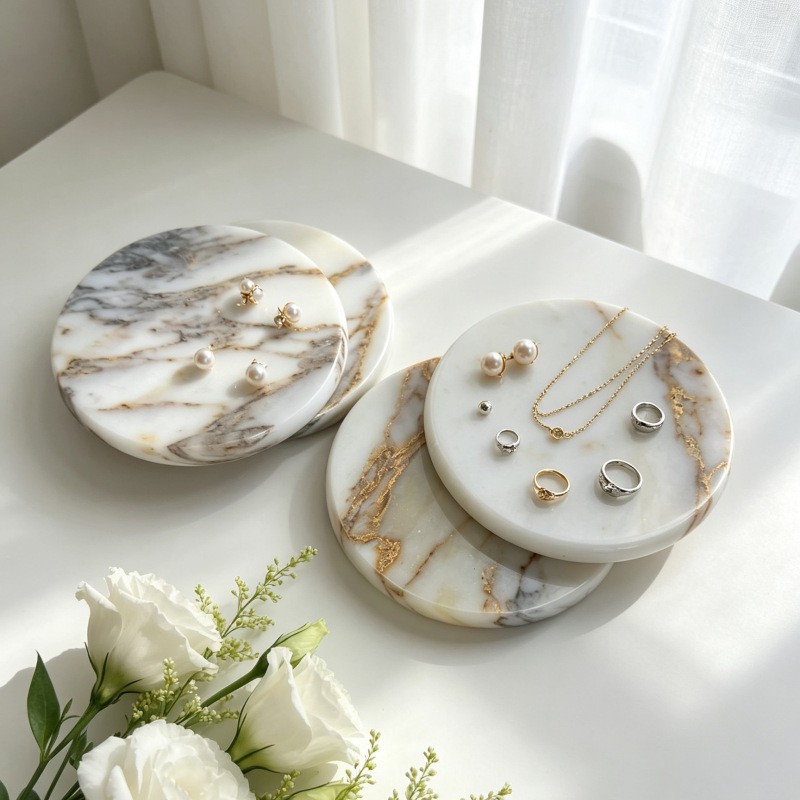
There is a moment when you first see Bulgari Gold marble that is hard to describe. It is not the shock of color — the stone is predominantly white, after all. It is the presence of the gold. The veins do not sit on the surface like a pattern printed on fabric. They run through the stone, visible from every angle, catching light at every turn, as if the marble itself is lit from within by something ancient and slow-burning.
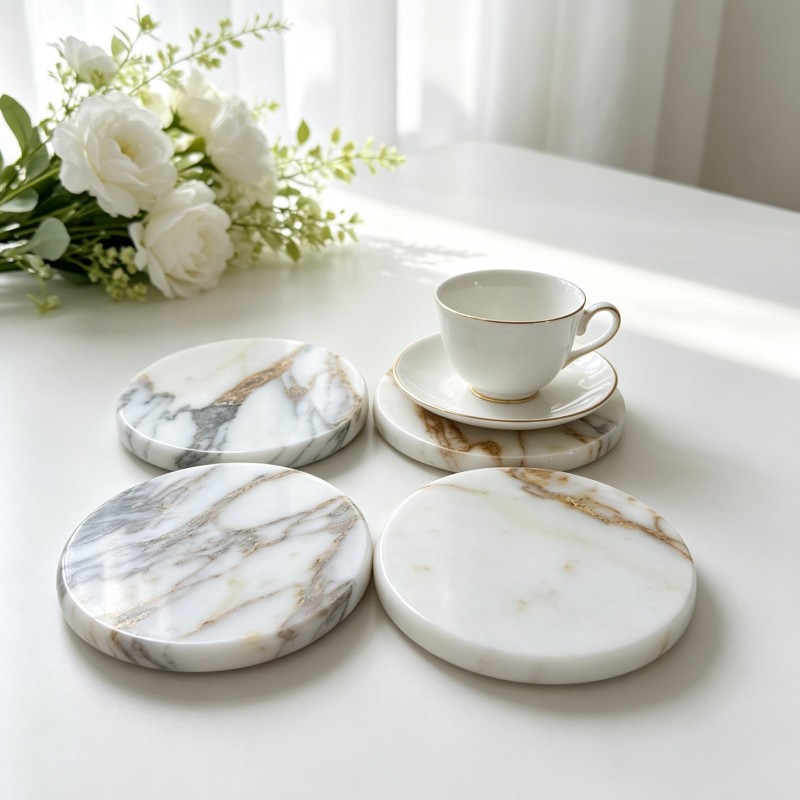
This is the marble that changes a room. Not by dominating it — a 10-centimeter coaster is not large — but by completing it. Place one under a coffee cup and the coffee looks deliberate. Place one under a whiskey glass and the amber liquid echoes the gold in the stone. Place one on a nightstand with nothing on it and the nightstand suddenly has a focal point.
The Geology of Gold: How Bulgari Marble Got Its Veins
Bulgari Gold is not a single quarry or a trademarked name. It is a descriptor for a type of white marble — typically sourced from select deposits in Italy, Greece, and Turkey — that carries pronounced veins of golden-brown and soft gray. These veins are the visible record of a process that began roughly 200 million years ago, when the limestone that would become this marble was still a seabed floor, accumulating the shells and skeletons of ancient marine organisms.
Over millions of years, the limestone was buried, compressed, and heated — metamorphosed into marble. During this transformation, mineral-rich fluids percolated through fractures in the stone. Iron oxides and manganese deposited along these fracture lines, coloring them in shades that range from pale champagne to deep, burnished gold. The result is a stone that carries the memory of fluid movement through solid rock — a geological photograph of ancient groundwater, preserved in white and gold.
What this means for the coaster on your table is simple: the gold veins are not decorative. They are documentary. They are the stone’s autobiography, written in a language of minerals and time.
What “Bulgari” Means in Marble
The name evokes Bulgari — the Italian luxury house known for jewelry that combines white gold with colored gemstones. It is an apt association. Bulgari Gold marble does what Bulgari jewelry does: it pairs an understated white base with accents that elevate. The gold veins in the stone are the equivalent of a sapphire set in white gold — a flash of warmth against a cool, calm background.
But unlike jewelry, this stone does not need to be worn. It sits on a table, available to anyone who sits down. It is luxury that does not exclude — it includes. A $9.90 coaster made of the same geological material that lines the lobbies of five-star hotels and the countertops of Michelin-starred kitchens. The stone does not know its price tag. It only knows it is stone.
The 10-Centimeter Canvas
Ten centimeters. That is the diameter of this coaster — roughly the span of an adult hand, the footprint of a coffee mug, the size of a small plate. It seems modest. But in the world of marble, 10 centimeters is a surprising amount of real estate.
Within that 10-centimeter circle, an entire geological narrative plays out. The golden veins twist and branch. The white background shifts from bright to soft cream. Occasionally, a fleck of darker mineral — perhaps a tiny crystal of pyrite or a grain of biotite — catches the light. No two coasters tell the same story. Every 10-centimeter circle is a unique chapter in a 200-million-year book.
The thickness — 1 centimeter — is chosen for the right balance of presence and practicality. Thinner, and the coaster would feel insubstantial, easily knocked aside. Thicker, and it would feel like a trivet, too heavy for a bedside table. At 1 centimeter, it has enough weight to stay put (approximately 250 grams), enough presence to be noticed, and enough subtlety to let the marble do the talking.
The Hospitality Standard
We designed this coaster with hospitality in mind — specifically, the kind of hospitality that understands that details are not details. They are the experience.
A hotel that places a Bulgari Gold coaster on every nightstand, every minibar, every coffee station is telling its guests something: we thought about this. It is the same message sent by a handwritten welcome note, a perfectly folded towel, a chocolate on the pillow. The coaster does not have to announce itself. It just has to be there — white and gold and quietly correct.
For bed-and-breakfasts, the coaster becomes part of the breakfast presentation. A French press on a Bulgari Gold coaster. A teacup and saucer centered on white-and-gold marble. The morning light hits the stone, the gold veins glow faintly, and the guest takes a photo — not of the coffee, but of the coaster beneath it. That is how you know the detail worked.
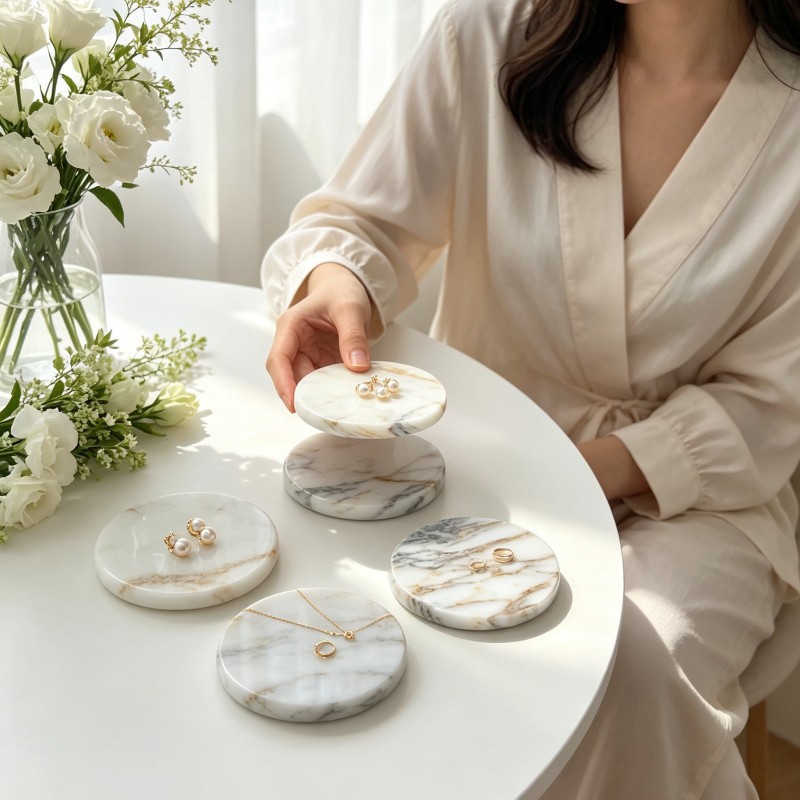
For homes, the math is simpler: buy four. Or six. Or eight. Place them wherever drinks land — coffee table, side tables, nightstands, desks. The consistency of the material across the home creates a visual rhythm. White-and-gold circles, recurring like a motif, tying the rooms together without anyone quite noticing why.
Natural Variation: A Promise, Not a Disclaimer
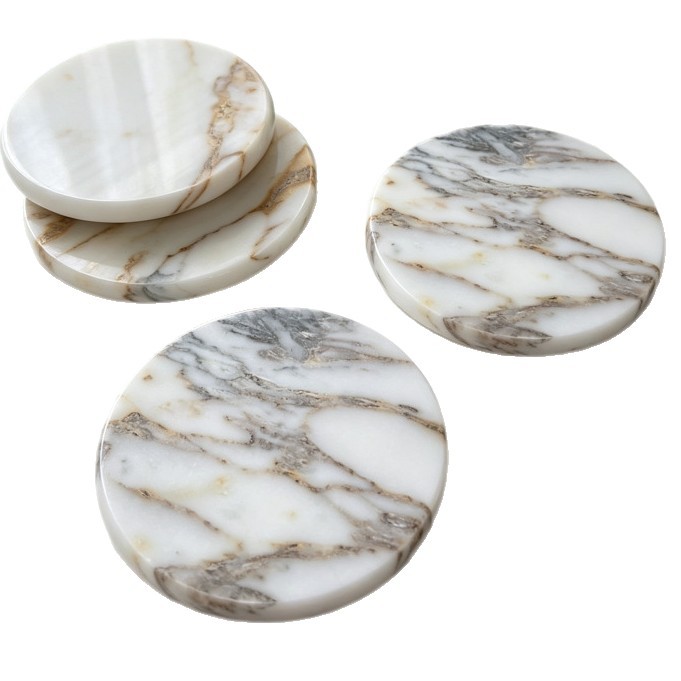
Every product description for natural stone eventually arrives at the “natural variation” paragraph. It is usually written as a disclaimer: your product may not look exactly like the photo. We reject that framing. Natural variation is not a disclaimer. It is the promise.
When you order a Bulgari Gold coaster from Quarra Home, we guarantee that it will not look exactly like the photo. It will have its own golden veins — different in density, different in pattern, different in the way the gold plays against the white. This is not a manufacturing variance. It is the fundamental nature of working with a material that was formed by geological processes, not factory molds. Every coaster is a one-of-one. Every coaster is, in a small but real way, an original work of the earth.
Care That Respects the Material
Marble care is not complicated — it is simply different from caring for plastic or ceramic. The stone is sealed with a food-safe matte sealer that protects against staining without adding gloss. The surface should feel like stone, not like a coated countertop. To clean, a damp cloth is all you need. Avoid abrasive cleaners and acidic substances (lemon juice, vinegar) — not because the stone will be ruined, but because acid etches marble over time, dulling the surface. A quick wipe after use prevents any liquid from sitting long enough to matter.
With this minimal care, the coaster will serve for decades. Scratch that — for generations. Marble is one of the most durable materials on earth. The coaster on your table today could be on your grandchild’s table seventy years from now, its golden veins unchanged, its white surface just slightly warmer with the patina of decades of use.
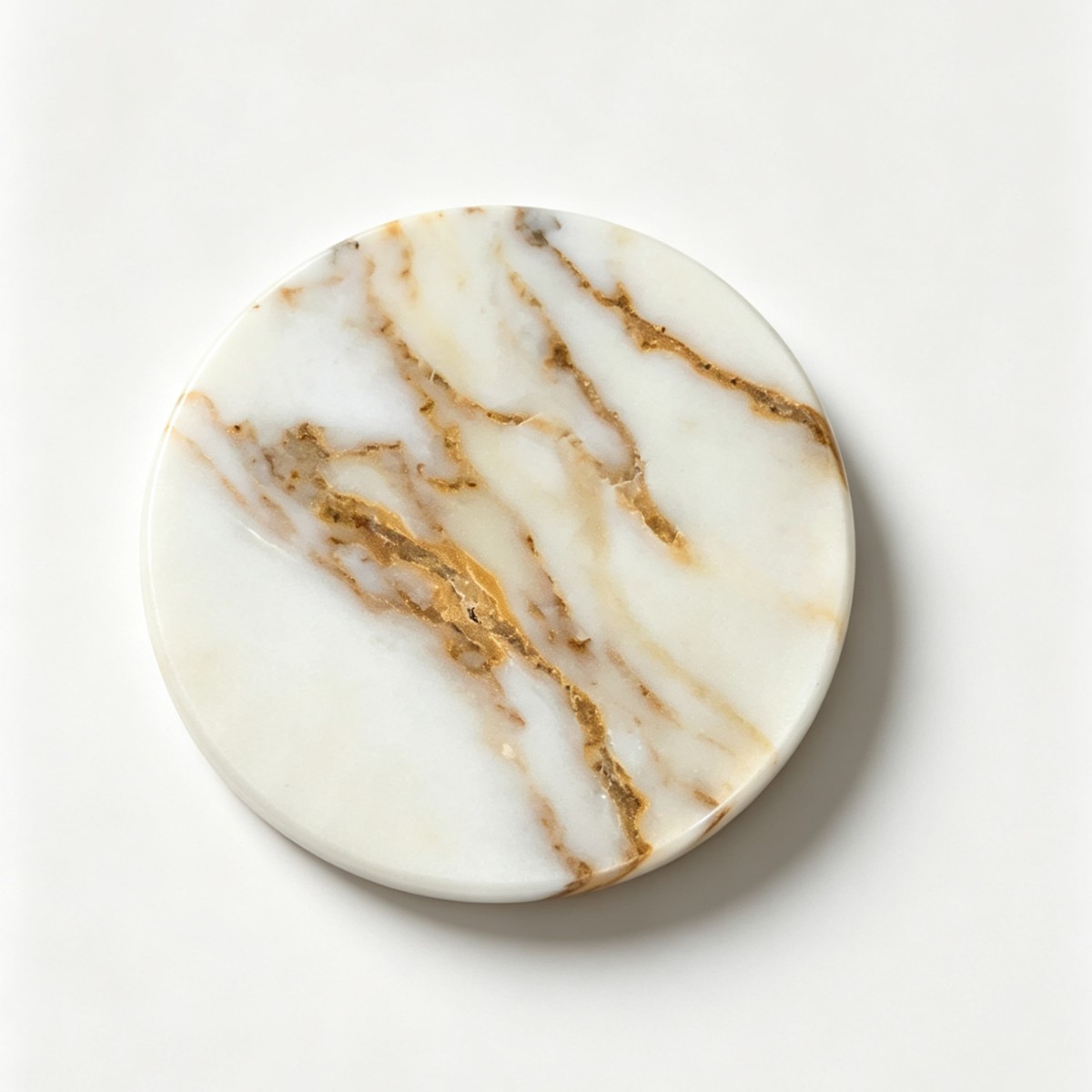
Each Bulgari Gold Marble Coaster is cut from a unique slab of natural stone. The golden veins in your coaster will be yours alone — no other piece on earth carries the same pattern. Round, 10 centimeters in diameter, 1 centimeter thick. Sealed for daily use. Weight: approximately 250 grams. Sold individually or as a set.