
Every morning, millions of people place a hot mug of coffee on a coaster without thinking about where that coaster came from. This is understandable — mornings are for coffee, not geology. But if you pause long enough to look at a Bulgari Gold marble coaster, you are looking at a journey that began roughly 200 million years ago, in a warm, shallow sea that no longer exists.
This article is about that journey. Not the journey from quarry to workshop to shipping container — though that is part of it. The deeper journey: from seabed sediment to metamorphic rock, from raw stone to finished coaster, from anonymous geology to a named object on your coffee table. It is a story of transformation at every scale — tectonic, thermal, and human.
Act One: The Ancient Seabed (200 Million Years Ago)
Picture a warm, shallow sea — not unlike the Caribbean today, but older by a factor of a thousand. The water is clear. The seafloor is covered in the calcium carbonate shells and skeletons of countless marine organisms: corals, mollusks, foraminifera, coccolithophores. As these organisms die, their remains drift down and accumulate on the seabed, layer upon layer, century upon century, millennium upon millennium.
This accumulation — called sedimentation — is the first act in the marble story. Over millions of years, the layers of biological debris are compacted by the weight of the material above them. Water is squeezed out. The loose sediment becomes limestone: a sedimentary rock composed almost entirely of calcium carbonate. Limestone is marble’s parent rock. It is the raw material. Everything that comes next is transformation.
Act Two: The Metamorphosis (50–100 Million Years Ago)
Tectonic plates shift. Continents collide. The limestone that was once a seabed is pushed deeper into the Earth’s crust — sometimes as deep as 10 to 20 kilometers. At these depths, the temperature rises to 300–500°C. The pressure is immense. The limestone does not melt, but it changes. The calcium carbonate crystals recrystallize — they grow larger, interlock more tightly, and lose the fossil traces that identified them as biological in origin. The limestone becomes marble.
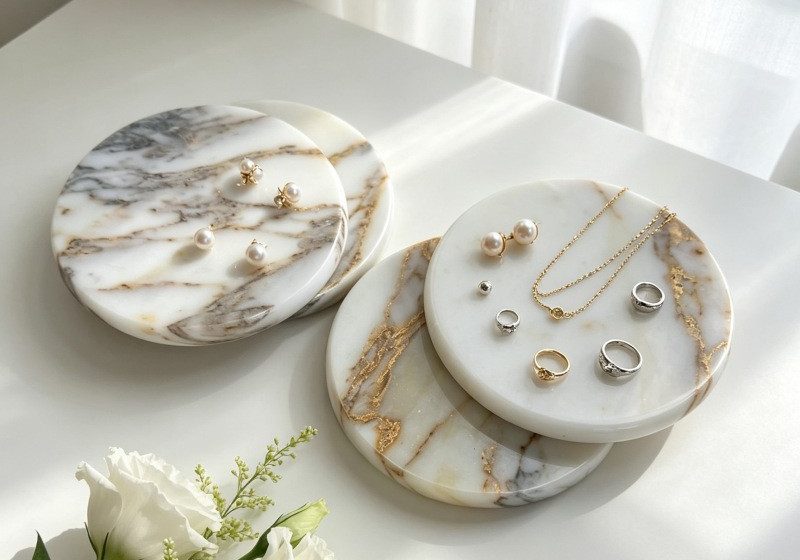
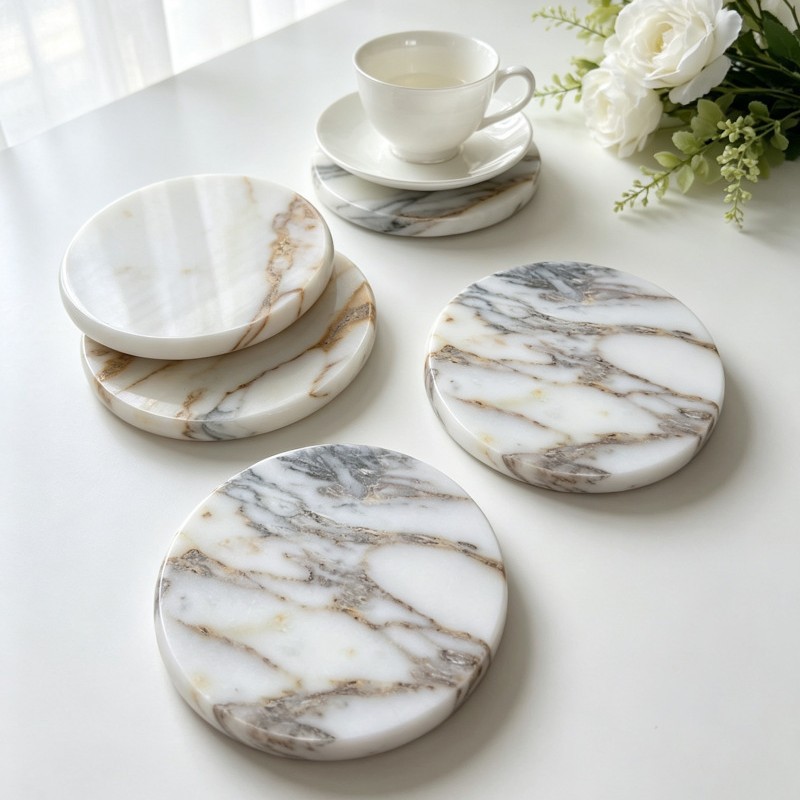
During this metamorphosis, mineral-rich fluids circulate through fractures in the forming marble. Iron oxides — the same compounds that give rust its color — dissolve in these fluids and travel along the cracks. When the fluids cool or the pressure drops, the iron precipitates out, staining the fracture walls in shades of yellow, brown, and gold. These are the veins you see in Bulgari Gold marble: the fossilized pathways of ancient groundwater, colored by iron and preserved for eternity.
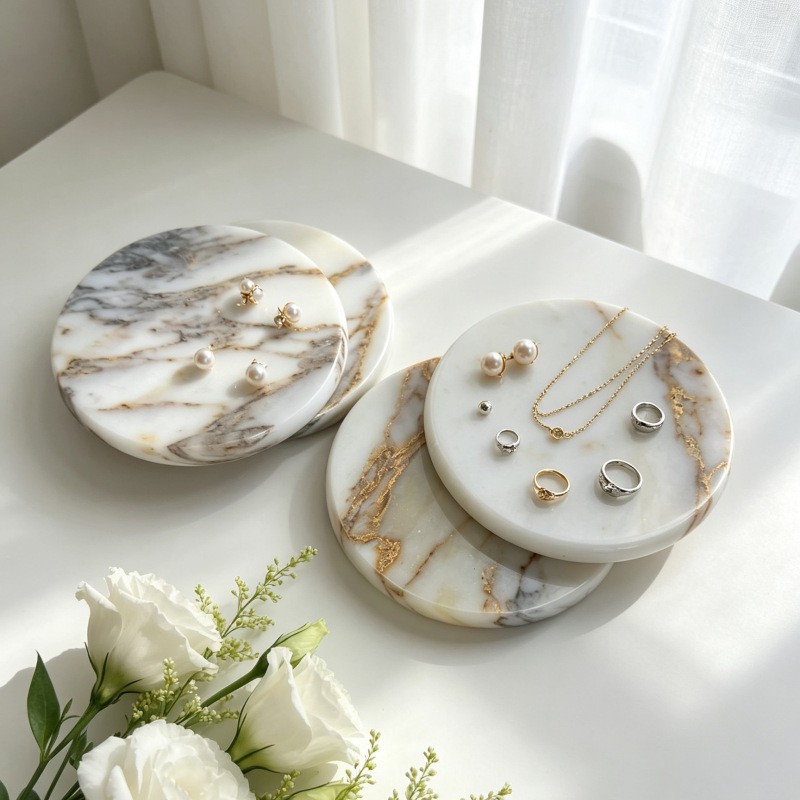
Act Three: The Quarry (Present Day)
Millions of years pass. Tectonic forces push the marble closer to the surface. Erosion strips away the rock above it. And then, one day — very recently, in geological terms — a quarry team arrives.
Quarrying marble is a slow, careful art. The stone is cut from the mountain in large blocks using diamond wire saws — cables embedded with industrial diamonds that can slice through marble like thread through butter. The blocks are enormous: often 10 to 20 tons each. They are transported to processing facilities where they are cut into slabs, then into smaller pieces, then — in the case of a coaster — into a 10-centimeter circle.
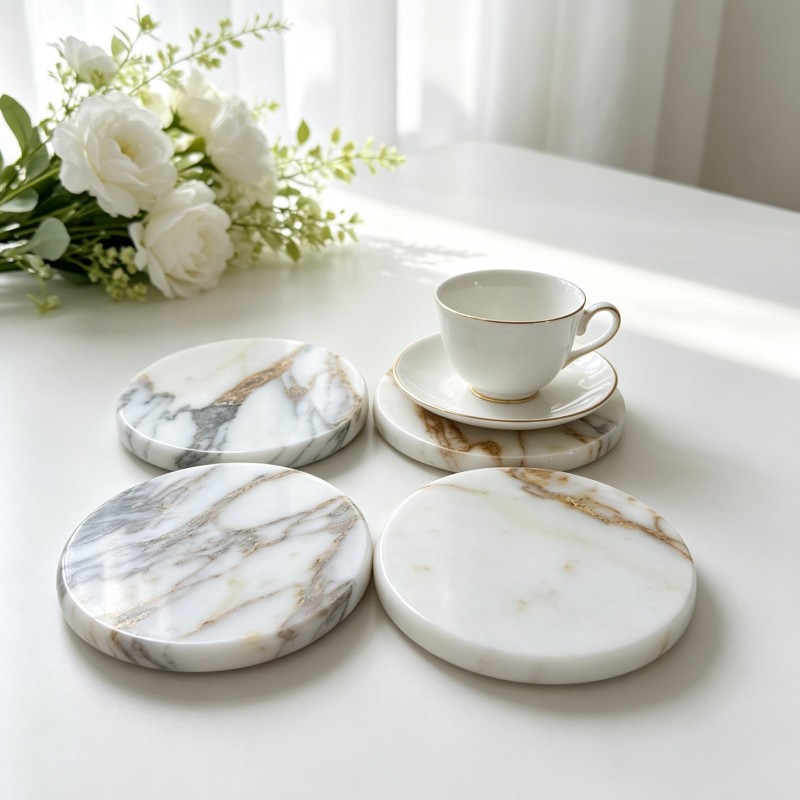
The cut is made with a water-cooled diamond blade. The edges are beveled slightly — not enough to be decorative, just enough to be kind to the fingers that will pick it up a thousand times over its lifetime. The surface is honed, not polished: a matte finish that respects the stone’s natural texture and prevents glasses from sticking. Finally, a food-safe sealer is applied — invisible, matte, and protective.
Act Four: Your Table (Now)
Two hundred million years. A seabed becomes limestone. Limestone becomes marble. Marble is quarried, cut, shaped, finished. And then it arrives on your table — a 10-centimeter circle of white and gold, weighing about 250 grams, ready to do the simplest job in the world: hold a cup.
There is something almost absurd about this. A material that survived the collision of continents, the heat of the Earth’s interior, and the slow grind of millions of years of geological time — reduced to a coaster. But the absurdity is also the point. The best objects are the ones that carry more meaning than their function requires. A Bulgari Gold coaster does not need to be made of 200-million-year-old metamorphic rock. It could be made of cork, or silicone, or pressed cardboard. It is made of marble because marble makes the ordinary moment — setting down a coffee cup — feel like it matters.
Why Gold Veins Are Rare
Not all white marble has gold veins. Most white marble — Carrara, for example — is veined in gray, the result of graphite and other carbon-rich minerals. Gold veining requires a specific geological recipe: iron-rich fluids, the right temperature and pressure conditions, and fractures that formed at exactly the right moment in the marble’s metamorphic history. Too early, and the veins would have been recrystallized into invisibility. Too late, and the fluids would not have had time to penetrate. Gold veins are a geological coincidence — a happy accident of chemistry, timing, and tectonics.
This rarity is part of Bulgari Gold’s appeal. It is not the most expensive marble. It is not the most famous. But it is among the most distinctive — a white marble that carries warmth, a cool stone that reads as warm, a natural material that looks almost designed.
The Coaster as Keepsake
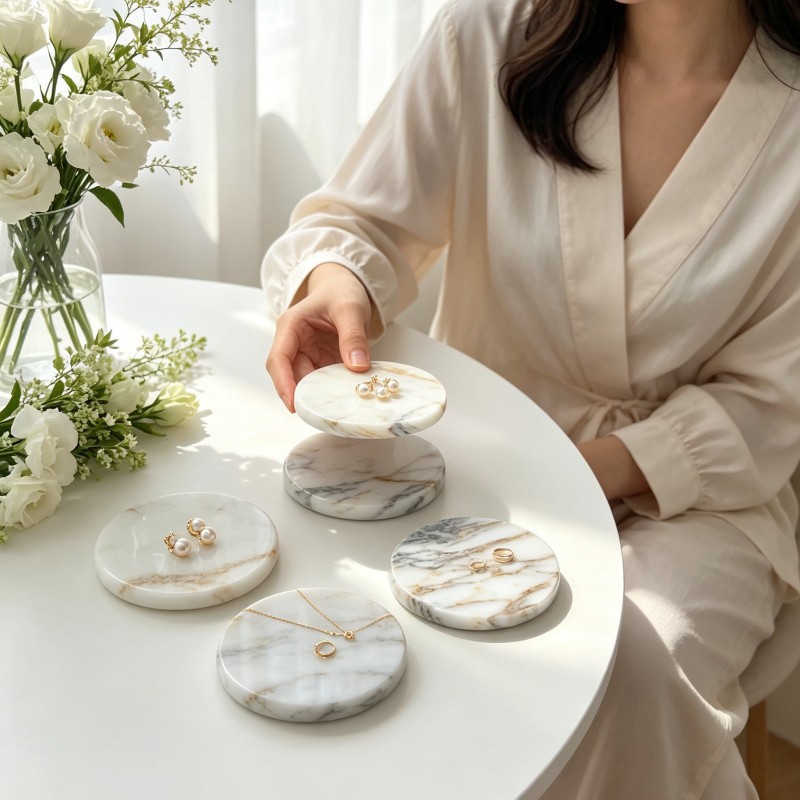
Objects become keepsakes when they carry stories. A ceramic mug from a trip to Kyoto. A wooden spoon carved by a grandparent. A marble coaster — not because of where you bought it, but because of what it is made of and how long it will last. The Bulgari Gold coaster is an object that invites storytelling. When a guest asks about it — and guests do ask — you can tell them: that stone is 200 million years old. Those gold veins are iron deposits from ancient groundwater. It was quarried in Europe, cut by hand, finished with a matte sealer, and now it’s on my coffee table.
Not many coasters inspire that conversation. Cork does not. Silicone does not. Only stone — and only stone that wears its history on its surface — can turn a coaster into a keepsake.
A Final Word on Price
At $9.90, this coaster costs less than the coffee you will place on it over a single month. It costs less than a movie ticket. Less than a cocktail at a nice bar. But it will still be here — on your table, under your cup, doing its quiet work — long after the coffee is drunk, the movie is forgotten, and the cocktail is a distant memory.
This is what we mean when we say that marble is an honest material. It does not pretend to be anything other than what it is. It does not wear out, fade, or lose its character. It simply is — white and gold and permanent — waiting for the next cup, the next conversation, the next morning.
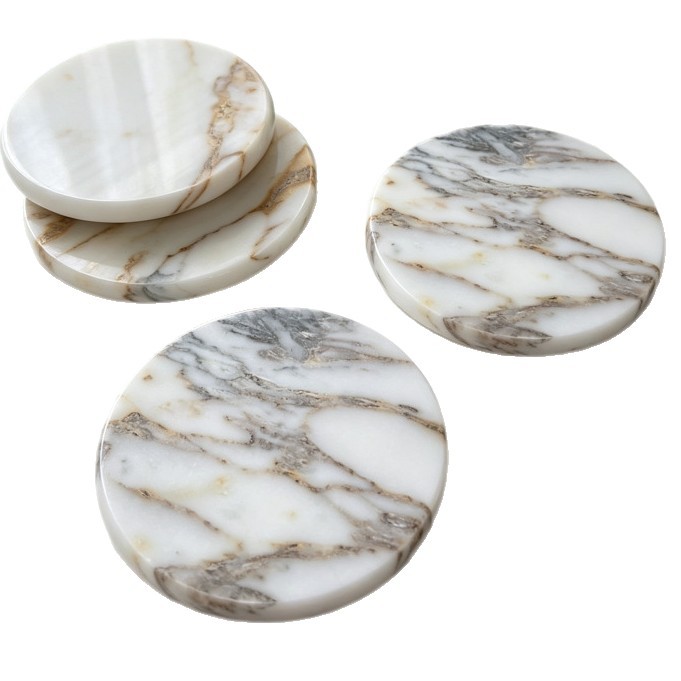
The Bulgari Gold Marble Coaster: Natural white marble with distinctive golden veining. Round, 10cm diameter × 1cm thickness. Each piece unique — vein patterns vary naturally. Sealed with food-safe matte finish. Ideal for coffee, tea, whiskey, and hospitality settings. Sold individually. $9.90 with free shipping worldwide.