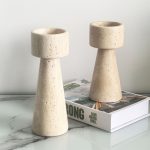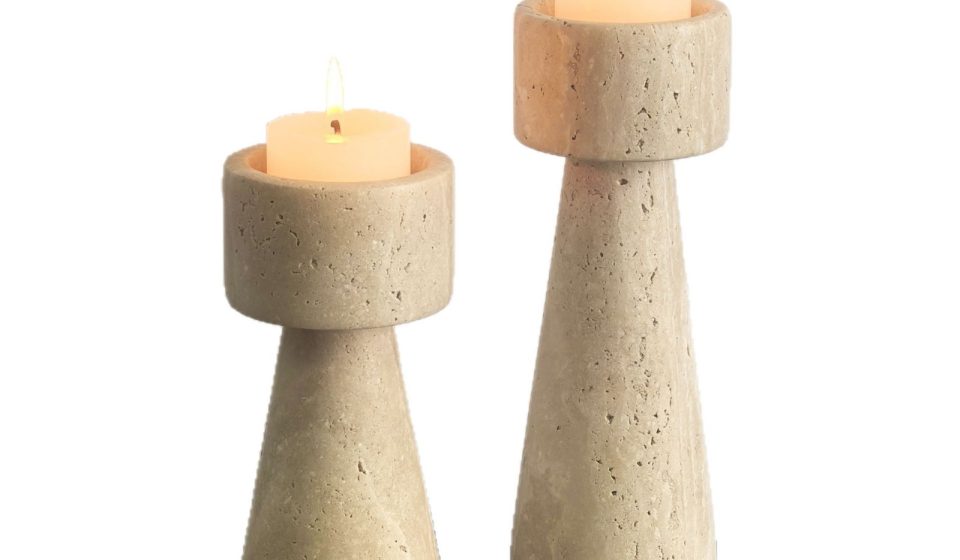

Restaurants learned it decades ago: overhead light flattens food and faces, and flame redeems both. The home version of that lesson is simpler than it looks — retire the pendant for the evening, raise two candles to the right height on real stands, and the table changes professions from kitchen to dining room. The travertine pillar candle stand is built for exactly this: a cone of beige stone lifting standard pillars 18 or 22 centimeters, deep cups catching the wax, the pair costing less than the bottle you open alongside it.
The Height Rule
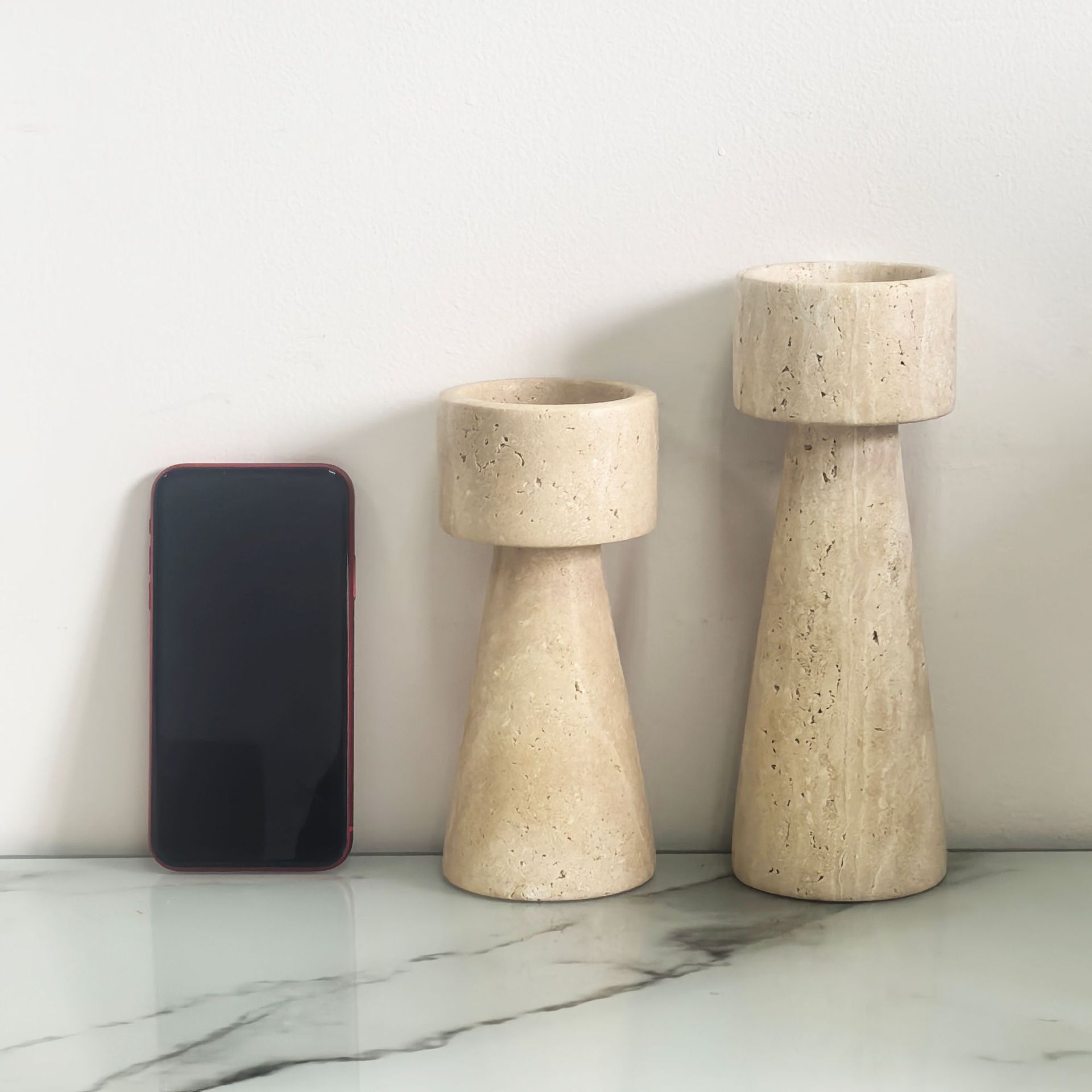
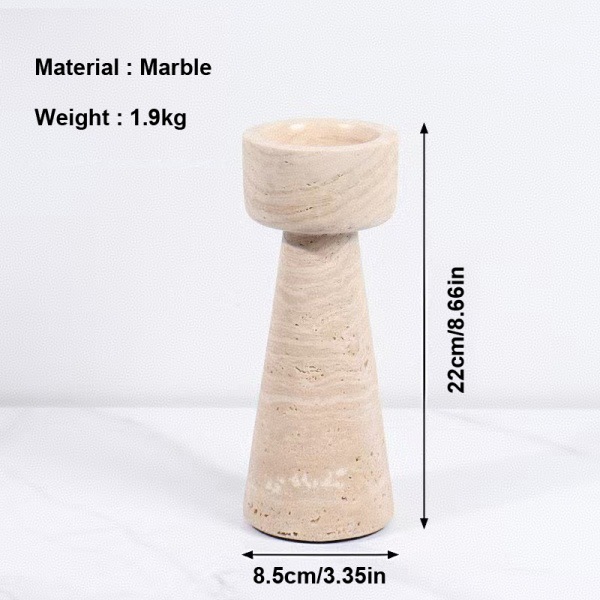
Flame belongs at or just below seated eye level — high enough to throw light across the table’s landscape, low enough that nobody talks around it. That is why the stand’s two heights work as a system: the 22-centimeter stand reads across the table, the 18 sits closer to the plates, and staggered they cover a table for four to six without a single tall, wobbling taper in sight. If guests must lean to see each other past a candle, it is too tall; if the light pools only on the centerpiece, it is too low. Between the two stands, the window is generous.
Placement, Not Symmetry
The amateur table runs its candles in a dead-center line; the composed table offsets them. Place the tall stand off the table’s true center, toward the room’s brighter side, then bring the short one a hand-width toward it — the two-step grouping from the styling rulebook, now doing dinner service. Keep flames a full hand span from anything that leans (flowers, the wine, a guest’s sweater) and nothing within reach of the reach-er. Centerpieces shrink accordingly: a low bowl, a runner, and the stands are the whole production. The stone’s matte beige flatters every tablecloth color by refusing to compete with any of them.
Choosing Candles That Burn Clean
The stand’s cup wants pillars 6 to 7 centimeters across — wide candles that burn slow and steady down the middle. Buy cream for the quiet weeks and one saturated color for the season; unscented at the table, always, because vanilla and pasta are a bad pairing. Trim wicks to five millimeters before lighting — this one habit prevents more soot, smoke, and drip than any candle brand difference ever will. Give the first burn time: a pillar allowed to melt edge to edge on night one burns honestly for the rest of its life, and the stand gets to do its job instead of babysitting a tunnel.
The Evening, Choreographed
Light the candles first, before guests arrive — a table met by flame sets its own tone, and the host is free to open the door with clean hands. Dinner runs long because candlelit dinners do; the stands need nothing mid-meal. Coffee moves to the sideboard with the short stand following, and the tall one keeps the table company through the part of the night that has no agenda. When the evening ends, pinch or snuff rather than blow — wax stays where it landed — and let everything cool while the last glasses are washed. The cleanup is the headline: cooled wax lifts from the sealed cup in one piece, one damp cloth finishes both stands, done.
Beyond Dinner
The same pair works the rest of the week without a single guest in the house. Sunday breakfast, one stand unlit, holds the table’s center with a bowl of lemons beside it. Working from home, the tall stand on the sideboard is the reason the four o’clock slump gets a match and ten minutes of nothing. Winter evenings argue for moving the pair to the coffee table zone — stone travels well, and a table that hosts candlelight twice a week starts to feel like the room’s hearth regardless of what the floor plan says. This is the quiet return on carved stone: the holder outlives the candles by decades and quietly defines the evenings in between.
Small Tables, Big Rooms: Adapting the Pair
The two-stand system scales by arithmetic, not by nerve. A bistro table for two wants exactly one stand — the 18 — set off-center with the other chair’s sightline in mind; two candles across a tiny table turn dinner into an obstacle course. A table for four takes the full pair, staggered toward the room’s darker side so the light pushes where it is needed. Tables for eight and up multiply the pair: two sets, four stands spaced evenly down the runner, each pool of flame claiming three seats — this is the configuration long farmhouse tables were born for, and the cost of four stone stands is still less than most single centerpieces pretending to do the same job. Big open-plan rooms have the opposite problem: flame disappears in volume. There the stands work at half-distance — on the coffee table, on the sideboard behind the sofa — carving the big room into lit islands rather than trying to light the whole floor. Rental hosts and restaurateurs discovered the same trick photographing rooms: three points of flame at three heights read as atmosphere in a way no lamp arrangement can fake, and the stands are the only part of the equation that never needs re-buying. Whatever the surface, the constants hold: off-center placement, a hand span of clearance, wicks trimmed short, and the pair staggered so the eye has a staircase to climb. Get those four right and the stands will do the rest in any room, at any table, for any number of chairs — which is what equipment means, and why carved stone is the version worth owning.
The Sideboard Shift
Every home has a sideboard moment — the long surface behind the sofa or against the dining wall that never quite decides what it is for. Candle stands are the decision. The pair staggered down its length converts the strip from storage-top to stage: the tall stand at one end, the short a body-length along, and the middle left for whatever rotates — a bowl of citrus in summer, the mail tray on weekdays, the cheese board when people come. The sideboard has advantages the table does not: no elbows, no reach-across, no height limit, so the tall stand runs its full 22 centimeters without anyone negotiating around it, and scented candles finally get their turn since dinner smells are not competing. It is also the surface guests actually touch — keys land there, coats pause there — which is why the stone earns its keep: a damp cloth forgives the traffic, and 1.9 kilograms of cone means nothing wanders. Restaurants discovered the same arithmetic at their entry tables, where a single raised flame is the cheapest square meter of atmosphere a floor can buy. Whether the sideboard hosts dinner service or daily clutter, the stands reframe it nightly: same furniture, different light, entirely different room — and the pair moves there in one trip, one per hand, which is the other quiet argument for buying carved stone instead of assembled brass.
Frequently Asked Questions
How far should candles sit from guests?
Keep flames a full hand span from flowers, glasses, and sleeves, and place stands where nobody leans across them to pass a dish.
Are scented candles okay for the dining table?
Better not — scent competes with food. Use unscented pillars at the table and keep scented ones on the sideboard or coffee table.
How do I clean wax out of the cup?
Let it cool fully, then lift it — wax releases from the sealed stone in one piece. A damp cloth finishes the cup; no chemicals needed.
Bring one home: the Retro Travertine Pillar Candle Stand — $69, hand-carved and polished, ships worldwide in a rigid gift box.
Read next: pillar candle stands: height, grouping, and stone and the sculptural holder trend.