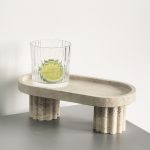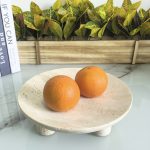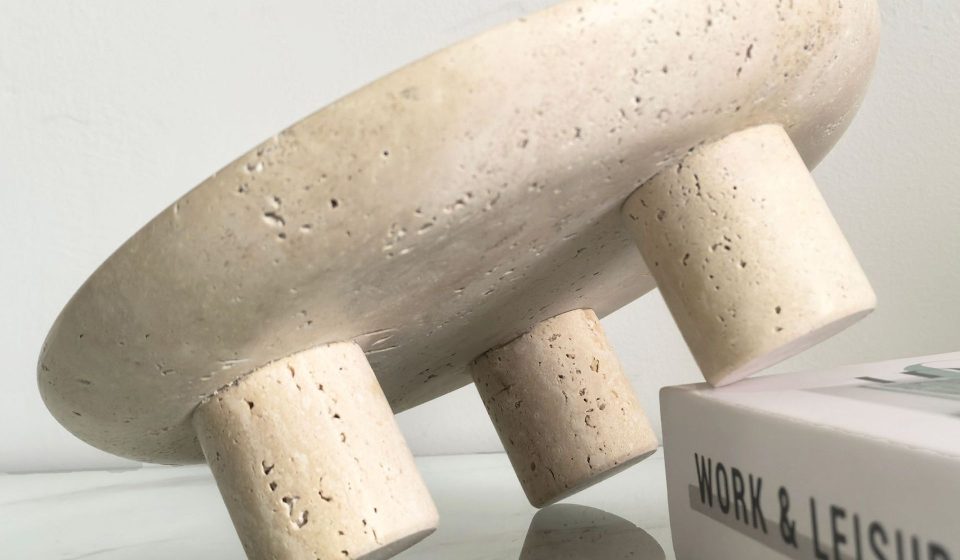

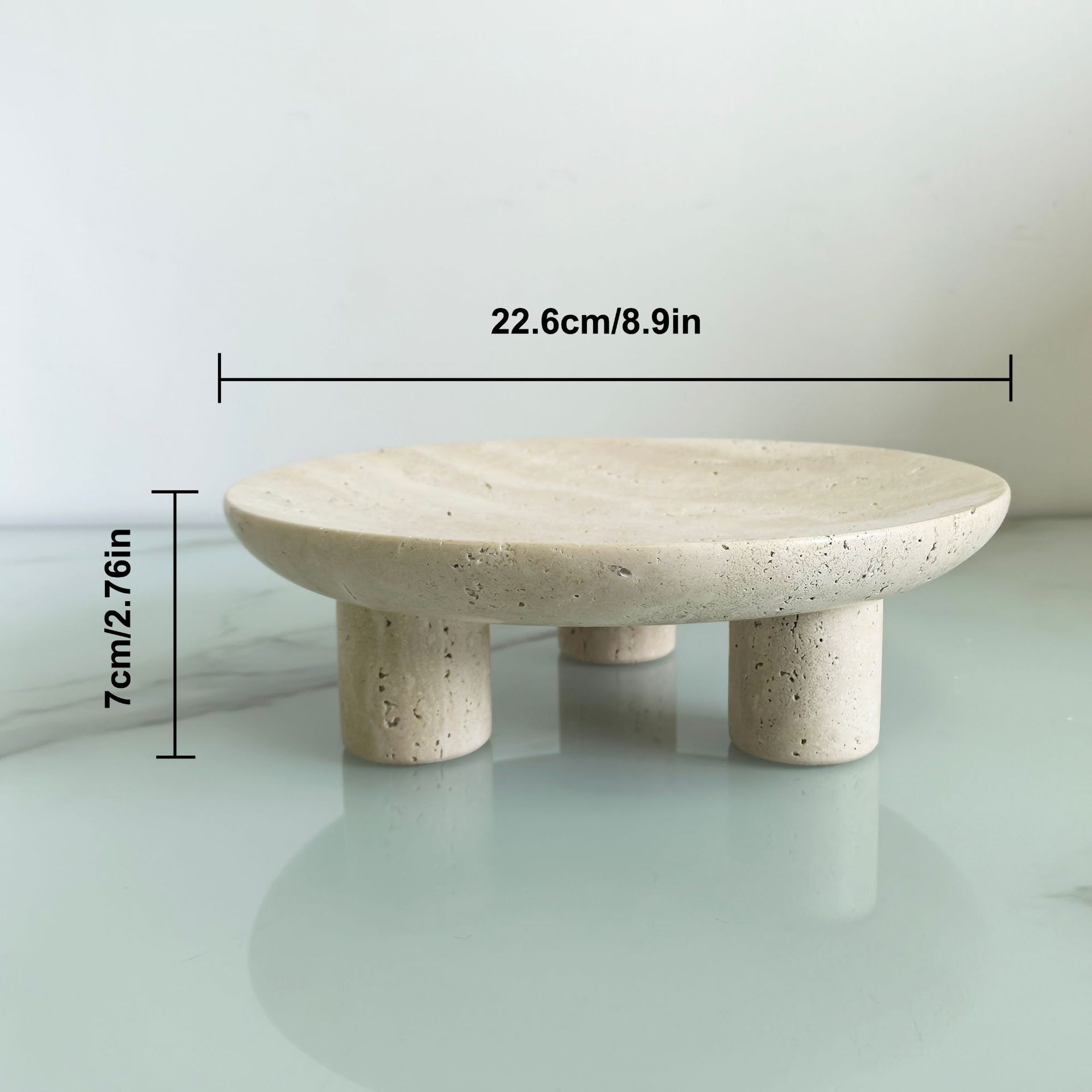
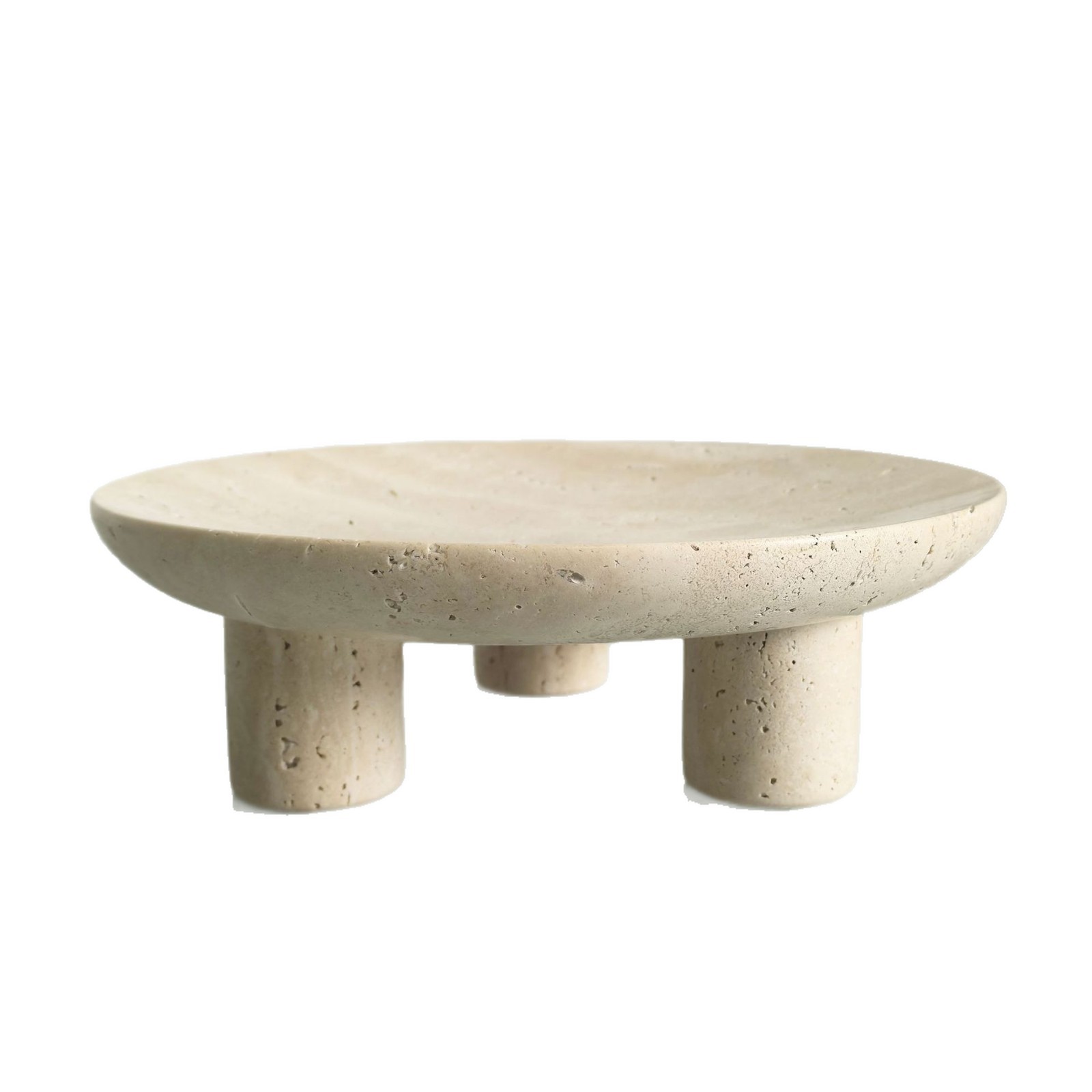
Some forms survive five thousand years because they are perfect, and the three-legged stand is one of them. Ancient bronze ding vessels, milking stools, campfire tripods, cake stands: strip away the era and the engineering is identical — a flat top carried on three points, stable on any surface ever made. The round travertine pedestal tray is that ancient solution in warm beige stone: a 22.6-centimeter dish, seven centimeters tall, standing on three hand-cut cylinder legs carved from the same block as the top.
The Geometry Lesson
Three points define a plane — that is the whole trick, and it cannot fail. A four-legged table rocks on any floor that is not perfectly flat, because one leg always finds itself shortest. A three-legged object cannot rock: set it on tile, on marble with a lipped edge, on a slightly warped wooden table, on grass, and all three legs touch, every time, with the quiet authority of mathematics. For a tray that migrates between rooms and surfaces — bathroom counter to coffee table to vanity — that guarantee is not a luxury. It is the reason this form keeps getting reinvented by every civilization that worked in stone or clay.
The Stool Inheritance
The silhouette borrows directly from a low milking stool: generous round top, turned legs, honest joints. On a coffee table it reads as furniture in miniature — which is why the tray photographs so well next to books and textiles that are, in fact, furniture. The legs are carved as true cylinders, sanded smooth, and spaced wide enough that the tray feels planted rather than poised. Lift it and the weight distribution tells the story: low and centered, steadier than any flat tray of the same diameter has a right to be.
Round Is a Different Display
A rectangular tray presents objects; a round tray gathers them. There is no front and no back — the composition reads from every angle, which makes the piece perfect for tables that are walked around rather than faced: coffee tables, kitchen islands, dining tables with sitters on all sides. Display logic changes too. On a rectangle you line things up; on a circle you cluster them, heights staggered toward the center like a small skyline, the rim catching anything that rolls. Fruit is the classic demonstration — oranges mounded in a stone circle have fed the eye since painting began — but perfume, candles, and jewelry all gain the same gathered quality.
Where It Lives
- Coffee table: the fruit bowl that never leaves, or the candle-and-coaster cluster with a stone anchor.
- Vanity: perfume arranged in the round, visible from the door and the mirror alike.
- Bathroom: sealed stone and raised legs — towels, soap, and skincare all dry and staged.
- Entry console: a round drop zone that softens a hallway of hard lines.
Warm Stone, Honest Pores
The material is beige travertine: oat tones, fine banding, and the small pores that hot-spring water left in the stone before it was ever quarried. Polished smooth and sealed, the surface wipes clean and resists the water rings and skin oils of daily service; the pores remain visible as texture, which is the difference between stone and its imitations. Every tray is cut from a different slice of the block, so the banding on yours — thicker here, whisper-thin there — is a one-off that exists nowhere else on earth.
Styling the Circle
Three rules compose a round tray. First, work in triangles, not lines: three objects of staggered heights, their centers forming a triangle, is the minimum complete composition. Second, keep the tallest element off-center; a circle with a dead-center tower looks like a birthday cake, while an off-center one looks like a landscape. Third, let the rim work — anything round that might roll, from a lemon to a lip balm, belongs inside the dish, which is the quiet functional genius of the raised edge. Beyond three objects, add in pairs and step back between additions; the circle tells you when it is full.
Surface Pairing
On marble and quartz coffee tables, beige travertine adds the warm note that cool stone counters lack. On wood, it belongs without discussion — the pairing is as old as furniture. On linen runners and rattan, it reads Mediterranean; on black steel and glass, deliberately contrasted. One caution covers all cases: keep strongly patterned neighbors at arm’s length, and let the stone’s banding be the only story on the surface. A candle, the tray, done — that is a complete tablescape at any budget.
The Long Term
Stone objects are the ones that get inherited, for the boring reason that they cannot wear out in a human timescale. No hinge, no finish to peel, no mechanism — just sealed mineral, renewable with an afternoon kit should a decade ever dull it. The three-legged form adds a practical guarantee: nothing to loosen, nothing to fold, nothing to bend. Set it down once and it stands for as long as the room wants it, then moves to the next room and stands again. Very few purchases at any price offer that career path, and none of the alternatives — bowls, mats, woven trays — do it while looking like something a museum would keep.
The Pedestal Family and Its Cousins
Once you notice the three-legged form, you see it everywhere in the decor canon — and the tray’s relatives explain its charm. The cake stand is the pedestal form at its most theatrical: raised high for display, footed for ceremony. The mortar bowl is the same geometry working for a living. Japanese gotoku stands and Korean iron trivets carry pots on three points; Etruscan candelabra carried flames the same way. What all the cousins share is a refusal of the fourth leg, and every one of them is more stable for it. Collectors of the form eventually notice a second shared trait: pedestals age into usefulness. A cake stand becomes a fruit stand becomes a soap dish becomes, in some bathrooms, the tray that holds the hand soap — the form migrating through the house for decades because nothing on it can break. This travertine version is cut to start its career at the versatile end of that story: a dish sized for fruit or perfume, low enough for daily reach, tall enough to matter. Where it lands in ten years is up to the room. The guarantee worth noting is structural: with three legs carved from the same block as the dish, there is nothing to tighten, nothing glued that can shear, and no joint that humidity can find. The form that carried bronze to ancient tables will carry your oranges indefinitely, and it will do it on any surface you ever set it on.
Frequently Asked Questions
Will the tray wobble on an uneven surface?
No — three legs always find the same plane, so the tray stands steady on tile, marble, wood, or stone where a four-legged piece would rock.
What fits on the 22.6cm round dish?
Six to eight perfume bottles, a pyramid of four to six oranges, three candles with companions, or a full entryway drop of keys, watch, and sunglasses.
Is the stone heavy enough to stay put?
Yes — several kilograms with the weight seated low in the pedestal form. It does not slide when bumped; lift rather than drag it on soft wood.
Bring one home: the Round Travertine Pedestal Tray 22.6cm — $99, hand-carved and polished, ships worldwide in a rigid gift box.
Read next: styling the circle: what goes on a round tray and why curved edges win on a vanity.