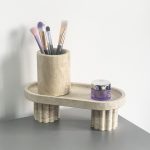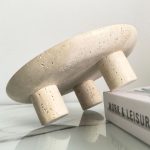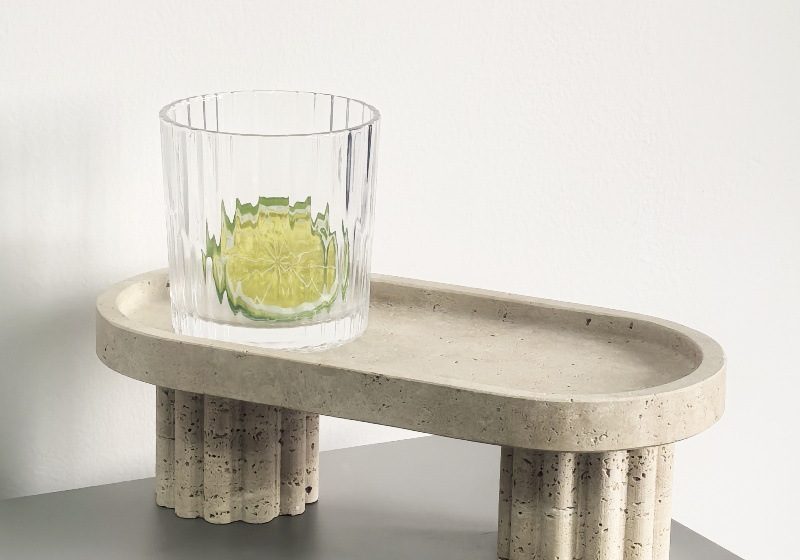

The bathroom is where decor goes to die. Wood swells. Wicker frays. Ceramic chips, plastic yellows, and the bamboo tray that looked serene in the shop grows black spots by the second month. Yet the bathroom is the room most worth decorating — it is where every day begins and ends, and its counter is the largest flat canvas in the house. The travertine footed tray is the material answer to that paradox: carved stone that treats humidity as irrelevant, raised on feet that treat standing water as a design brief.
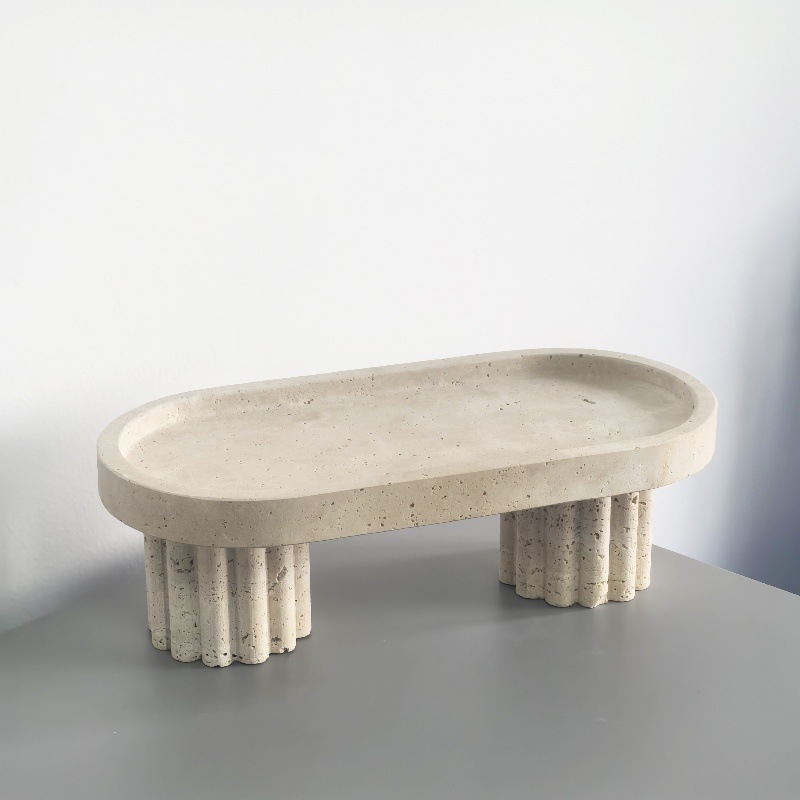
Travertine is formed in hot springs, which means the stone spent its geological childhood being soaked — the pores and banding in every slab are the record of water moving through it for millennia. A bathroom holds no surprises for it. Sealed and polished, the beige stone wipes clean of water spots, toothpaste, and skin oils, and its warm oat coloring does what no white ceramic can: it makes tile and basin feel like a spa rather than a clinic.
The Humidity Problem Stone Solves
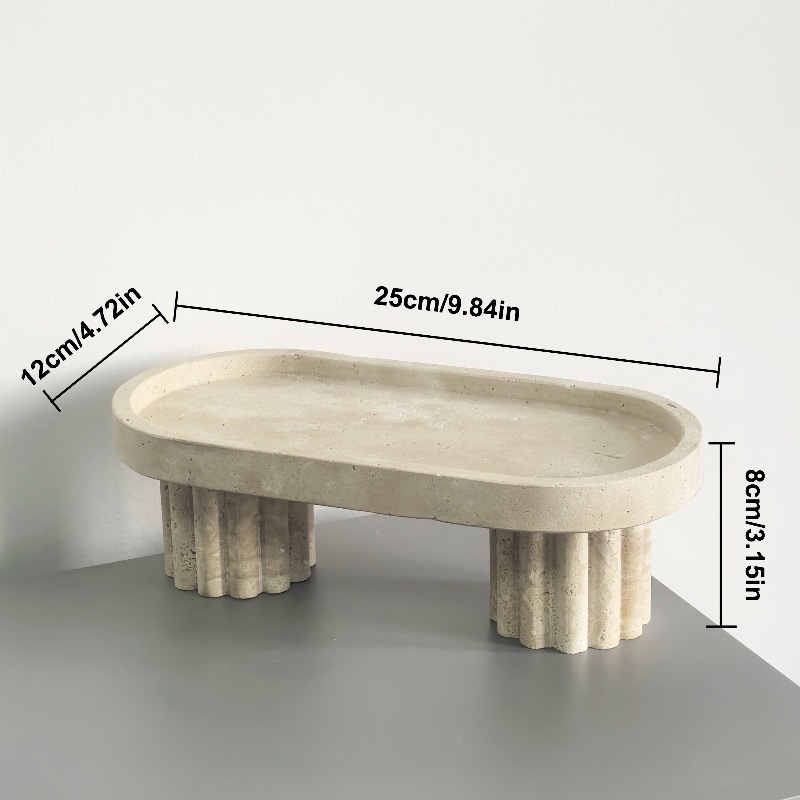
Every bathroom fights a war against damp, and most lose it on the windowsill and the counter edge, where objects sit in their own condensation. Stone changes the physics twice. First, the sealed surface does not absorb — water beads and evaporates instead of staining. Second, and more importantly, the tray is raised: its fluted feet hold the slab eight centimeters above the counter, so air circulates underneath and nothing trapped below the slab stays wet. Soap is the classic beneficiary — a bar resting on raised stone dries on all sides between uses and lasts weeks longer than one sulking in a ceramic dish — but razors, sponges, and the cloth that wipes the basin all dry faster on stone that breathes.
Hotel Logic, Home Edition
The reason hotel bathrooms feel composed is not budget; it is staging. Every object on the counter has a declared home, and the tray is that home. A folded hand towel, a soap bar, a small glass — three objects on stone read as hospitality. The same three objects loose on laminate read as clutter. At home, the trick transfers directly: give the daily items a stone stage and the counter stops being a shelf that things land on and becomes a surface that things are placed on. That shift in verb is the entire difference.
Staging the Counter in Five Minutes
Start with the tray’s position: center of the counter, or centered under the mirror if the counter runs long. Back of the slab: the tallest daily bottles, where the raised stone frames them. Middle: the reach items — the soap, the hand cream, the thing your hands hunt for with wet fingers. Front edge: deliberately empty, so the stone’s banding stays visible and the composition keeps air. One rule applies with force in bathrooms: nothing on the tray that you have not used in a month. Stone’s whole appeal is calm, and calm is a subtraction problem.
Care That Fits Real Life
The maintenance contract fits in a sentence: wipe with a damp cloth, avoid acidic sprays, reseal once a year. No dishwasher, no special cleaner, no conditioning oil like wood demands, no grout to bleach like tile demands. Should a decade of use ever dull the polish, a afternoon resealing kit from any hardware store renews the surface completely — stone is the only common counter material that can be restored rather than replaced. The fluted feet, sanded smooth, will not scratch a stone or wood counter, and their reeding hides the micro-scratches of daily placement that flat bases display.
What Travertine Pairs With in a Bathroom
Brushed brass and travertine is the pairing the boutique hotels discovered first — warm metal on warm stone, both aging gracefully. Chrome and white porcelain push the same tray toward crisp and contemporary. Terracotta and linen make it feel Mediterranean; grey tile makes it feel intentional, the one warm note in a cool room. The stone is neutral enough to survive every repaint the room will ever get, which is the quiet financial argument: the tray outlasts the color scheme it was bought for.
Beyond the Bathroom
Owners of this tray rarely leave it where it started. The oval shape that suits a basin also suits an entry console — keys and sunglasses gathered on warm stone instead of scattered on wood. On a desk it becomes the stationery stage; on a kitchen shelf, the oil-and-salt cellar’s home; on a nightstand, the watch and hand-cream station. The eight-centimeter height that dries soap in the bathroom also displays perfume in a bedroom, which is a long way of saying the tray does not belong to a room so much as to a job: gathering small objects onto something worth looking at. Buy it for the bathroom; expect it to travel.
The Gift That Survives Bathrooms
Housewarming and wedding gifts avoid the bathroom for exactly the reasons everything else dies there — which is precisely why a stone tray is the gift that gets remembered. It needs no sizing, no taste assumptions beyond warm-neutral, and no maintenance discipline from its recipient beyond an occasional wipe. A year later it is still on the counter, still doing its job, still looking like the one gift the giver thought about. Few objects at this price hold that record.
The Layout Mistakes That Break a Bathroom Counter
Before staging anything, delete three habits. First, the corner dump: counters collect objects at their far corners, where they become invisible — a tray placed center or under the mirror keeps its contents in use, not in storage. Second, the towel-draped tray: hanging a hand towel over the edge of any tray hides the very material you bought and traps moisture against the stone’s rim; towels get their own spot, folded beside the basin. Third, the everything-tray: the moment a tray holds more categories than three — say, skincare plus hairpins plus a toothbrush — it stops being staging and starts being a drawer with walls. The counter should resolve at a glance into tray, towel, and tissue box, and nothing else. Visitors will assume a professional arranged it; only you will know the secret was subtraction. One bonus habit: keep a microfiber cloth folded in the drawer below the counter, and the entire cleaning routine becomes a thirty-second sweep at the end of the week — stone rewards consistency, and consistency is easier when the tools are already at hand. And once a month, lift everything off and wipe the counter under the tray — the eight-centimeter feet make the space beneath accessible, but stone’s calm reputation depends on what you never let accumulate under it: dust, hair ties, the single earring every vanity harbors somewhere.
Frequently Asked Questions
Will travertine stain from soap or toothpaste?
No — the polished, sealed surface does not absorb. Water beads and wipes away; rinse the same evening after spills and the stone stays unmarked.
Does the raised tray really keep soap dry?
Yes — air circulates under the slab, so a bar dries on all sides between uses and lasts weeks longer than soap sitting in a flat ceramic dish.
How often does it need resealing?
Once a year in a humid bathroom, less elsewhere. A hardware-store sealing kit renews the surface in an afternoon — stone restores, it is never replaced.
Bring one home: the Oval Travertine Footed Tray 25x12cm — $99, hand-carved and polished, ships worldwide in a rigid gift box.
Read next: why curved edges win on a vanity and what to put on a round tray.