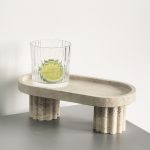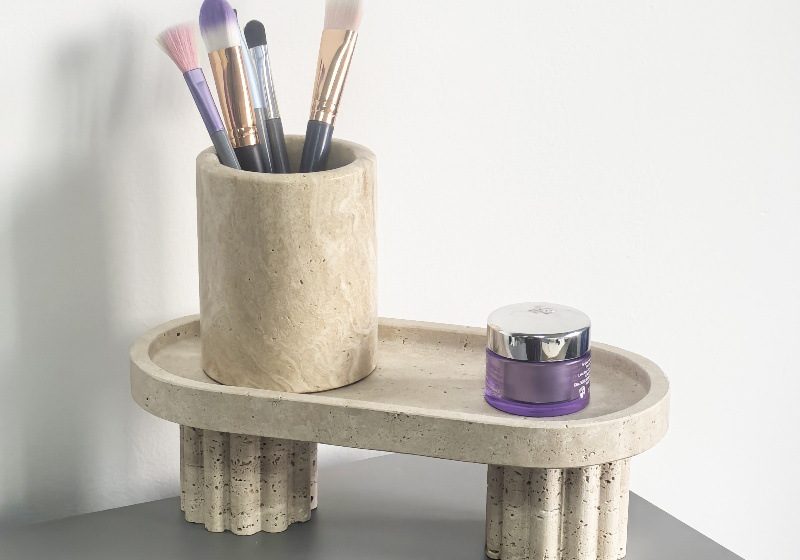

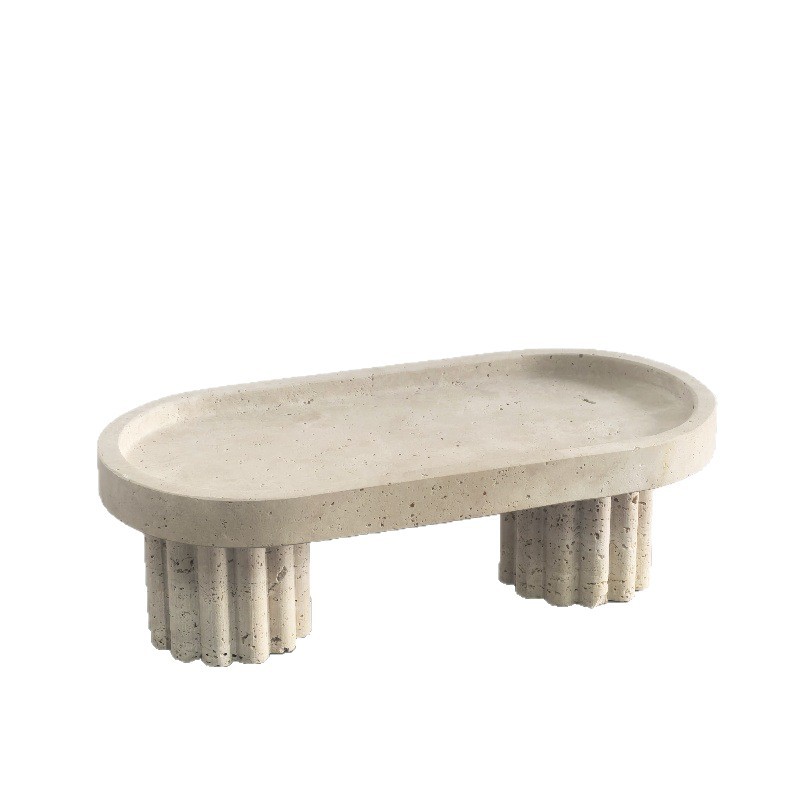
Rectangles are the default of the tray world, and that is exactly the problem: a rectangular tray on a rectangular counter draws a box inside a box, and the eye reads grid where you wanted grace. The oval travertine footed tray takes the other path. Its 25-by-12-centimeter top is a true ellipse, raised 8 centimeters on two hand-carved fluted feet, and the curved silhouette does something rectangles cannot — it follows the shapes that already live on a vanity: round jars, cylindrical bottles, the arch of a hand mirror. Nothing on the counter argues with it.
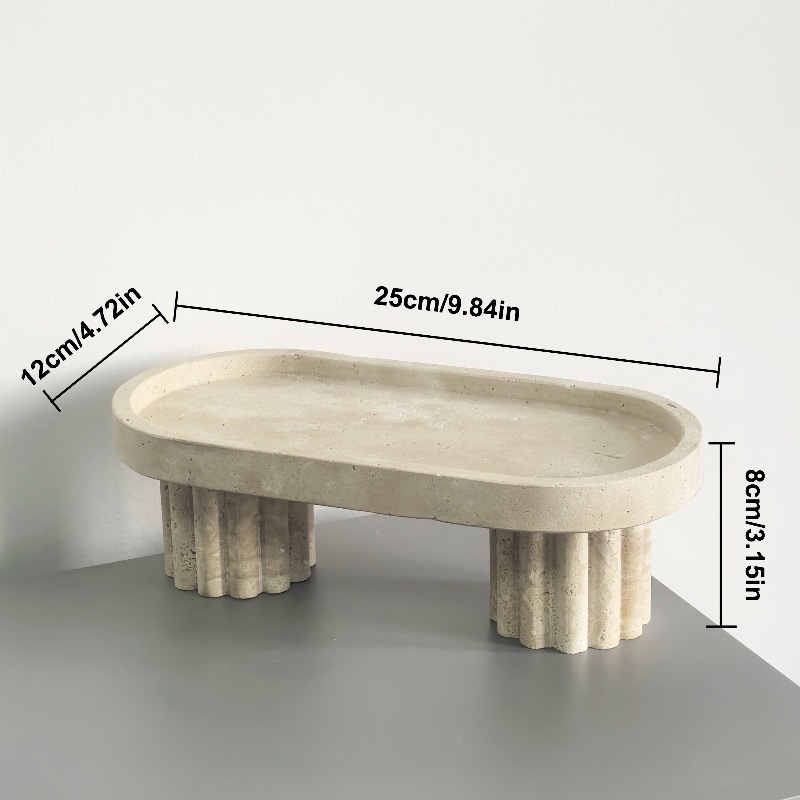
The proportions earn their keep too. Twenty-five centimeters runs a full daily lineup — perfume, a cream jar, a lip color, a watch — while twelve centimeters of depth keeps everything in one easy reach. At eight centimeters tall, the tray reads as a small table rather than a mat, and that vertical claim matters: it lifts the objects above the visual clutter of the counter edge, the way a shelf lifts books above a floor.
The Ellipse Advantage
Curves are kinder to compositions than corners. On a crowded vanity, a rectangle adds four more right angles to a surface that already has too many; an oval adds none. The shape also softens what sits on it — three bottles lined up on stone read as a row, but the same three bottles on an oval read as a bouquet, gathered and held. And because the ellipse narrows at its ends, the tray leaves natural breathing room at either side of the counter without surrendering its center-stage footprint. It is the geometry of welcome, borrowed from serving platters and church fonts, scaled for a dressing table.
Feet With a Pedigree
The two feet are the detail that makes the piece. Each is carved with vertical fluting — narrow reeded channels, the same treatment that ran up the columns of classical buildings — and the effect under real light is quietly spectacular: as the day moves, thin bands of brightness travel across the reeding, so the tray changes its own texture without changing at all. The feet and the top come from one block of travertine, carved as a single object, which means the veining runs unbroken from the slab down through the columns. That continuity is the fingerprint of honest stonework; glued assemblies can never fake it.
What Lives on It
- Vanity: the daily fragrance row, a cream jar, and the watch that comes off at six — all lifted into the light.
- Bathroom: soap and a sponge drying in moving air, because the raised slab lets every face breathe.
- Entry console: keys, sunglasses, and the small change of a day, corralled in a shape that flatters the table it guards.
- Desk: the pen, the badge, the earbuds case — gathered onto stone that makes a workspace look managed.
Warm Stone, Honest Skin
Beige travertine is the friendliest stone in the catalog: oat and sand tones, tiny pores left by ancient springs, banding that drifts across the slab like weather. Against white counters it adds warmth without color; against wood it belongs immediately. The pores are not a defect to apologize for — they are the record of the stone’s formation, and the reason no two trays are identical. Your tray is cut from its own slice of the block; the pattern on yours exists nowhere else.
The Bathroom Case
Wet rooms destroy most materials quietly: wood swells, wicker frays, ceramics chip, plastics yellow. Sealed travertine shrugs all of it off. A damp cloth is the entire maintenance routine, a yearly reseal is the whole long-term plan, and the stone’s own warmth — both visual and to the touch — is what makes a bathroom counter feel finished rather than tiled. Raised on its feet, the tray also solves the oldest bathroom complaint there is: the soap that never dries. On this slab, air passes underneath and the bar lasts weeks longer.
Styling the Oval
Three rules do most of the work. First, arrange along the curve: place the tallest object at the ellipse’s center back and let heights fall away toward the ends — the arc does the composing for you. Second, leave the front third of the slab empty; the stone’s own banding is part of the display, and a crowded tray hides its best material. Third, give it one vertical neighbor — a lamp, a tall vase — so the composition has a skyline. Break these rules in a month when the mood changes; stone is patient with restaging.
Pairing by Surface
On white quartz and pale marble counters, beige travertine reads warm and dimensional — the correct choice when the room needs one soft note. On walnut and oak, it is native; stone and wood have shared interiors for four thousand years. On grey tile, the oat tones keep a bathroom from going cold. What to avoid: another strongly patterned stone immediately beside it. Let the tray be the only material telling its story.
Year Five, Not Day One
The honest test of a vanity object is not the unboxing but the fifth year, when trends have turned over twice and the counter has been cleaned roughly a thousand times. Stone passes that test by simply remaining: no finish to peel, no felt to replace, no hinge to sag. A tray like this gets handed to the next occupant of the room rather than thrown out with the season’s decor, and few purchases at any price can claim that trajectory. The oval shape, meanwhile, is the reason you will still like looking at it — curves age more slowly than angles, in furniture as in faces.
Where the Oval Came From
The ellipse has always been the shape of ceremony. Roman serving platters, the basins of Renaissance washstands, the valet trays of grand hotels — whenever an object’s job was to hold something gracefully in front of someone, designers reached for the oval, because the curve directs the eye around the contents instead of slicing them off at a corner. The fluted feet on this tray come from the same lineage: reeding was the classical way to make a supporting element feel deliberate rather than structural, and it costs extra labor that only hand carving can pay. Modern manufacturing skips both — the oval and the flutes — because curves are slow to mold and reeding is slow to finish, which is precisely why a hand-carved version reads as heirloom the moment it is unboxed. There is also a practical inheritance in the shape. Oval platters were sized to pass down a dinner table without catching sleeves; this tray’s 25-by-12 footprint follows the same logic at vanity scale, narrow enough to sit between the mirror’s edge and the counter’s, long enough to hold a day’s objects in one line. When you set it down, you are participating in a design conversation that has been running for two millennia — and the stone, quarried rather than molded, gives the old shape a new signature every single time a block is cut.
Frequently Asked Questions
Will the fluted feet scratch my vanity or wooden table?
No — the feet are carved and sanded smooth from the same stone as the slab, with no metal or saw marks. The tray sits silent on wood, stone, or glass.
What fits on the 25x12cm oval surface?
A full daily lineup: three to five perfume bottles, a cream jar, a watch and rings, or a soap bar with room to dry. Sized for one person’s counter.
Is travertine suitable for a humid bathroom?
Yes — travertine formed in hot springs and sealed travertine shrugs off humidity. Wipe with a damp cloth and reseal once a year in wet rooms.
Bring one home: the Oval Travertine Footed Tray 25x12cm — $99, hand-carved and polished, ships worldwide in a rigid gift box.
Read next: travertine in the bathroom: warm stone for wet rooms and why three legs never wobble.