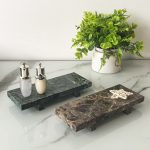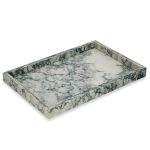

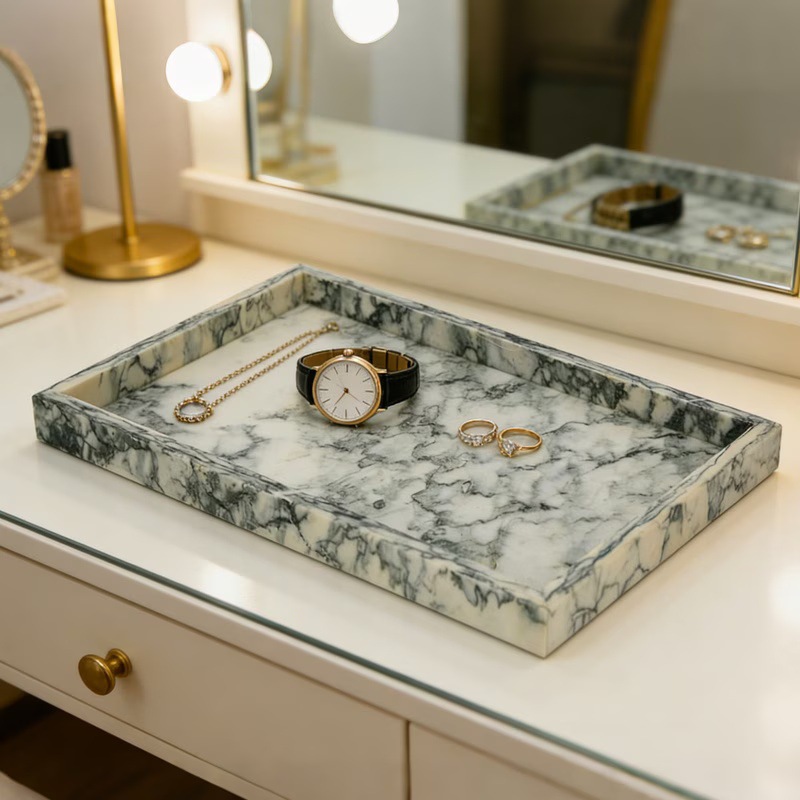
Green is the hardest color to buy for an interior — get it wrong and the room argues with itself for years. Stone solves the problem the way nature does: not green paint but green mineral, veined through pale ground by geology, so the color arrives already balanced with white, grey, and depth. The green travertine vanity tray is exactly that balancing act at useful size: thirty by twenty centimeters of pale stone crossed by emerald webs, its rim hand-joined from cut stone panels in the patchwork style.
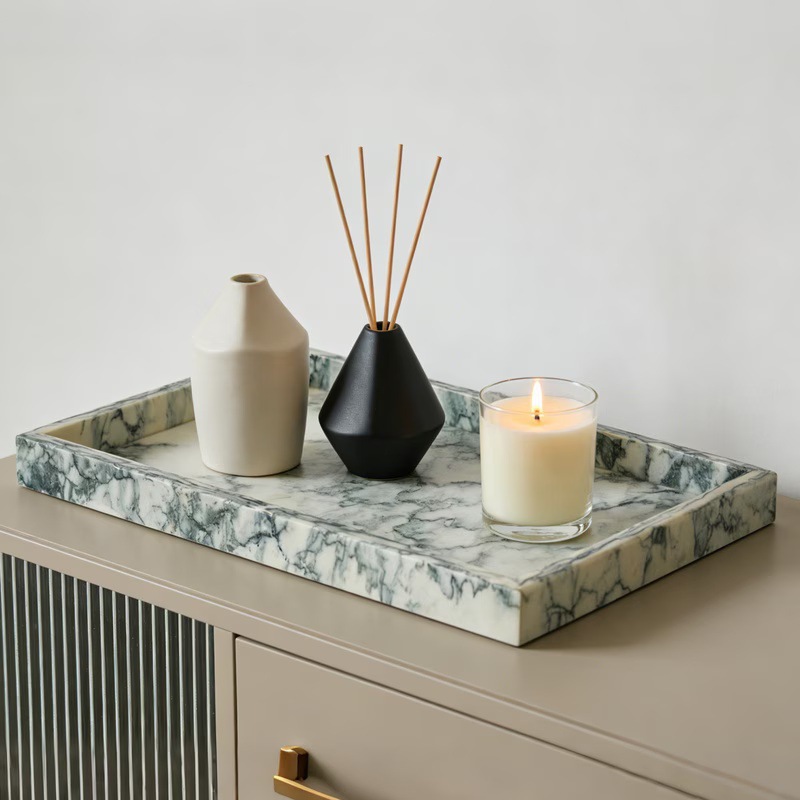
The patchwork construction deserves a first look. Unlike a one-piece slab, this tray’s rim is built from strips of stone cut and joined by hand, ground flush so the top reads as one continuous panel while the edge shows a fine layered line — a detail borrowed from fine cabinetry that makes the tray feel architectural. The raised rim is deep enough to corral jewelry, fruit, or a candle collection, and the 3-centimeter profile gives the tray real presence without eating a counter.
Where Emerald Veining Works Hardest
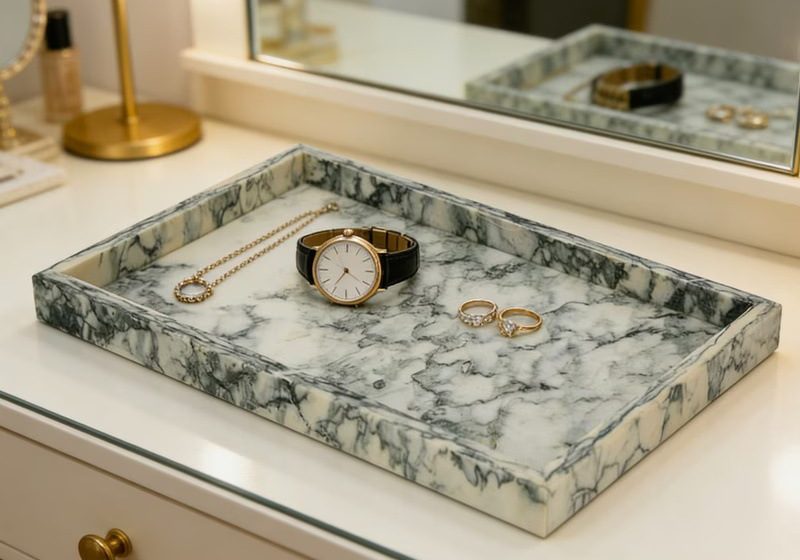
The vanity is its natural home: against white or wood drawers, the green web reads like a painting you store jewelry in. The coffee table takes it as a color anchor — one tray carrying the room’s entire green note, holding candles and remotes. The bathroom counter shows it off against white basins, where the veining does the decorating and towels do the softness. The entry console turns it into the first impression: keys dropped onto emerald stone is a different daily experience than keys dropped onto a rubber mat, and the difference compounds every single morning.
What Pairs With Green Stone
The stone has done the color theory for you — pale ground plus deep webs means it pairs with whatever sits at either end of its own spectrum. Brass and gold bring out the warm undertone in the veining; chrome and glass cool the whole arrangement toward contemporary. Wood in any tone works, because green and wood is the oldest partnership in interiors. The only genuine mistake is another strongly patterned object beside it: let the tray carry the pattern and keep its neighbors matte and plain. A candle, a small vase, done.
Why the Veining Never Repeats
Every panel is cut from a different section of the stone block, which means the webs on your tray — thick here, whisper-thin there, pooling dark near one corner — exist nowhere else on earth. Mass-produced green decor prints the same pattern a million times; carved stone issues originals. This is also why the tray photographs so well and why owners end up moving it around the house for years: it keeps offering new compositions as the light changes through the seasons.
Care in Plain Terms
Wipe with a damp cloth; the sealed surface shrugs off water rings and skin oils. No acidic sprays, no dishwasher, no abrasive powders — the standard stone rules, and the only ones. Reseal once a year in a humid bathroom. The joined rim is ground smooth, so nothing snags a sleeve, and the tray’s weight keeps it planted wherever you stage it.
The Vanity Stage by Stage
Because the tray is the largest object on most vanities, it sets the counter’s composition — so stage it like one. Back row: the tallest bottles against the raised rim, where the stone frame turns them into a skyline. Middle: the daily pieces — watch, rings, the lipstick actually worn — where a hand can reach them without rearranging. Front edge: deliberately empty, so the veining stays visible and the tray keeps its own identity. The same logic works on a bathroom counter for skincare, and on a console for keys and sunglasses, because the three-row principle — tall, daily, empty — is just good composition applied to whatever the room sheds. Keep the tray’s long axis parallel to the counter’s edge on narrow surfaces; turn it perpendicular only when you want it to read as an island, which suits wide dressers and kitchen islands where it can float with clearance on all sides.
One habit worth stealing from professional stylists: restage the tray monthly. The stone never changes, but moving the objects — winter fragrance forward in December, the new watch in spring — keeps the counter feeling attended rather than abandoned, and it costs nothing but a minute.
Why Patchwork Beats Print
Faux-marble products print one photograph of stone a million times; the repetition is what betrays them. Here the pattern is geology, cut into panels by hand — and the patchwork construction multiplies the effect, because each strip of the rim carries a different slice of the web. Look at the corner of the tray and you can see the veins jump from panel to panel, interrupted and resumed: a rhythm no printed film can imitate, because print repeats and craft varies. The joins are ground flush and sealed, so the surface cleans as one piece, but the eye keeps finding the lines — that is the charm. It is decoration and construction in the same gesture, and it is the reason the tray reads as furniture-grade even before you touch it.
The Room-by-Room Tour
Primary bathroom: the tray spans the counter between the two sinks, holding his and hers daily items in one composed strip — the fastest route to a hotel-grade counter that exists. Dressing room or closet island: perfume and jewelry live here permanently, and the emerald webs make the inside of a closet feel designed. Living room: the tray under the coffee table’s candle cluster, with the rim corralling coasters and remotes. Dining sideboard: when guests come, the vanity tray demotes itself to service duty — napkins and small plates — then returns to the bathroom after. Guest room: the tray that makes visitors feel looked after; a carafe of water, a glass, and the room reads as a boutique hotel for the cost of one stone object. The pattern across all six rooms is the same: the tray is big enough to be the composition and neutral enough to fit any of them, which is why owners rarely keep it where they first planned.
The construction also explains the tray’s tolerance for real life. A one-piece slab this size would need to be cut thick to survive handling; the joined panels distribute stress around the rim, so the tray is lighter than it looks yet no more fragile. Lift it once and the balance tells you the panels were set by hand: no wobble, no rocking, no uneven leg, because the base was ground flat after assembly rather than before it. Check any stone tray you buy the same way — a flat base is the quietest signature of a workshop that cares.
Frequently Asked Questions
Is the green color painted or stained?
No — the emerald webs are natural mineral veining running through the stone, cut from the block. Every tray’s pattern is unique and cannot fade or wash off.
What is the patchwork rim?
The raised border is built from hand-cut stone strips joined and ground flush — a fine layered edge borrowed from cabinetry that gives the tray its crisp, architectural profile.
Can it hold fruit?
Yes — the raised rim contains fruit safely, and the sealed stone rinses clean. Rinse the same evening and the surface stays unmarked.
Bring one home: the Green Travertine Vanity Tray 30x20cm — $89, hand-carved and polished, ships worldwide in a rigid gift box.
Read next: the 30cm vanity tray, room by room and the footed marble tray, explained.