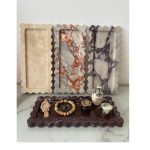

Somewhere between the plain rectangle and the ornate baroque frame lives the scallop: a repeating wave, cut into the edge of a tray like the crust of a pie. It is an old shape — silver dishes of the 18th century wore it, and so did the marble fonts of Italian churches — and it has come back hard in interior styling, because it does something almost no functional object manages: it is decorative without a single ornament on it. The scalloped marble tray is that shape, hand-carved into solid stone.
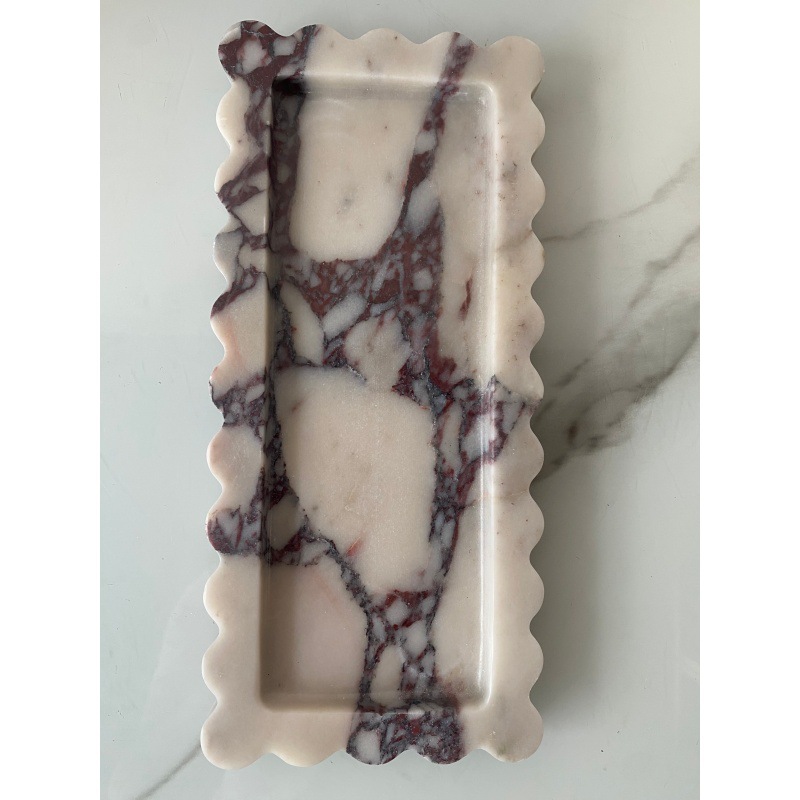
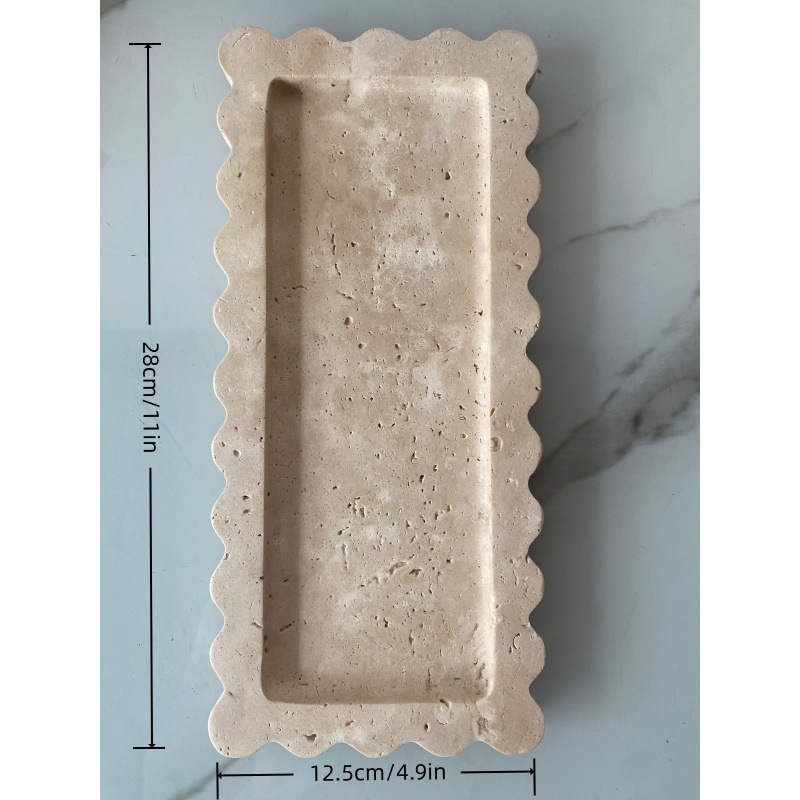
The tray measures twenty by twelve and a half centimeters — the compact, anywhere size. Its walls rise gently from a polished well, and the scalloped border catches light differently at every hour: shadow in the morning, a soft ripple by lamplight. On a nightstand it reads as a small piece of architecture. On a bathroom counter it reads as a jewel. Neither impression comes from color or pattern; it comes from the edge alone, which is the mark of genuinely good form.
Four Stones That Suit the Shape
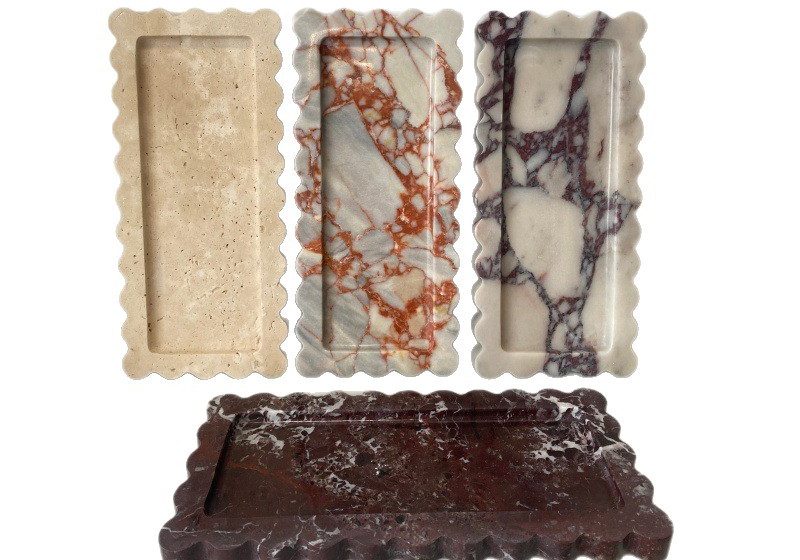
The scallop flatters veined stone especially well, because the wave cuts through the pattern and keeps it moving. Bulgari Purple is the headline: warm white marble crossed by violet-black webs, the stone of the moment, and in this small format it reads like a framed fragment of a larger slab. Bulgari Red is the boldest — orange-red veining over a cool grey-white ground, as if the stone held a sunset. Rosso Levanto goes the other way, deep wine-red crossed with white lightning, nearly black in low light and rich as velvet by day. Beige Travertine is the quiet option: sandy, pore-textured, and calm, the stone for rooms dressed in linen and pale oak.
If you are choosing one: rooms that already carry pattern take travertine; rooms that want one point of drama take Bulgari Purple or Rosso Levanto; and collectors take two, because the tray’s small footprint means two stones stack into a vignette rather than clutter.
Small Tray, Many Jobs
Jewelry: rings and earrings settle against the scalloped walls and stay visible at a glance — the wave keeps small round things in the well instead of letting them creep to the edge. Nightstand: a watch, a lip balm, and a hair tie; the tray makes three objects look like a styled vignette. Bathroom ledge: a soap bar lifted clear of standing water in a tray that rinses clean in seconds. Desk: paperclips and the small screwdriver that always vanishes. Flat-lays and content shoots: the wavy profile is why stylists keep a scalloped tray in the kit — from above, it frames whatever it holds.
Carved, Not Cast
The scallops are ground into solid stone by hand and polished smooth, so nothing snags a sleeve or a silk scarf. This matters: resin imitations of this exact shape exist, and they are easy to spot once you have held the real thing — cast resin has seams, uniform coldness, and a plastic lightness, while carved marble has weight, coolness, and veining that runs through the material rather than sitting on it. At this size the tray weighs enough to feel like furniture, which is precisely why it does not wander around a counter the way light dishes do.
Care in Brief
Damp cloth to clean; no acidic sprays, no dishwasher, no abrasive powders. The sealed surface shrugs off water spots from a bathroom ledge; reseal once a year in humid rooms. Veining and pore pattern vary piece to piece — the honest signature of real stone.
A Short History of the Scallop
The shape carries more history than its size suggests. Scalloped borders appear on Roman marble altars, on the silver épergnes of Georgian dinner tables, and on the painted trays of nineteenth-century canal boats — each era rediscovering the same truth: a repeating wave makes an edge feel crafted rather than cut. Italian stone workshops never really stopped producing it; the form simply waited for interiors to swing back toward ornament that is structural rather than applied. What is new is the material honesty: where a Victorian scalloped tray hid its base metal under enamel, this one is the stone all the way through, the wave carved into solid marble and polished with the rest. The modern version is also smaller and more functional than its ancestors — not a centerpiece holding fruit for twelve, but a personal tray sized for the objects one person actually uses.
That heritage is worth knowing when the tray is given as a gift. It explains why the shape reads as classic rather than trendy, and why it suits a Georgian apartment and a new-build with equal ease. Shapes that have survived four centuries of interiors rarely clash with a fifth.
Stacking and Grouping Trays
One scalloped tray is a vignette; two or three are an installation. The small format invites grouping: a travertine tray and a Bulgari Purple tray side by side on a wide dresser, offset by half their width, hold the shared jewelry of a couple and read as a collected set. On a bookshelf, a tray can sit flat on one shelf holding small objects while a second stands upright on the shelf below as a textured panel — stone is thick enough to display edge-on. When grouping, keep one material constant (all marble, same polish) and let the stones differ; it is the same principle that makes a set of mismatched porcelain plates look intentional when the glaze matches. And leave one slot of the shelf empty around any group — the wave needs a little air to read as a wave.
Choosing by Light
The same stone looks like four different stones depending on the light it lives in, and this is the factor most buyers underestimate. North light is cool and even: it flatters Bulgari Red’s orange webs and keeps travertine looking chalky rather than yellow. South-facing rooms flood with warm light that wakes up Rosso Levanto’s wine tones and makes Emperador’s caramel glow — but it can wash out pale travertine until the pores disappear. Artificial light is the third case: under warm LED or lamplight, Bulgari Purple’s dark webs deepen dramatically, which is why the stone photographs so well in evening interiors, while cool-white office lighting flatters India Green’s near-black depth. If you can, check the surface at the hour you actually use the room — the tray you love at noon in the shop window may not be the tray you love at eleven at night on your own nightstand.
The scallop also has a practical dividend that pure decoration lacks: the wave stiffens the rim. A straight edge on a thin stone slab is its weakest line, but the repeating curve distributes stress around the border — the same reason corrugated cardboard outstiffens flat sheet. The tray’s walls are already thicker than a ceramic dish’s, and the scalloped profile adds rigidity without weight, which is why a carved stone shape this slender survives daily handling, a hand carrying it one-handed from room to room, and decades of objects dropped into the well. Form and function, in this one rare case, are the same curve.
Frequently Asked Questions
What fits in a 20×12.5cm tray?
Rings, earrings, a watch, a soap bar, a small perfume, or desk sundries — the everyday small objects of one person, with the scalloped walls keeping everything in the well.
Is the scalloped edge sharp or uncomfortable?
Not at all. The waves are ground and hand-polished like every other surface, smooth enough for a silk scarf to pass over without catching.
How is this different from a cast-resin copy?
Weight, coolness, and veining that runs through the material. Cast resin has seams, uniform warmth, and printed-looking pattern; the marble tray is solid stone, roughly a kilogram of it.
Bring one home: the Scalloped Marble Vanity Tray 20×12.5cm — $89, hand-carved and polished, ships worldwide in a rigid gift box.
Read next: wavy-edge tray styling, room by room and the long marble tray for every ledge.