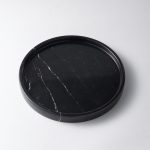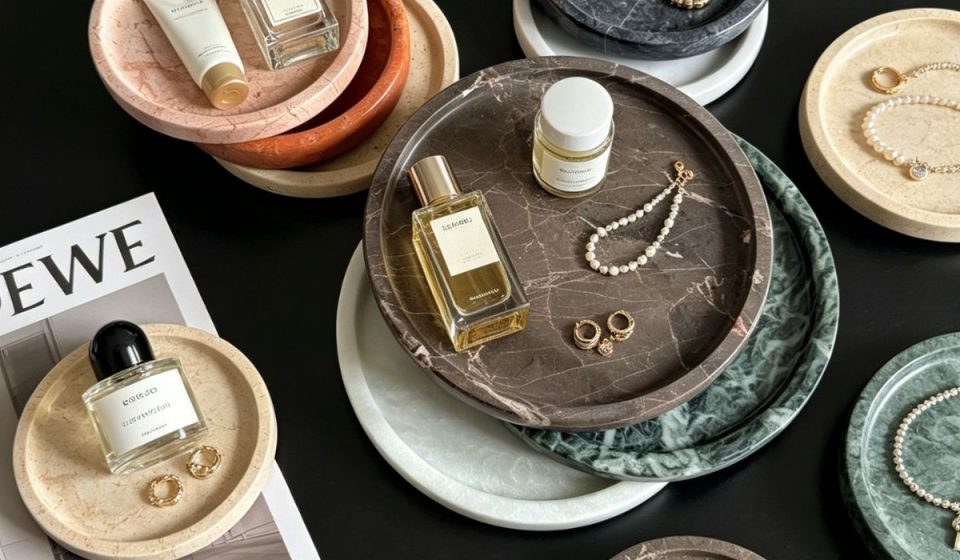

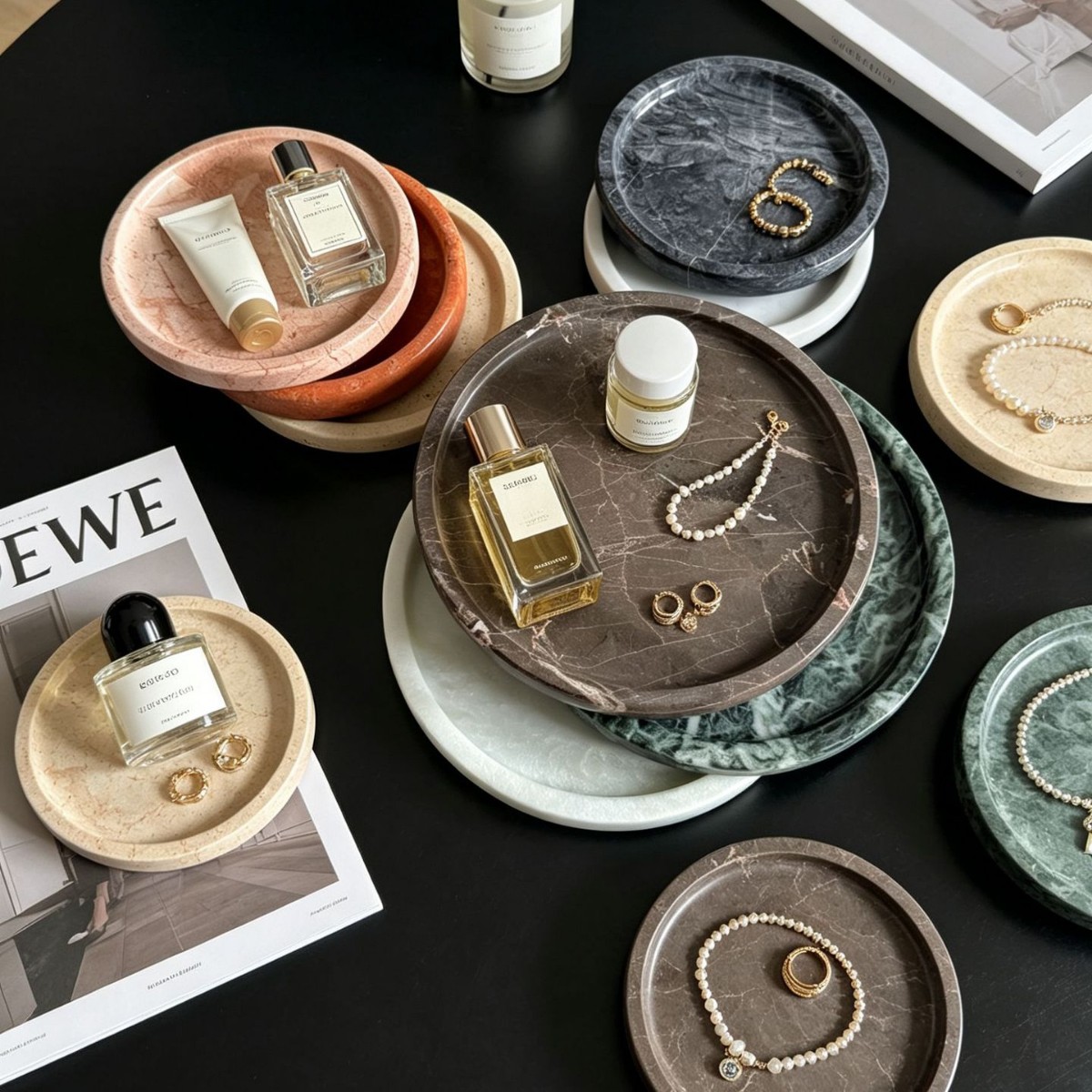
There is a particular kind of attention that small objects demand. A coffee table book you reach past. A candle you light without thinking. And then there are the objects you choose — deliberately — to hold the fragments of your day. A ring slipped off before sleep. A watch removed at the threshold of home. A set of keys dropped into something that feels less like a container and more like an arrival.
We made the Small Round Marble Tray for that moment. The pause between entering and leaving. Between wearing and resting. Between the noise of the outside world and the quiet of the space you have made yours. It is a small object. That is precisely the point.
The Philosophy: Small Means Significant
Most design begins with function and works backward to form. A tray needs to hold things, so it must be flat and rimmed. A tray needs to be durable, so it must be made of something hard. These are not design decisions — they are engineering requirements. Design begins where requirements end.
We began somewhere else entirely. We began with stone — a material that has been forming for one hundred and eighty million years, through the slow, relentless pressure of tectonic plates and the patient crystallization of calcite in ancient seabeds. And we asked a question that no engineering brief would ever pose: what is the smallest honest object we can make from something this old?
The answer was a circle. Three circles, in fact: fifteen centimeters, twenty centimeters, and twenty-five centimeters in diameter. No corners to catch the light wrong. No edges that dictate a front or a back. Just a disc of natural stone, shaped by hand, carrying the full weight of its geological history into your entryway, your bedside table, your bathroom counter, your kitchen island.
This is not minimalism for the sake of aesthetics. It is restraint as a form of respect — for the material, for the craftsperson who shapes it, and for the person who will live with it, touch it, perhaps pass it down.
The Craft: Why We Hammer Instead of Polish
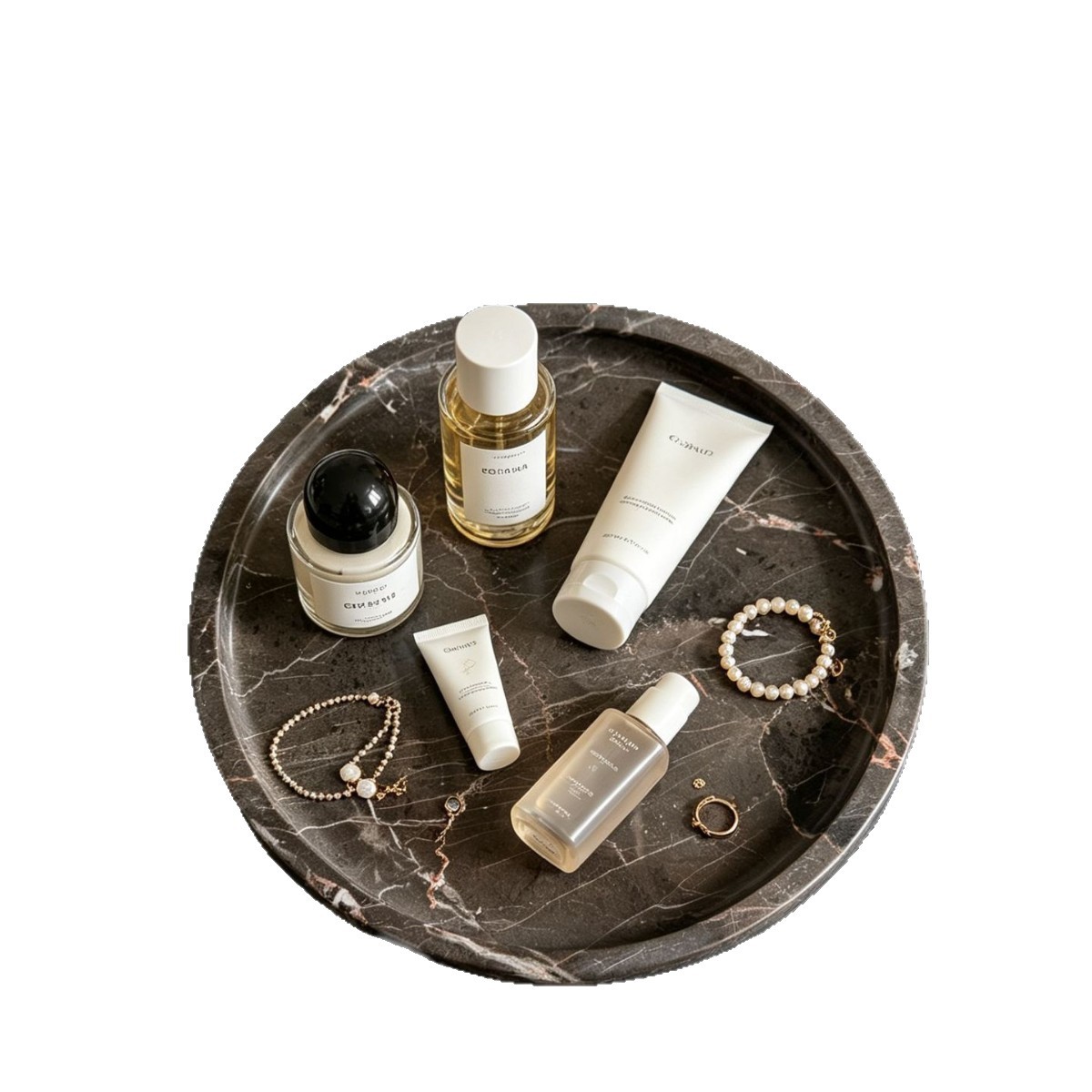
Each tray begins as a raw slab of natural marble — dark Nero Marquina from the Basque country of northern Spain, or pale Carrara Bianco from the Apuan Alps of Tuscany. The slab is examined for structural integrity, for the character of its veining, for the way light moves across its surface. Only then is it cut into circular blanks.
Then comes the edge. And the edge is where everything changes.
Most stone objects are polished to a uniform, machine-perfect finish. The result is predictable, repeatable, and indistinguishable from a thousand other objects made the same way. We do the opposite. We hammer the edge. By hand. With a mason’s hammer and a steady, patient rhythm that cannot be automated.
Each strike of the hammer leaves a micro-fracture — a tiny, textured irregularity that catches light differently from every angle. The edge becomes a sequence of deliberate imperfections, a record of the human hand announcing itself against the geological patience of stone. Run your finger along it. You will feel decisions, not algorithms.
The surface, by contrast, is honed smooth. Not polished to a mirror — that would feel cold, industrial, removed. Instead, we hone it to a soft, matte finish that invites touch. Your finger will find its way there without thinking. This is not an accident. We designed for it.
The Material: A Record of Deep Time
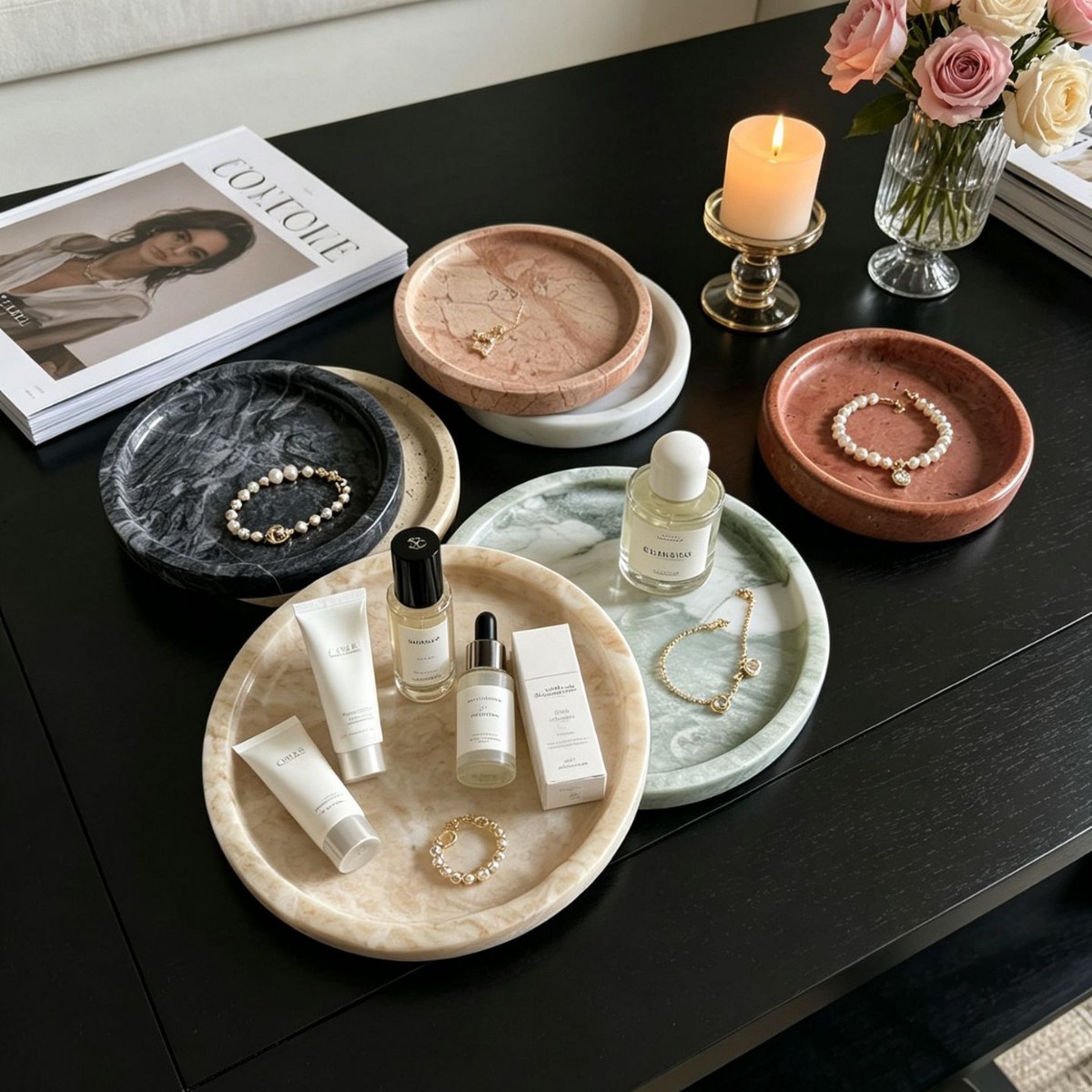
Natural marble is not a manufactured surface. It is a geological record. Every vein of white running through black Nero Marquina is a calcite intrusion that occurred millions of years ago, when tectonic pressure forced mineral-rich fluids through fractured limestone under unimaginable heat and weight. Every grey whisper in Carrara is the ghost of ancient seabed sediment — the shells of marine creatures, the skeletal remains of microscopic organisms — compressed and crystallized under the weight of mountains that no longer exist.
When you place a Small Round Marble Tray on your nightstand, you are placing roughly 180 million years of planetary history on your nightstand. The stone has witnessed epochs. It has been buried, folded, uplifted, exposed. It has survived everything the earth could throw at it. And now it holds your keys.
There is a humility in that — and also a quiet grandeur. An object that has outlasted species now serves your morning routine. We think about this every time we cut into a new slab.
There is no “standard” marble tray because there is no standard marble. Each piece is cut from a different section of the quarry block, revealing a different chapter of the same epic story. The tray that arrives at your door will not look identical to the one in our photographs. It will look like the stone that happened to be there, in that part of the earth, at that moment in deep time. The veining, the shade, the way light plays across the surface — all of it will be uniquely yours. This is not a flaw in our quality control. This is the entire point of working with natural stone.
Three Sizes, Three Lives
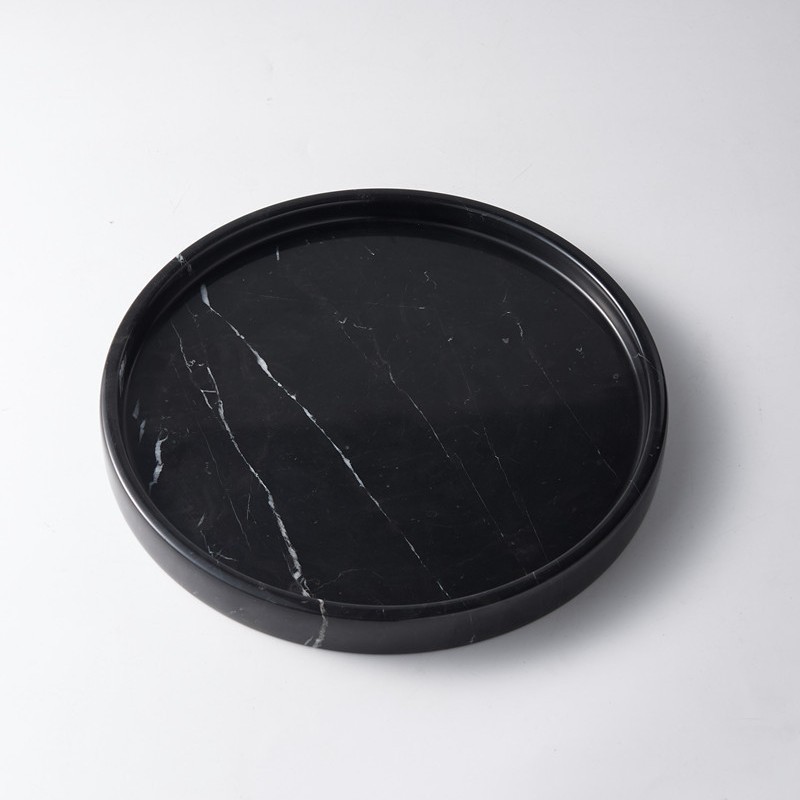
At 15 centimeters, the tray is intimate. It is a catchall for rings, earrings, cufflinks — the small, precious objects you remove at the end of a day and reach for at the beginning of the next. It belongs on a nightstand or a vanity, holding not just things but meaning. In this size, the tray becomes almost ceremonial — a small altar for your daily rituals of arrival and departure.
At 20 centimeters, the tray becomes communal. It holds keys in the entryway — yours, your partner’s, the spare set for the guest who stays over. It serves as a coaster for a French press in the morning, a soap dish that elevates the bathroom from merely functional to quietly intentional, a landing pad for sunglasses and loose change at the end of a long day.
At 25 centimeters, the tray asserts its presence. It becomes a serving surface for cheese and charcuterie when friends come over, a platform for a candle arrangement that transforms a dinner table, a sculptural centerpiece that performs even when it holds nothing at all. In this size, the tray is not an accessory — it is furniture, scaled down to the dimensions of a gesture.
The Objects We Touch Every Day
There is a Japanese concept — yo no bi — which translates roughly to “beauty in everyday use.” An object becomes beautiful not through ornament or preciousness but through the act of being used, day after day, until the patina of touch becomes part of its identity. A well-worn wooden handle. A leather wallet that has shaped itself to a back pocket. A marble tray that has received ten thousand keys, ten thousand rings, ten thousand small moments of homecoming.
A marble tray does not wear out. It wears in. The hammered edge softens imperceptibly under the repeated touch of your fingers. The honed surface accepts the faint ghost of a coffee ring not as a stain but as a record — proof that the object is living, not just existing. It becomes a collaborator in your life, an object that accumulates meaning rather than losing it.
This is the opposite of disposable design. This is an object meant to outlast you — to be picked up by someone else someday, who will see the faint marks of use and understand, without being told, that this thing was loved.
A Small, Quiet Ambition
We did not set out to make a tray. We set out to make something that would make you pause — just for a second — when you dropped your keys into it at the end of a long day. Something that would remind you, in that second, that the earth is old and generous and that a piece of it now lives in your home, shaped by hands that cared about what they were making.
That is the ambition of the Small Round Marble Tray. Nothing more. Nothing less. Just the weight of deep time, carried into the smallest corners of your daily life.
Explore our full collection of handcrafted marble trays, available in Nero Marquina and Carrara Bianco, in diameters of 15cm, 20cm, and 25cm. Each piece is made to order by artisans who sign their work.