The Coaster That Changes the Room: Why the Smallest Surface Tells the Biggest Story

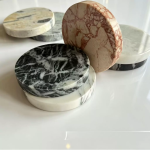
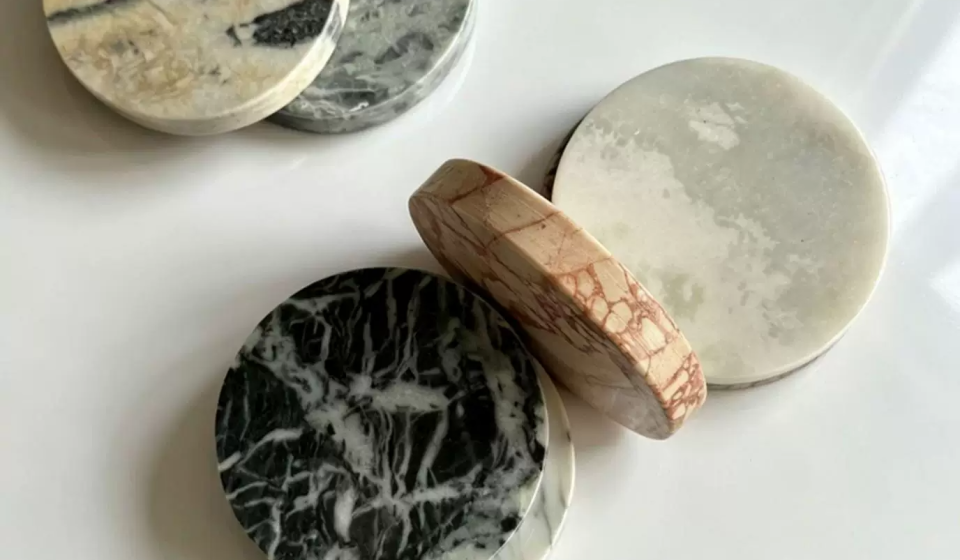
No one walks into a room and says, “Nice coasters.” But they feel the difference. The weight of real stone under a glass. The cool touch on a warm evening. The way six distinct marbles scattered across a coffee table turn a functional object into a design choice.
This is an essay about coasters. But it’s really about something bigger: why the objects we barely notice are often the ones that say the most about who we are.
The Physics of Presence
Coasters are strange objects. They exist to be ignored. Their entire purpose is to sit between a glass and a surface and not call attention to themselves. And yet — put a marble coaster next to a cork one, and the difference isn’t subtle. It’s gravitational.
Marble is heavy. At 300 grams and 1.5 centimeters thick, our coasters have mass. They don’t slide when you set down a drink. They don’t curl at the edges like paper. They don’t absorb stains and develop that faint mildew smell that cork gets after a humid summer. Marble just is — the way mountains just are.
That weight matters psychologically, not just physically. A heavy coaster signals permanence. It says: “I thought about this. I chose this. This home doesn’t do disposable.”
The Sound of Stone
Let’s talk about sound. When you set a glass down on a marble coaster, you hear a clean, muted clink — not the hollow thud of wood or the scratchy silence of cork. It’s a satisfying sound, the acoustic signature of density. Your guests won’t consciously notice it. But they’ll register it somewhere deep in their lizard brain, the same part that knows the difference between stepping on hardwood and stepping on carpet.
Then there’s the inverse sound: the silence of condensation. A cold drink on a hot day sweats. On a paper coaster, that sweat pools and the paper disintegrates. On marble, the stone absorbs the moisture at its own pace, and the surface stays dry. No squelch. No ring. Just the quiet performance of geology doing its job.
Temperature as a Design Feature
Marble is naturally cool to the touch. That’s not a side effect — it’s a feature that architects have exploited for millennia. The Romans built their baths from it. Renaissance sculptors chose it because it felt alive under their hands. A marble coaster inherits this thermal gift: it stays cool even in a warm room, offering a tiny moment of sensory pleasure every time you reach for it.
The science: marble has high thermal conductivity. It absorbs heat from your fingertips quickly, creating the sensation of coolness. It’s the same principle that makes a marble floor feel refreshing on bare feet in summer. At coaster scale, it’s a whisper of that same luxury.
Six Colors, One Palette: How to Style Marble Coasters
The beauty of a curated set is that it works as a system. You don’t need to match — in fact, matching is the enemy of interesting design. Here’s how the palette reads across different interiors:
For the minimalist: Fendi White and Bulgari White, side by side. The subtle difference between their grey threadwork becomes a quiet conversation between two near-identical whites. It’s the kind of detail minimalists live for.
For the maximalist: All six, mixed. Ink Wash next to Bulgari Pink next to Cloud Jade. The chaos of geology becomes a controlled riot on your coffee table. Your guests will pick up each one and tell you which is their favorite. (Spoiler: everyone picks a different one.)
For the traditionalist: Ancient Wood Grain takes center stage. Its wood-like banding bridges the gap between classic interiors (where wood dominates) and the cool sophistication of stone. Pair with dark leather and brass.
For the romantic: Bulgari Pink and Cloud Jade, with their warm blush and jade-green veining, bring softness without sentimentality. Great for a bedroom nightstand or a vanity table.
For the art lover: Ink Wash deserves its own spotlight. Frame it in a coast of natural light and let the brush-painting patterns do what they were born to do: make people stop and stare.
Beyond the Coffee Table: Unexpected Places for a Marble Coaster
We call them coasters because that’s what they do. But a 10cm marble circle has range.
Vanity tray. A single Bulgari White coaster becomes a landing pad for your perfume bottle or jewelry dish. The cool stone protects wooden surfaces from oil-based fragrances.
Candle base. Place a pillar candle on a dark Ink Wash coaster, and the contrast between flame and stone becomes a tiny altar. The marble’s heat resistance means you can burn the candle all the way down without worrying about the surface underneath.
Soap dish. In the bathroom, a coaster keeps bar soap elevated and dry. The stone’s natural porosity helps wick moisture away — and it looks a thousand times better than a plastic dish.
Plant saucer. For small potted plants, a marble coaster catches drainage water while adding heft and stability. It won’t tip over when you water — and unlike terracotta saucers, it won’t crack.
Key drop. By the front door, a Cloud Jade coaster becomes the designated landing zone for keys and sunglasses. It’s an unconscious upgrade: the ritual of coming home now involves setting your things on stone instead of on a cluttered counter.
The Gift That Doesn’t Feel Like a Gift
Coasters are the perfect stealth gift. They’re personal enough to feel thoughtful, practical enough to avoid the “what do I do with this” face, and beautiful enough to become a permanent fixture in someone’s home.
Give a set of six to a couple moving into their first apartment. Give a single Cloud Jade to a friend who just painted their bathroom. Give an Ink Wash to your dad who claims he doesn’t want anything — the geological patterns will give him something to look at while pretending not to be impressed.
At $9.90, it’s an impulse buy disguised as a considered choice. The kind of gift that arrives in a small box but occupies a permanent place.
The Bottom Line
Coasters are small. But the things we touch every day shape us more than the things we only look at. A marble coaster under your morning coffee cup, under your evening wine glass, under your guest’s cocktail — that’s hundreds of small moments, every day, where your hand meets stone instead of cardboard.
That’s not just a coaster. That’s a relationship with an object that will outlast you. The marble has already been here for 200 million years. It can handle your coffee.