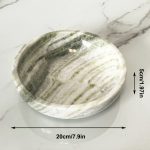

A bowl is the most flexible piece of stoneware decoration most homes own, and the most neglected. It holds fruit in the kitchen, jewellery by the bed, keys in the hallway, and a candle on the bath edge. The 20 centimetre marble bowl is the size that does all four properly — large enough to be a centrepiece, small enough to clear a bathroom shelf, and deep enough (five centimetres) that whatever you put in it stays put.
Why 20 x 5 cm Is the Sweet Spot
Twenty centimetres across clears a standard door shelf, fits beside a standard basin, and holds a proper fruit display rather than a decorative handful. Five centimetres of depth is the number people underestimate: it corrals oranges so they do not roll onto the floor, keeps keys and coins from sliding off the edge, and lets you set a candle inside the bowl where the rim protects the flame from draughts.
It also means the bowl nests. A 20-centimetre bowl stacks inside a larger dish, inside a larger bowl, which is the difference between an object you keep and an object that lives in a cupboard. Small-footprint stoneware is what makes apartment living possible without giving up the heavy, permanent feel of real marble.
Purple: The Statement Bowl
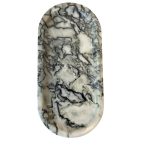
The purple option is a deep rosso levanto marble, burgundy ground shot through with white veining. It is not a subtle stone. Placed on a pale console or a white counter, it becomes the first thing anyone sees; placed on dark wood, it warms the whole corner. It pairs with cream, brass and matte black, and it is the option to choose when the room needs one confident thing rather than three cautious ones.
Because the colour is strong, the styling around it should be quiet: one object inside the bowl, one tall thing beside it, nothing else competing. A purple bowl full of mixed small objects looks busy; the same bowl with five lemons and a sprig of eucalyptus looks expensive.
Green: The Calm Bowl
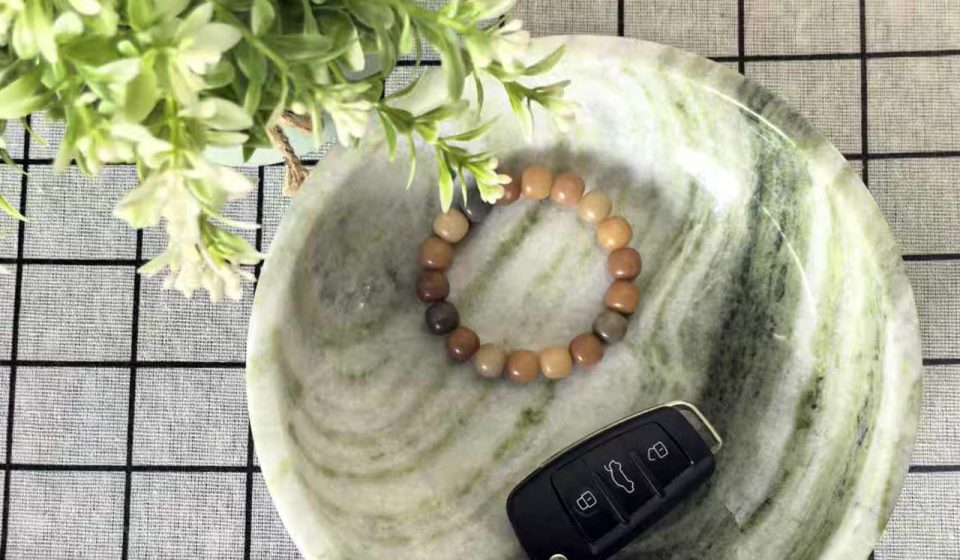
The green option is a pale green marble with soft white and grey movement — closer to jade or a shallow lagoon than to a deep forest stone. It is the quieter of the two, and it is the one that disappears into a light scheme while still clearly reading as stone. In a bathroom it makes everything around it look fresher; in a kitchen it sits happily next to white ceramics and pale wood.
Green also forgives more than purple. Water marks, soap residue and dust show less on a mid-light stone with movement than on a saturated ground, which matters in a room where the bowl sits near a basin. If the bowl will be used daily rather than displayed, this is the more practical choice.
Seven Rooms for a Marble Bowl
1. Kitchen: the fruit bowl, replenished weekly, the single most useful object in the house. 2. Entry console: keys, post and coins gathered in one place. 3. Bathroom: soap, a small vase, or a candle by the basin. 4. Bedside: rings, a watch, hair ties — the bowl is what stops them migrating across the sheets. 5. Coffee table: a bowl of polished pebbles or a single sculptural object. 6. Dresser: the daily drop for jewellery before the shower. 7. Patio: fruit or an ice bucket, with the understanding that stone survives weather better than wood does.
How to Style It
Fill rules are simple. One type of content, three or four objects, all at similar height — a bowl of one kind of fruit reads richer than a mix of three kinds. Leave some stone visible inside the bowl, because the interior veining is as beautiful as the rim and a full bowl hides it.
Height beside the bowl matters more than height in it. One tall object next to the bowl (a vase, a bottle, a candle) frames it; two tall objects bracket it; three turns the corner into a market stall. And keep the material palette tight — stone, glass, metal, wood — so the veining stays the loudest thing in the arrangement.
What to Check Before Buying a Marble Bowl
Weight first: a solid 20-centimetre marble bowl weighs several kilograms, and anything that feels like a hollow shell is a cast copy. Then look at the interior — hand-finished bowls show slight tool marks and natural pitting rather than a perfect, uniform gloss. Finally, check the rim: it should be smooth to the touch with no sharp edges, because a bowl you cannot comfortably touch is a bowl nobody uses.
A Brief History of the Stone Bowl
The stone bowl is one of the oldest objects in the house. Carved from marble or granite, bowls have served for grain, water, washing and offerings for thousands of years — the reason so many traditional Italian and Middle Eastern kitchens still hang one permanently on the wall. What changed in the last century is not the object but the idea that it can be purely decorative. That shift is what makes a carved marble bowl such an effective object in a modern interior: it carries the visual weight of something functional, so a room that needs one object gets an object that looks like it has a purpose.
It also explains why bowls feel heavier than trays in a room. A tray organises small things; a bowl holds them with authority. On an empty shelf or console, the bowl reads as a form with history behind it, which is a very cheap way to make a modern room feel less temporary.
Caring for a Marble Bowl
Marble is calcium carbonate, which means acid is the one thing to keep away from it: lemon juice, vinegar, citrus cleansers and some bathroom descalers will etch the polish over time, leaving dull patches that do not wash off. The daily routine is otherwise trivial. Rinse with warm water, wipe with a soft cloth, dry immediately. If a bowl holds fruit, a weekly rinse and a dry is enough; if it holds cosmetics or soap, wipe it every few days rather than leaving residue sitting.
Two habits prevent nearly all damage. First, never put a hot pan or a burning candle inside a bowl — marble tolerates gentle warmth but thermal shock can craze a polished edge. Second, lift the bowl rather than dragging it across a counter, both to protect the polish and to protect your fingers, because the underside of a solid stone bowl is unforgiving.
Matching the Bowl to Furniture
The purple bowl wants dark, warm furniture — walnut, dark oak, leather, brass — because it borrows depth from wood and throws warmth back at it. The green bowl does the opposite: it flatters pale wood, white lacquer, linen and rattan, and its coolness makes a cream sofa look fresher than it is. Neither rule is absolute, but both are the reason those pairings look right on the first attempt.
Where the room has no strong furniture colour at all, work from the floors and walls. A grey floor pulls the green forward; a warm wooden floor pulls the purple forward. And if the floor is busy, pick the bowl for its own sake and let it be the one calm, solid object in a patterned room.
The Gift Angle
Stone bowls are among the safest gifts in homeware: no gender, no age, no style test, immediately useful. Housewarmings, weddings, birthdays for people who have just moved. The stone is what lifts it above a ceramic bowl, and the fact that it will hold fruit every morning is what makes it a gift that gets used rather than stored.
Frequently Asked Questions
Will a 20cm bowl fit under a standard kitchen cabinet? It needs about 21-22 cm of clearance including the handle; on lower shelves that is usually fine, on an upper shelf check the rail height first.
Is the bowl food safe? Yes — natural marble is food-safe for dry and non-acidic foods. Avoid lemon and citrus juice sitting in it overnight, as acid etches the polish.
Can I use it as a planter? Not directly without a liner. Marble is porous enough that constant moisture will stain and dull the surface; use a plastic insert and keep drainage clear.
The Green and Purple Marble Bowl 20cm is hand-carved in purple or green marble, shipped cushioned in bubble wrap and a protective carton.
For placement ideas room by room, read how to style a marble bowl for decor.