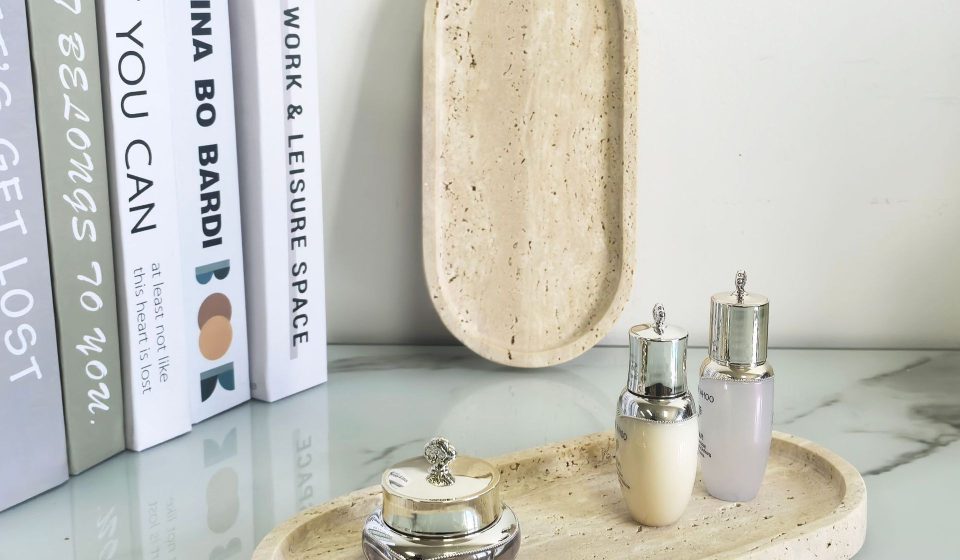

Small trays solve small problems, and small problems are what make a room feel lived-in. Rings and studs that migrate across the dresser top. Keys that end up in the wrong pocket. Perfume bottles that need a landing place that is not the shelf edge. The 25 by 12 centimetre oval travertine tray is sized for exactly that cluster of small things — and the oval shape is not a style accident: it fits narrow shelves and curved surfaces where a rectangle would crowd.
Travertine, Not Marble
Travertine is limestone, formed by mineral deposits in ancient springs. Where marble is dense and glossy, travertine is porous, cloudy and matte, with small pits that give the surface its texture. That texture is the appeal: it feels warm and hand-made rather than polished and corporate, and it hides fingerprints and dust the way a matte finish always does.
This tray is hand-finished rather than mirror-polished, which means the rim and top are smooth to the touch while the character of the stone stays visible. It is the difference between a glossy tray that shows every water mark and one that simply looks like stone.
Why Oval
Three practical reasons. First, fit: an oval 25 by 12 centimetre tray tucks into a narrow shelf or a slim dresser where a rectangular tray would overhang. Second, flow: the curved edge has no corner to catch on jewellery or fabric when you slide the tray across cloth. Third, feel: an oval reads as a considered object from every angle, where a rectangle seen end-on reads as a slab.
The oval is also the tray’s best trick when it is not holding anything at all — an empty travertine oval on a dresser top with a watch beside it looks like a photograph, not an absence.
Five Stone Colours, Five Personalities
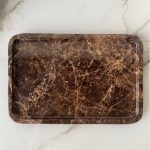
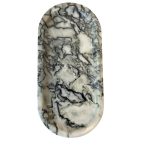
Pink Bvlgari is the soft one: a blush ground with rust-coloured veining, warm and feminine without being pastel. Beige travertine is the natural: warm cream with soft pitting, the option that disappears into an existing scheme until someone touches it. Rosso Levanto is the dramatic: deep burgundy with white movement, the same stone as our rectangular tray, on a more intimate format.
Ruby Red is the bold one — a saturated red-veined stone for someone whose dresser needs a pulse. Emerald Green is the cool one: white and dark green movement, the colour that makes everything placed on it look more expensive. Five options is unusual at this price point, and it is the reason this tray works as a gift: you are choosing a temperament, not just a colour.
Six Jobs
1. Jewelery catchall: rings, studs and a watch at the end of the day. 2. Key dish: by the door or in the hall table. 3. Perfume landing: atomisers go on the tray, not the shelf edge. 4. Candle plate: a votive sits safely inside the lip. 5. Earring stand base: if you prefer the tray to the full tower. 6. Display riser: lift a small object to eye level on a shelf.
What to Look For When Buying
Three checks. Weight — solid travertine at this size is around a kilogram; if it feels hollow, it is a cast copy. Base — hand-finished pieces show slight tool marks and are not perfectly flat, which is a signature rather than a defect. Grain — run your thumb along the surface: natural travertine has tiny pits that a moulded resin copy smooths away entirely.
And the photograph rule: if the product photo shows a perfectly uniform surface with no pitting, it is probably a different material than the one described. Natural stone photos show the movement.
Where Travertine Comes From
Travertine forms where mineral-rich spring water deposits carbonate over long stretches of time, which is why it reads as layered rather than crystalline: you can often see horizontal banding in a cut face, the slow record of water moving. For builders of the Roman Empire it was the material of columns, floors and basins — Venice’s buildings still wear it. It is one of the oldest building stones we still use, and holding a piece of it puts that history a couple of centuries ahead of your bathroom.
Commercially, most travertine comes from Italy and Turkey, and the pitting you see is characteristic of the formation. Cut and filled travertine has the voids sealed for a smoother surface; open-pore travertine, like this one, keeps them, which is both the tactile point and the reason it needs a little more care around oils and stains.
Travertine in a Wet Room
Travertine is limestone, so it tolerates humidity well — the same property that makes it a bathroom standard. It does not swell like wood or corrode like metal in a damp room, and its matte surface will not show the water spots that plague polished marble. The one caution is the same one that applies everywhere: keep acidic cleaners away from the surface. Bleach-based sprays dilute for daily use; lemon, vinegar and citrus descalers do not.
For an oval tray this size, the bathroom is genuinely the best room for it — the lip contains soap and water rings, and the small footprint suits narrow vanity cabinets where a larger tray would overhang the sink.
Stable, and Small Enough to Move
At 25 by 12 centimetres, this tray carries real weight without becoming a two-handed object. That balance matters: it stays put when you slide it across a dresser to reach the back, and it can be moved with one hand to clear a surface for something else. That combination — planted but portable — is why it works in so many rooms.
Travertine Care
Because travertine is limestone, acids are its enemy: lemon, vinegar, citrus sprays and some bathroom descalers will etch the surface over time. The daily routine is simple — wipe with a damp cloth, mild soap if needed, dry immediately. Once or twice a year, treat the surface with a stone sealer if you want extra stain resistance, particularly if it lives on a dresser where perfume and hand cream might land.
Gifting an Oval Stone Tray
It is the easiest of the small stone objects to give: light enough to wrap, neutral enough for any dresser, useful immediately. Pair it with a candle for a birthday, a set of rings for an anniversary, or nothing at all for a housewarming. The five colours make it a gift that matches someone else’s taste rather than yours.
Frequently Asked Questions
Is the surface slippery for rings? No — the hand-finished matte surface gives slightly more grip than polished marble, which matters for small jewellery.
Will the pits in travertine collect dirt? Slightly in heavy use, and a damp cloth handles it in seconds. A stone sealer closes the pores if you prefer a wash-safe surface.
Can it hold a candle safely? Yes. The raised lip contains wax and the stone tolerates gentle heat; just keep it off the flame.
Is it heavy enough to stay put on a dresser? Around a kilo of solid travertine, which is enough to resist a daily nudge without needing to be fixed down.
The Oval Travertine Catchall Tray 25x12cm comes in five stones, hand-finished and shipped in a protective carton.
For styling ideas around each stone, read five stones, one oval tray.