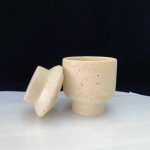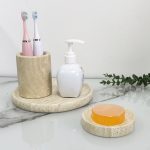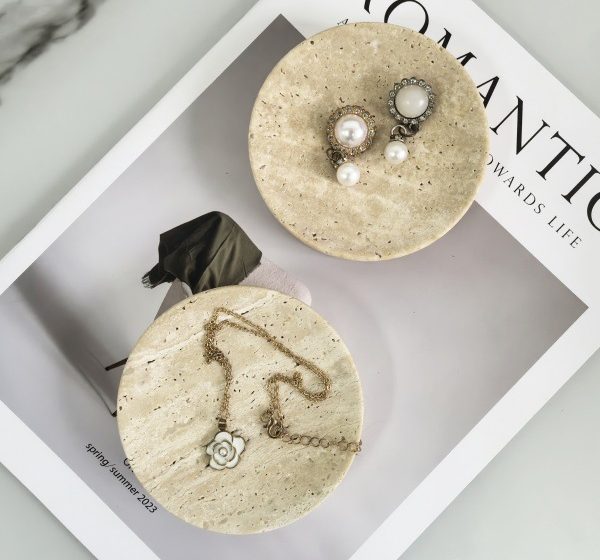

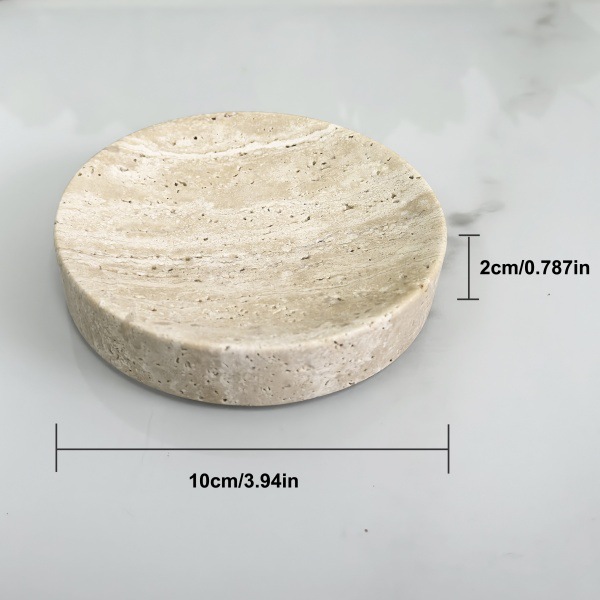
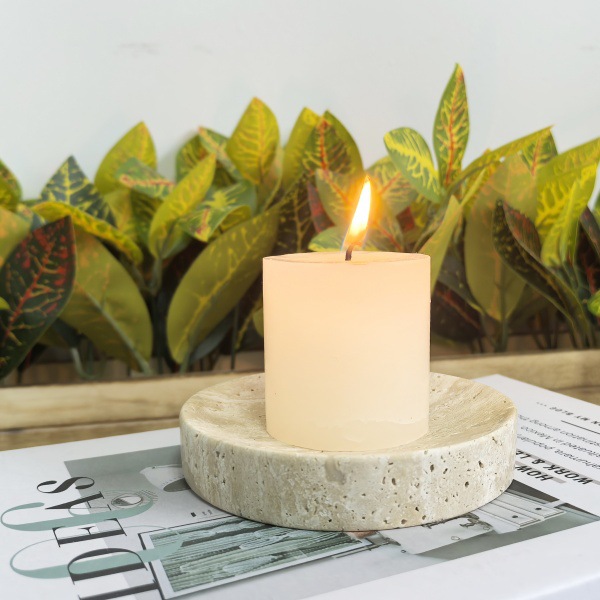
Every house has a surface where small things land and never quite settle: the coin that escapes the wallet, the ring that comes off at the sink, the key that multiplies on the console. Interior designers have a word for the object that solves this, and it is not “organizer” — it is the catchall tray. The round travertine catchall tray is that object cut from a single disc of beige stone: ten centimeters across, two centimeters thick, and honest about its job. This guide covers what a catchall actually does, why travertine suits the work, and how one small tray gets used in four different rooms.
What a Catchall Tray Actually Does
A catchall is not storage; it is choreography. Storage asks you to decide where something belongs, open something, and put it there. A catchall asks nothing — it simply stands where your hands already are, so the ring lands on stone instead of on the counter edge. That is why it works in every room and why it never reads as clutter: one tray, one shape, one place. The failure mode of countertop organization is always the same — too many compartments, each with a label and a rule. A catchall inverts it. Everything goes in one dish, and the dish is handsome enough that “everything” looks intentional. Psychologists who study habit formation call this the path of least resistance; hotels call it the guest experience. Either way, the mechanics are identical: give small things a designated landing zone and they stop migrating.
Why Travertine Suits the Small Stuff
Travertine is a limestone born in mineral springs, and its signature is a soft field of natural pores over a warm cream ground. On a large slab those pores are a texture; on a small disc they are the whole show — you read the stone the way you read suede. The beige family is the most forgiving color in the stone palette. It carries warmth that white marble lacks and calm that patterned stone interrupts: beside chrome it softens the metal, beside oak it holds its own, and against a painted wall it reads as a quiet, matte object that does not demand attention. Weight matters more than it seems at this scale. A ten-centimeter dish in resin slides every time a key drags across it; two centimeters of solid stone stays put, and the habit works only if the tray does. The rim is cut low and the walls are even, so nothing balances precariously — watches lie flat, candles sit square, soap drains.
Four Jobs for One Ten-Centimeter Disc
- The soap dish. A bar of soap on a flat ceramic dish sits in its own meltwater and dissolves into a puddle. On this tray the bar rides above the stone’s natural texture, air moves underneath, and the bar lasts visibly longer. The beige stone also flatters a bathroom more than plastic ever will.
- The jewelry tray. Rings off at the sink, earrings off at the mirror, bracelet off at the desk — the tray catches all three. Stone is smoother than fabric-lined boxes and cannot snag a chain, and everything stays visible instead of disappearing into a drawer.
- The key catchall. By the door, the tray becomes the exit ritual: keys, coins, transit cards, the spare AirTag. The disc’s low walls keep small metal from sliding off, and the stone deadens the clatter of dropped keys better than any ceramic bowl.
- The candle coaster. A pillar candle on stone is a classic for a reason — the tray catches stray wax, tolerates the warmth, and turns a plain candle into a styled vignette. Ten centimeters fits standard pillars up to eight centimeters across with a safe margin.
Where the Circle Beats the Rectangle
Most trays are rectangles because rectangles fill rectangles — they match tables and shelves. But small objects are round, and a round tray composes differently: it interrupts the long lines of a console or countertop with a single curve, which is why stylists reach for circular dishes when a surface feels stiff. On a square tile floor plan, a circle reads as a deliberate pause. On a wooden nightstand with straight grain, the disc softens the geometry. There is a practical dividend too: no corners means no dead zones. In a rectangular dish, small items pool in the corners where fingers fumble; in a disc, everything gathers center-stage, one scoop away. The round shape also rotates visually — turn it forty-five degrees and the tray looks newly placed, which is the cheapest redecorating there is.
Size Notes: Ten by Two
The dimensions deserve a closer read, because they are the difference between a tray that works and a tray that lives in a cupboard. Ten centimeters across holds one bar of soap, one day’s jewelry, or one pocket’s contents — and nothing more, which is the point. Small trays earn their keep by refusing to become the drawer they were meant to replace: when the dish fills, it is time to put things away, and the tray resets itself as a habit rather than a hoard. Two centimeters of thickness gives the disc enough mass to feel like an object rather than a coaster — lift it and you register stone; set it down and it stays. That proportion also photographs well: low enough to never block a faucet or mirror, thick enough to cast the soft shadow that makes flat-lay photos look dimensional.
The tray arrives sealed, and the seal is worth understanding because it defines what the surface will forgive. Unsealed limestone drinks oils and pigments — a ring of olive oil, a wedge of beet — and keeps them as patina. The workshop’s sealant sits invisibly in those pores and buys you hours instead of seconds: a splash of salad dressing wiped within the hour leaves nothing, and a coffee ring lifts with soap and water. What sealing does not do is make the stone glassy. The matte hand-feel stays, the pores stay visible to the eye, and the disc keeps reading as mineral rather than coating. Resealing is a five-minute annual task — one coat, one wipe, one hour of drying — and it is the difference between a tray that ages and a tray that simply gets used.
Caring for Travertine
The care routine is deliberately short. Wipe with a damp cloth and, if needed, a drop of mild soap; dry with a towel. Keep lemon cleaners, vinegar, and bleach away from the surface — acids etch limestone’s finish into a dull patch, the same caution that applies to marble. The tray is sealed at the workshop, and an annual top-up keeps it that way: drip a little water on the surface, and if it soaks in within a few minutes instead of beading, the stone is ready for another coat. Soap and cosmetics are the tray’s daily diet and neither needs more than a rinse. Treated this way, the disc outlasts the room it starts in — stone trays move house more often than they wear out, which is the quiet economics of buying solid stone once.
Frequently Asked Questions
What exactly is a catchall tray for?
It is a designated landing zone for the small things that move daily — keys, rings, a bar of soap, coins. Everything drops in one place and stays visible, instead of migrating across counters and drawers.
Will a bar of soap damage the travertine?
No. Soap is neutral and the stone is sealed — a bar sitting on the tray is exactly the intended use. Just keep acidic cleaners off the surface and rinse occasionally.
Is the tray big enough for a watch and a ring?
Yes — at ten centimeters across it takes a watch, rings, and earbuds together, with the low rim keeping everything in view at a glance.
Bring one home: the Round Travertine Catchall Tray 10cm — $19, hand-carved and polished, ships worldwide in a rigid carton.
Read next: styling a travertine valet tray, room by room.