
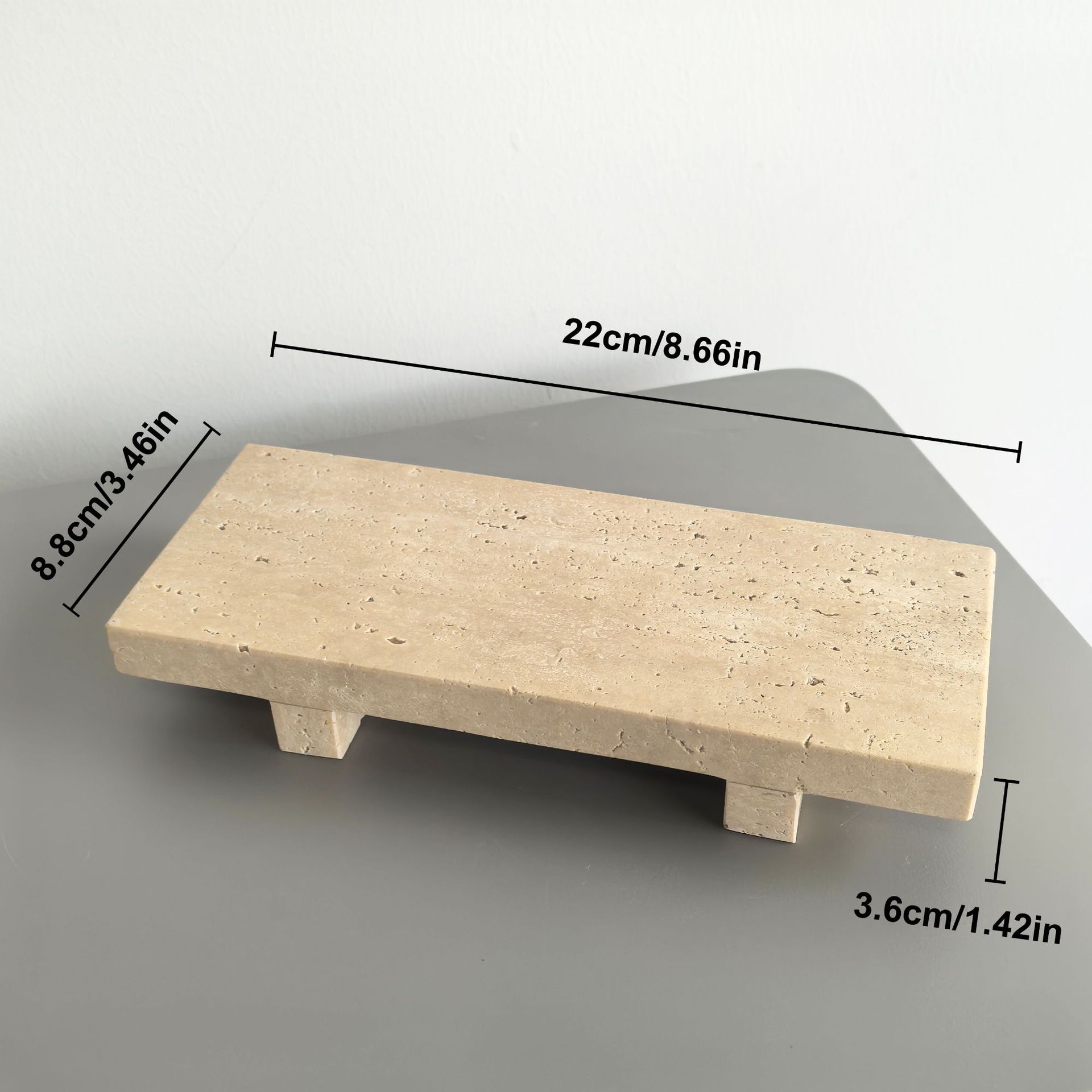
Flat trays have one hidden flaw: they seal whatever sits on them against the surface. A soap bar on a flat dish sits in its own moisture; a leather-backed watch rests on a damp counter; nothing dries, everything dulls. The footed marble tray fixes this with the simplest possible engineering — two stone feet carved from the same block as the slab, lifting the whole surface 3.8 centimeters into the air where air can do its work.
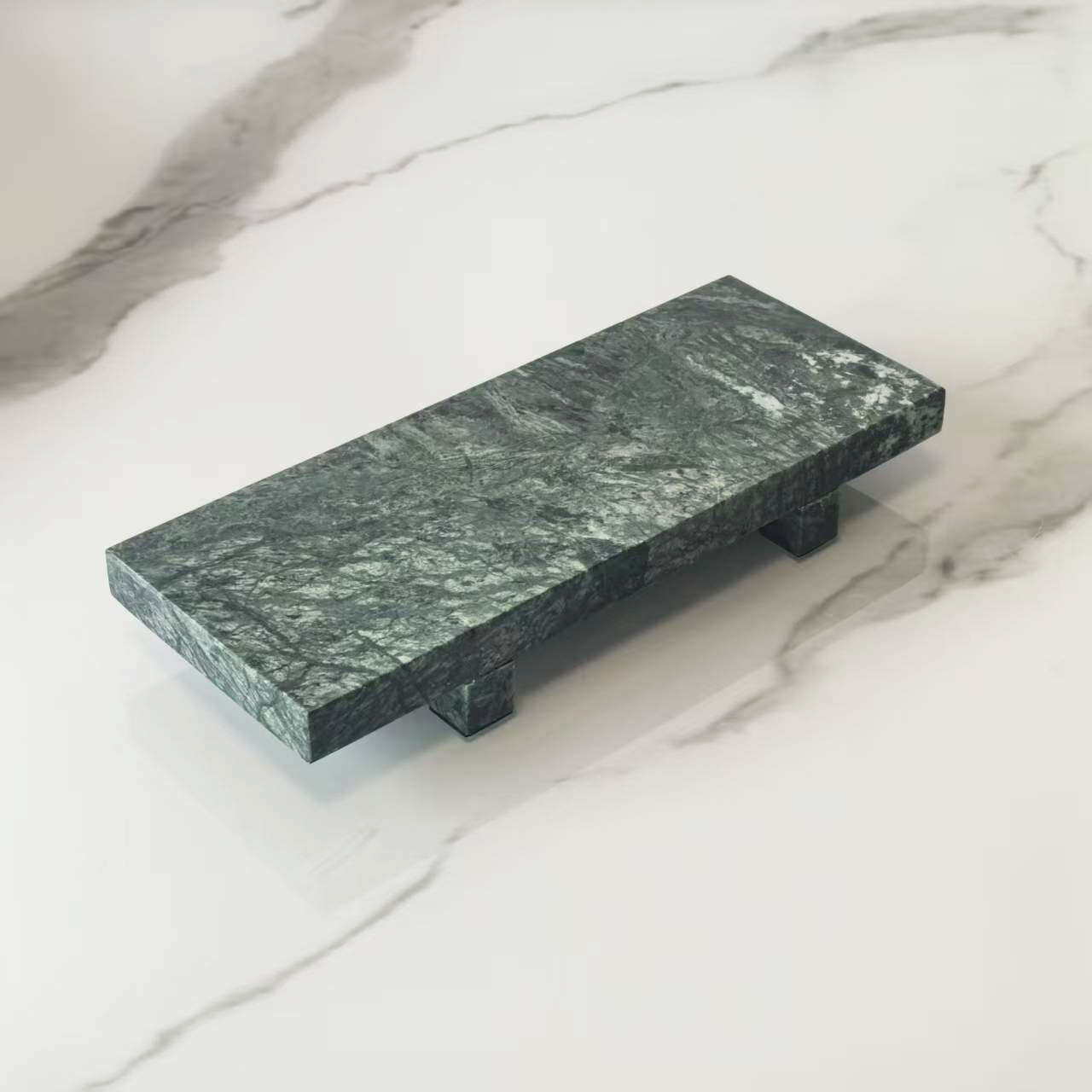
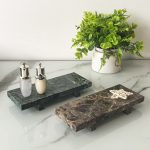
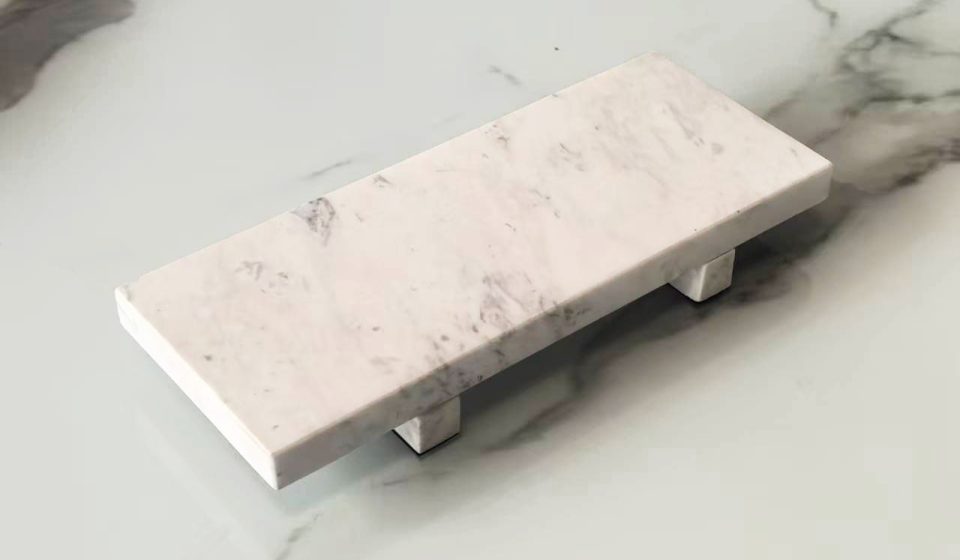
The tray measures 22 by 8.8 centimeters: a slim rectangle sized for the objects that leave your body or your bathroom routine — a watch, a ring pair, a soap bar, three perfume bottles in a row. Its silhouette reads as a small bench, and the metaphor is exact: things placed on it are displayed, not stored. On a vanity, the feet raise the stone slab into the light, which is why product photographers love this shape; on a bathroom ledge, it turns soap into something that looks placed rather than parked.
Two Levels From One Object
The feet do more than dry the surface below — they create a second, hidden level. On an entry console, keys and sunglasses live on top while the day’s mail slides underneath. On a desk, the tray holds the everyday items and the space below shelters the charging cable run. No flat tray offers anything underneath itself; this one quietly doubles its footprint’s usefulness without gaining a centimeter of counter space. For narrow vanities and crowded nightstands, that earned space is the whole argument.
Five Stones for Five Rooms
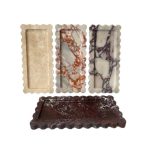
Beige Travertine carries the tray’s relaxed register: sandy pores, warm oat tones, and an easy friendship with linen, ceramics, and morning light. White marble is the shape’s most natural partner — the pale slab on pale feet reads almost architectural, like a fragment of a Greek column repurposed for your perfume. Nero Marquina goes the other way entirely: near-black stone shot with light veins, the tray equivalent of a tuxedo, and the choice for white countertops that need one dark anchor. Emperador Brown warms up wood-heavy rooms, its caramel cells echoing walnut and leather. India Green is the collector’s pick — deep green that hides in shadow until a window brings the veins alive.
The Bathroom Case Is the Strongest
Every bathroom fights the same war against damp soap, and most lose with ceramic dishes that pool water and breed sliminess by Thursday. Raised on stone feet, a soap bar dries on all six faces between uses, lasting weeks longer and never gluing itself to the tray. The same physics serves sponges, razors, and the cloth that wipes the sink. Because the marble is sealed, the wettest room in the house cannot touch it — wipe, done, and the stone looks the same in year five as on day one.
Carved, Not Assembled
Look at the joints: there are none. The slab and both feet come from a single block, carved and ground as one object, then hand-polished and sealed. That is the difference between stonework and stoneware — no glue lines to yellow, no seams to trap grime, nothing to wobble. The feet are sanded flat and smooth, so the tray sits silent and sure on wood, stone, or glass without a felt pad. Roughly two kilograms of stone does not skate when a hand reaches over it, and it will outlast every trend that walks through the room.
Styling the Bench: What Goes on Top
The rectangle rewards linear arrangement. Three perfume bottles in a height cascade — tallest at the back — turn a corner of the vanity into a shop display. A watch laid flat with the band looped once reads as deliberate; two rings paired beside it finish the vignette. In the bathroom, a soap bar centered on the slab with a small dish of pins or earrings at one end makes the tray work double duty without crowding. The one rule: leave the last fifth of the slab empty. A full bench looks stored; a bench with breathing room looks staged. If you own two of the trays, they stack into a longer run on a wide dresser — offset their ends by a few centimeters so the feet read as a rhythm rather than a row.
What not to place on it: anything wet for longer than an evening, anything hot, and anything that spills acid — the standard stone rules, which is to say the only rules. Everything else a vanity generates is fair game, and the stone’s own coolness makes it the natural home for the metal and glass objects that hate warm, humid surfaces.
Choosing by Surface and Light
Match the stone to what it stands on. On white quartz or pale marble counters, Nero Marquina creates the sharpest, most graphic pairing, while Beige Travertine almost dissolves — beautiful in a tone-on-tone room, wasted anywhere it needs to contrast. On walnut or oak furniture, Emperador Brown blends into the wood family and India Green pops against it. In a bathroom with grey tile, White marble echoes the coolness; in one with warm terracotta tones, travertine feels native. And consider the light’s direction: the veining on India Green and Nero Marquina is dramatic under downlights and lamplight but reads flatter in flat daylight, where the pale stones do their best work. When in doubt, hold your current counter objects next to the stone in the room it will live in — ten seconds of comparison prevents the return shipping.
A Day With the Tray
Morning: the watch goes on as the wrist clears the bathroom, the ring joins it before the dishwater. Midday: the tray holds the ring while lotion is applied, and the soap dries on the bathroom twin. Evening: everything returns — glasses, the second earring that turned up in a coat, the hair tie that migrated since breakfast — and the bench absorbs all of it without complaint. Night: the stone looks exactly as it did at the start, one damp-cloth pass if the day was careless. Multiply that loop by years and the tray’s value stops being decorative at all: it is the household’s fixed point, the place where the day’s small objects can always be found. Few purchases at this price hold that kind of daily job for that long, and none of the alternatives — dishes, pouches, drawers — do it while looking like something worth keeping out.
And if the house already owns a flat marble tray, do not retire it — the two shapes are colleagues, not rivals. The flat tray serves where width matters: the long console, the bathtub shelf, the coffee table’s book stack. The footed tray serves where height and dryness matter: soap, watches, skincare. One household, two trays, each doing the job its shape was born for, is a better outcome than any single tray doing all of them badly.
Frequently Asked Questions
Will the feet scratch my vanity or wooden table?
No — the two feet are carved and sanded smooth from the same stone as the slab, with no metal or rough saw marks. The tray sits silent on wood, stone, or glass.
What fits on the 22×8.8cm surface?
A watch plus glasses plus a ring dish in one line, or three perfume bottles, or a standard soap bar with room to dry. It is sized for one person’s daily-carry objects.
Is the soap-dish use hygienic?
Yes — air circulates under the raised slab, so soap dries on all sides instead of sitting in a wet dish. The sealed stone rinses clean in seconds.
Bring one home: the Footed Marble Vanity Tray 22×8.8cm — $59, hand-carved and polished, ships worldwide in a rigid gift box.
Read next: the watch and jewelry tray: a stone bench and styling emerald veining at full size.