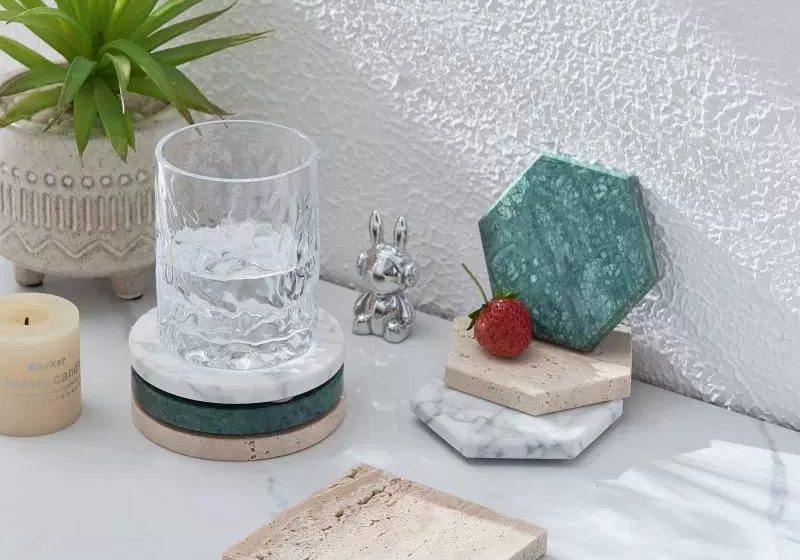

A stone does not have a shape. It has a mass, a density, a veining direction, a set of fractures, and a geological history. The shape is something we impose — a decision made by a human with a saw and a design intent. So when we offer a marble tile in three shapes — square, round, and hexagonal — the question is not which shape is best. The question is: what does each shape do to the stone?
This is a meditation on geometry and material. On why a round piece of Nero Marquina feels different from a square one, and why the hexagon might be the most honest shape of all.
The Square: The Architect’s Shape
The square is the most efficient cut. When you slab a block of marble, the resulting slab is a rectangle, and the most efficient way to divide that rectangle into tiles is with straight, parallel cuts. A square tile wastes almost nothing. It is the shape that the stone wants to be — or at least, the shape that the saw wants to make.
But efficiency is not the only story. The square carries a specific aesthetic weight. It is the shape of architecture — of floor plans, of city grids, of the grid itself. A square marble tile reads as structural. It feels like a building material, even when it is only ten centimeters across. Place a square of Carrara White on a desk, and it looks like a fragment of a floor, a piece of a wall, a sample of something larger.
This is its gift and its limitation. The square is the shape that connects a small object to a large tradition. It is the most recognizable, the most expected, and — in the right context — the most quietly powerful.
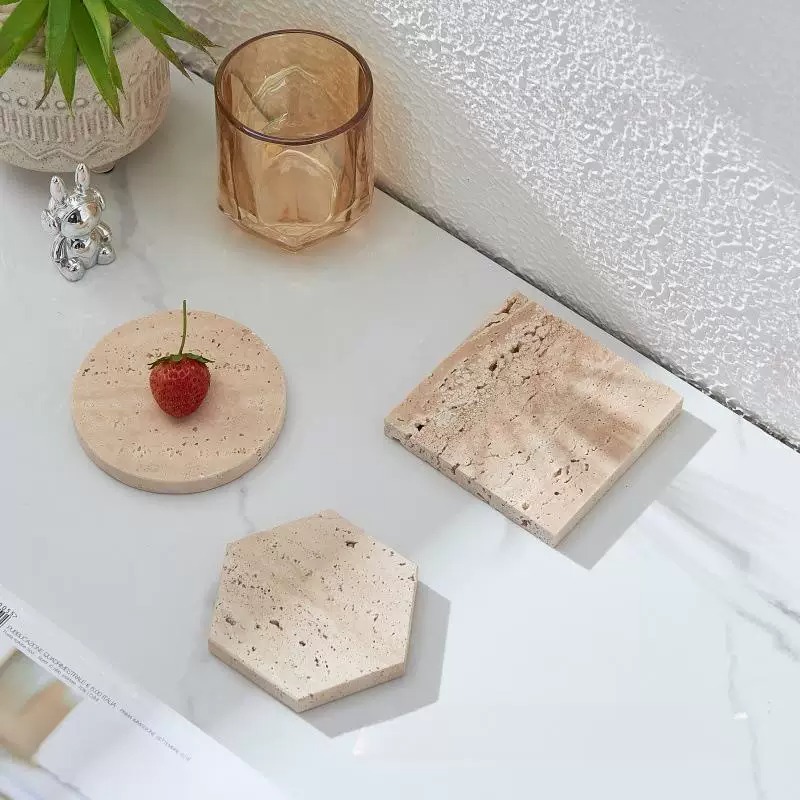
The Round: The Stonecutter’s Shape
A circle is the hardest shape to cut from a block. You cannot do it with a single pass of a blade. The round tile requires either a core drill — a hollow cylindrical bit that cuts a circle by removing the perimeter — or a CNC router that follows a curved path. Both methods are slower and more wasteful than a straight cut. The round tile is, materially, the most expensive shape to produce.
Why do it? Because the circle changes the stone. A square tile has corners — four sharp points where the veining is truncated and the edge is at its most fragile. A round tile has no corners. The veining runs continuously around the perimeter, curving and looping, and the edge is a single, uninterrupted line. This transforms the visual character of the marble.
Consider Nero Marquina. In a square, the white veins hit the edges and stop — they read as fragments, interrupted by the geometry. In a round tile, the same veins arc and sweep, creating a sense of movement and flow that the square cannot achieve. The round tile makes the stone feel organic — like a cross-section of a living thing, rather than a cut piece of material.
There is also a tactile difference. A round tile has no sharp corners to catch on fabric or skin. It sits in the palm like a river stone — smooth, weighted, and inevitable. Of the three shapes, it is the one most likely to be picked up and held without being put back down.
The Hexagon: Nature’s Tessellation
The hexagon is the outlier. It is not the most efficient cut (that is the square), nor the most tactile (that is the circle). It is the shape that exists for a different reason entirely: tessellation.
A hexagon is one of only three regular polygons that can tile a plane without gaps (the others are the square and the triangle). This is not a human invention — it is a mathematical property. Bees discovered it. Basalt columns discovered it. The hexagon is nature’s solution to the problem of covering a surface with identical units, and it has been used in architecture, in tiling, and in decorative stonework for centuries.
When we cut a marble tile into a hexagon, we are doing something subtly different from the square or the round. We are not imposing a shape on the stone — we are offering the stone a shape that cooperates with other stones. A hexagonal tile wants to be next to another hexagonal tile. It wants to form a pattern, a honeycomb, a surface. It is the only shape in the collection that implies a relationship with other tiles.
This makes the hexagon the most generous shape. It is not complete on its own — it is always pointing toward the next tile, the next stone, the next piece of the pattern. For a collection built around the idea of accessibility and exploration, the hexagon is the shape that says: one is not enough.
The Same Stone, Three Different Feelings
Here is the remarkable thing. Take a piece of Wave Grey marble. Cut it into a square, a circle, and a hexagon. Same stone, same block, same slab. The three resulting tiles will look and feel like three different objects.
The square will feel architectural — controlled, geometric, a fragment of something larger. The circle will feel organic — the grey bands arcing across the surface like contour lines on a map, the edge smooth and continuous. The hexagon will feel relational — a piece that wants company, that implies a pattern, that is never quite complete on its own.
This is why we offer all three. Not because we cannot decide, but because the decision matters. The shape is not a minor variation — it is a fundamental transformation of how the stone reads, how it feels in the hand, and how it relates to the space around it.
The Maker’s Perspective
On the production floor, the three shapes represent three different challenges. The square is fast — set the fence, make the cut, repeat. The round requires a core drill or a CNC pass, which means a separate machine, a slower cycle time, and more stone waste. The hexagon requires an angled cut — three pairs of parallel cuts at 120 degrees — which is neither fast nor particularly wasteful, but demands precision. A hexagonal tile with uneven angles will not tessellate. It will sit next to its neighbor with a gap, and the gap will be visible.
After cutting, all three shapes are hand-finished on the same polishing line. The finisher holds each tile against a sequence of diamond pads, working from coarse to fine, and the final bevel is applied by hand — a thin chamfer that softens the edge and catches light. For the round tile, this is a continuous motion. For the square and hexagon, it is a series of short, precise passes — one per edge.
The result is the same across all three shapes: a piece of marble that feels finished, weighted, and complete. The difference is what happens after it leaves the workshop.
Choosing Your Shape
If you are drawn to the stone itself — the veining, the color, the geological story — choose the round. The circle lets the stone speak without interruption, and it is the shape that most rewards being held.
If you are drawn to the idea of stone as material — as something architectural, structural, a fragment of a larger whole — choose the square. It is the shape that connects a small object to the tradition of building.
If you are drawn to pattern — to the idea that one tile might become two, and two might become a honeycomb, and a honeycomb might become a wall — choose the hexagon. It is the shape that is never finished.
And if you cannot decide, that is fine too. At $9.90, the cost of indecision is low. Pick one of each. Hold them. Turn them. Let the stone teach you the difference.