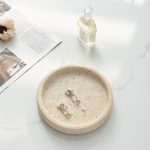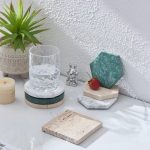

There is a moment, if you are lucky, when you pick up a piece of stone for the first time and understand that what you are holding is not a product. It is a fragment of geological time — compressed, heated, folded, and pushed to the surface over millions of years — and it has been waiting for you.
We make large things. We make hammered-edge trays that anchor a coffee table. We make sculpted dishes that hold the weight of an entryway. But we also make something small — a ten-centimeter piece of marble, cut from the same blocks, finished by the same hands, priced at $9.90. This is the story of why.
The Philosophy of the Small Object
In a world that measures value by size, there is something quietly rebellious about a small thing. A ten-centimeter marble tile does not dominate a room. It does not announce itself. It sits on a desk, on a shelf, on a windowsill — and it asks to be picked up. Not displayed. Picked up.
That is the design intent. We wanted an object that was cheap enough to be impulsive, small enough to be personal, and honest enough to be educational. Because the truth is, most people have never held a piece of Carrara White marble. They have seen it in photographs. They have walked on it in hotel lobbies. But they have never felt its cool density in their palm, turned it to catch the light, traced a vein with their thumb.
The 10cm Marble Mini Collection is our answer to that gap. It is not a sample. It is not a promotional giveaway. It is a finished product — cut, polished, and beveled by hand — that happens to be small enough to introduce you to a stone you may never have touched before.
Seven Stones, Seven Stories
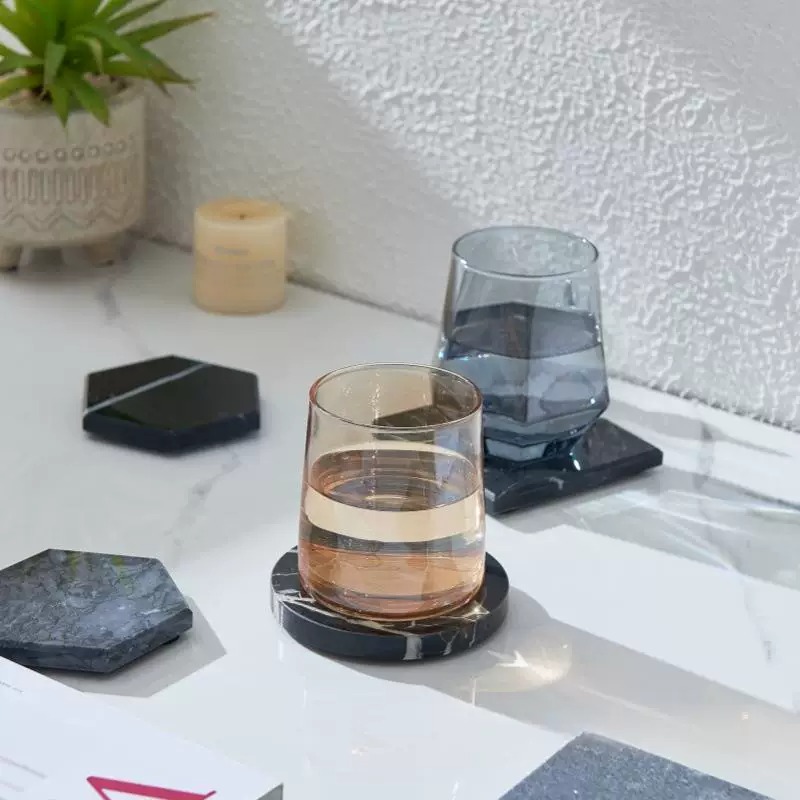
Each tile in the collection is cut from a different marble, and each marble carries a different chapter of the earth’s story. Here is the field guide.
1. Carrara White
The poet’s stone. Quarried in the Apuan Alps of Tuscany since Roman times, Carrara White is the marble of Michelangelo’s David, of Bernini’s Apollo and Daphne, of countless Renaissance facades. Its ground is a soft, milky white; its veins are feathered grey, running like calligraphy across the surface. In your hand, it feels cool and dense — the kind of cool that lingers. If marble has a default, this is it: the stone against which all others are measured.
2. Travertine
The Roman stone. Travertine is not technically marble — it is a form of limestone deposited by mineral springs — but it has been used alongside marble for two thousand years. The Colosseum is built from it. Its surface is warm and pitted, marked by the small voids where carbon dioxide bubbled out as the stone formed. Those voids are not flaws; they are the stone’s signature. Holding a piece of travertine is like holding a piece of ancient architecture — textured, warm-toned, and unmistakably old.
3. Nero Marquina
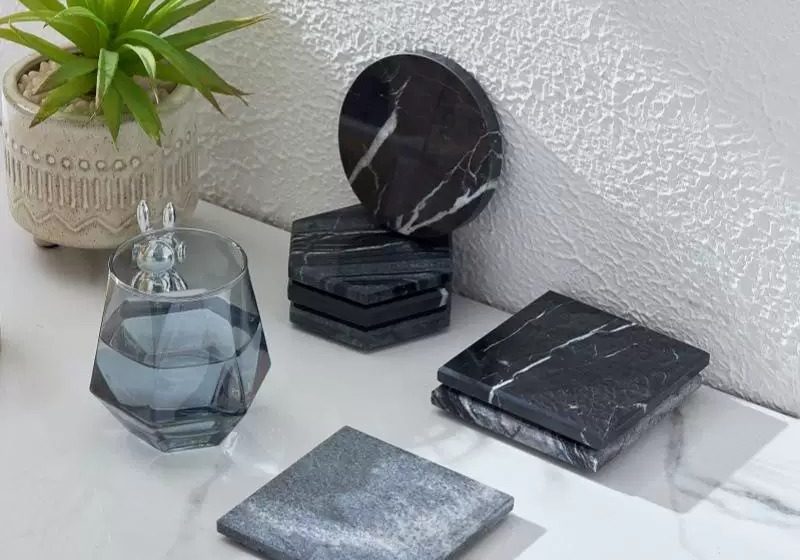
The dramatic stone. A deep, inky black ground cut by stark white veins — lightning frozen in stone. Nero Marquina comes from the Basque country of northern Spain, and it is one of the few truly black marbles in the world. In a small tile, the contrast is immediate and startling. You do not need to know anything about geology to feel its power. You hold it, and the stone speaks for itself.
4. Ancient Wood Grain
The illusionist. Ancient Wood Grain marble carries dendritic patterns — branching, tree-like veins that look exactly like polished driftwood or the cross-section of an ancient tree. But there is no wood in it. The patterns are manganese oxide, deposited along fractures in the stone as mineral-rich water seeped through over millennia. The result is a marble that tricks the eye: warm brown tones, organic branching lines, and a surface that feels like it should be lighter than it is.
5. Star White
The minimalist. Star White is the quietest marble in the collection. Its ground is a clean, bright white with very little movement — a few soft, almost imperceptible grey wisps, like breath on a cold window. It is the stone for people who love marble but do not want drama. In a ten-centimeter tile, Star White reads almost as a pure white object, and only when you tilt it toward the light do the subtle patterns reveal themselves. It rewards attention.
6. Wave Grey
The contemplative stone. Wave Grey carries soft, undulating grey bands across a lighter ground — like fog rolling over water, or the gentle stratification of a winter sky. It is a marble that does not demand attention but rewards it. The patterns are calm and repetitive, almost meditative. Of all the stones in the collection, Wave Grey is the one most likely to end up on a desk, held absently while thinking, turned over and over in the hand without conscious thought.
7. Emerald Green
The rare stone. Emerald Green marble is exactly what it sounds like: a deep, saturated green ground veined with white. Green marbles are uncommon — the color comes from minerals like serpentine and chlorite that form under specific geological conditions, often where oceanic crust has been subducted and metamorphosed. Holding a piece of Emerald Green is like holding a fragment of the deep earth — a stone that looks almost too vivid to be natural, and yet it is.
How They Are Made
Each tile begins as a block of raw marble, selected for color consistency and structural integrity. The block is slabbed on a gang saw — a steel blade running through the stone with abrasive slurry — and the resulting slab is inspected for fractures, inclusions, and veining direction. Slabs with issues are rejected; the rest move to cutting.
The tiles are cut to shape on a bridge saw: a diamond-bladed cutter guided along a rail, capable of straight cuts, curves, and the angular geometry of a hexagon. After cutting, the edges are hand-finished on a polishing line — a sequence of increasingly fine diamond pads, from coarse grit to a mirror polish. The final step is a bevel: a thin chamfer along the edge, softening the sharp corner and catching light.
None of this is unusual. It is the standard process for finishing dimensional stone. What is unusual is the scale. At ten centimeters, these tiles are small enough that the human hand does most of the finishing — holding the tile against the polishing pad, checking the edge by touch, deciding when the bevel is right. It is not automated. It is craft at the smallest scale.
What It Means
There is a particular kind of pleasure in holding a piece of stone that costs less than ten dollars. It is not the pleasure of luxury — of rarity, of expense, of exclusivity. It is the pleasure of access. Of being able to hold a fragment of the Apuan Alps, the Basque mountains, and an ancient mineral spring, all in the same afternoon, and to feel the difference between them.
We did not design the 10cm Marble Mini Collection to be a bestseller. We designed it to be a doorway. An entry point into the world of natural stone that does not require commitment, research, or a significant investment. It is the smallest, most honest object we make — and at $9.90 with free shipping, it may also be the most generous.
If you have never held a piece of Carrara White in your hand, or felt the pitted warmth of travertine, or been startled by the contrast of Nero Marquina — this is your invitation. Pick a stone. Any stone. It will cost you less than lunch, and it will outlast you.