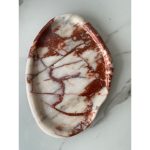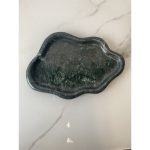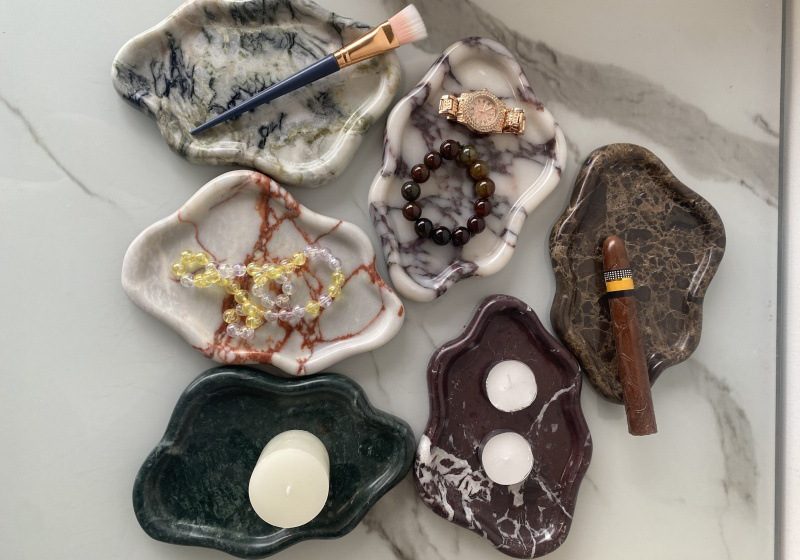

Scroll through any interior feed this year and the same shape keeps surfacing: a tray with wavy, lobed edges, neither round nor square, photographed under a hand holding a matcha or styled with a watch and a keyring. The cloud tray became the shape of the moment for a simple reason — it is the rare form that looks designed and relaxed at the same time. And when you carve it from real marble, it stops being a trend and becomes furniture.
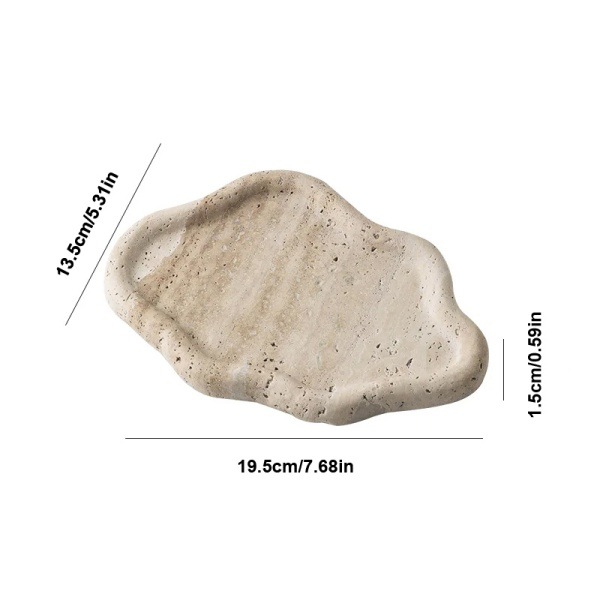
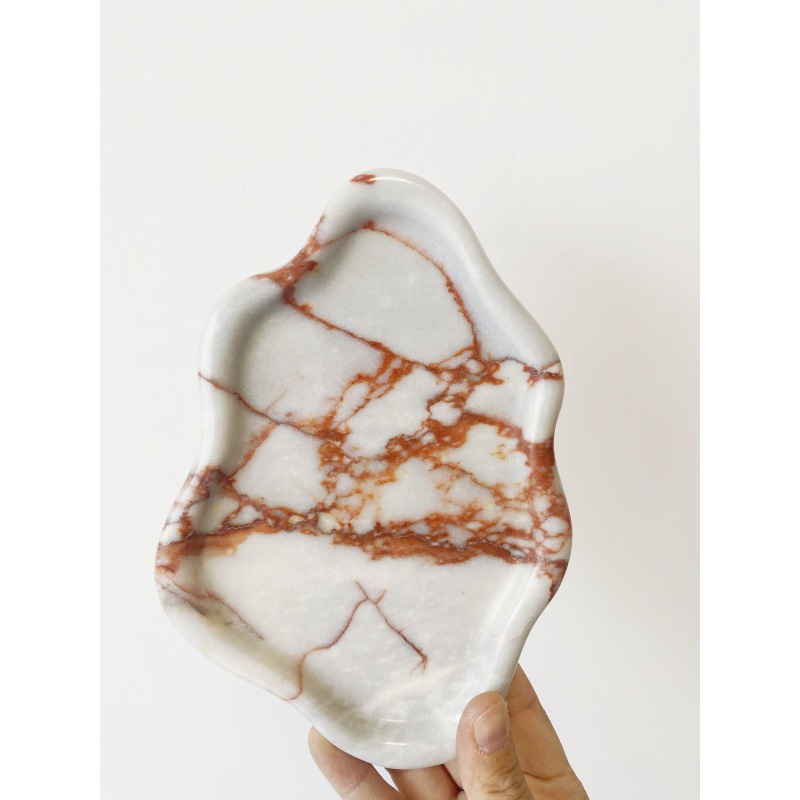
The cloud marble serving tray is cut from one block of stone, edges carved into soft lobes, surfaces hand-polished. It measures 19.5 by 12.5 centimeters — a footprint that fits a coffee table, a console, a washstand, or a show-flat vanity — and comes in six stones: Bulgari Purple, Bulgari Red, India Green, Emerald Green, Rosso Levanto, and Emperador Brown.
The Shape, Explained
The cloud silhouette works because it borrows the best of both parent shapes. From the round tray it takes approachability: no corners, no hierarchy, every lobe equally welcoming. From the rectangular tray it takes direction: the long axis gives styling a natural left-to-right flow. The lobes themselves create small bays that hold objects — a ring settles into a curve, a candle sits in a bay like a boat in a harbor. Flat trays organize by surface area; the cloud organizes by geometry.
There is also the shadow play. The wavy edge catches light unevenly, producing a soft scalloped shadow that straight trays cannot. On a styled shelf, photographed or simply lived with, that detail is what makes people pick the tray up.
Six Stones, Six Personalities
Bulgari Purple is the signature: violet webs over warm white, the stone that made Bulgari marble famous. Bulgari Red lays warm orange-red networks on cream — the friendliest of the six. India Green mists pale green like a Chinese landscape painting. Emerald Green goes deep, almost black at night, and turns botanical under daylight. Rosso Levanto brings the drama of purple-red with white lightning. Emperador Brown, with its coffee-dark cells, anchors rooms full of oak and leather. Six stones means the same cloud can live in six completely different homes.
Why Show Flays Order Them by the Dozen
Stagers need single objects that read as a styled vignette from three meters away. A cloud marble tray plus two props — a watch, a perfume bottle — does exactly that, in any color scheme, in any market. It photographs equally well from above and from a low angle. It weighs enough to stay put during open houses. And because real marble never repeats its veining, every unit in a development can be slightly different without looking mismatched. That is why the wavy stone tray has become a default prop in model rooms from Shanghai to Lisbon.
At home, the same physics applies. One tray on the coffee table, a candle in one lobe, remotes in the middle, a match cloche at the far tip — done. The tray supplies the composition so you do not have to.
Living With It
Sealed marble tolerates daily contact with metal, glass, skin-care products, and food. Wipe it weekly with a damp cloth, use mild soap after serving, and dry it — about thirty seconds of care a week. The only forbidden things are acidic cleaners and thermal shock — no boiling pans straight from the stove. Reseed once a year if it lives in a wet bathroom. The tray you buy for the trend will outlast it by decades; the shape is having a moment, but the stone is permanent.
The Trend Timeline: Where the Cloud Came From
The wavy silhouette did not appear from nowhere. It is the meeting point of two older currents: the organic, Arp-like curves that sculpture has toyed with for a century, and the “soft geometry” that took over product design as interiors turned away from sharp minimalism. The pandemic years accelerated it — homes became the subject of endless photography, and shapes that flatter a camera (curves, layers, warm stone) won over shapes that merely store things. Marble entered the story because stone is the material that makes a trend feel earned: a plastic wave tray is a gag; a marble one is an heirloom with a fashionable edge. That is why the cloud tray will still be on your coffee table after the feed moves on.
Photographing the Cloud (For Sellers and Show-Offs)
If you list products, stage apartments, or simply photograph your home, the cloud tray is the most cooperative prop we sell. Three setups cover everything. Top-down: the tray on plain plaster or oak, one object per lobe, shot straight down — the silhouette carries the frame. Low angle: camera at counter height, tray against a window, and the wavy edge becomes a skyline. In-hand: hold it up and the veining does the selling; stone photographed at arm’s length is how every one of our best-performing images was made. Use the scale label of a lemon or a watch so viewers feel the 19.5cm footprint — scale is the hardest thing to fake and the easiest thing to show.
Which Stone for Which Room — A Cheat Sheet
Buyers ask us this daily, so here is the shorthand. Bulgari Purple: the icon — violet webs on warm white; suits marble-adjacent interiors and photography sets alike. Bulgari Red: warm and social; best against cream, oak, and terracotta. India Green: soft green misting; the gentlest of the six, ideal for bedrooms and calm vanities. Emerald Green: deep and moody; reads almost black at night, perfect for libraries and dark-tiled bathrooms. Rosso Levanto: purple-red with white lightning; the statement stone for entries. Emperador Brown: coffee-dark cells; the natural partner of leather sofas and walnut desks. Every one of them carries the same cloud silhouette — the room decides the stone, and the stone never decides the room.
Gifting, Staging, and Bulk Orders
Because the cloud tray is universally useful and ships in a protective rigid box, it has become our most requested corporate and staging piece. Real-estate teams order them per unit to style kitchens and vanities identically across a development; wedding registries list them because nobody returns carved stone; and design studios buy mixed-stone sets to keep on hand for shoot days. If you are outfitting several rooms, we recommend anchoring each space with one tray and varying the stone — the repeated silhouette ties the rooms together while the different marbles keep each vignette individual. Bulk inquiries ship from the same workshop with consistent carving depth across units, which matters more than most buyers realize until they have unboxed mismatched resin copies from a marketplace.
Frequently Asked Questions
What size is the cloud tray best for?
19.5×12.5cm is the sweet spot: large enough for a styled vignette or a two-person snack board, small enough to live on a coffee table or washstand without dominating it. The 1.5cm profile also slides under shelves.
Why is the wavy shape so popular?
It combines the approachability of a round tray with the direction of a rectangle, and the lobes create natural bays that hold objects in place — plus a scalloped shadow that straight trays cannot produce. Styling looks composed with almost no effort.
Is every cloud tray identical?
No — and that is the point. Each tray is cut from a single block of real marble, so veining varies piece to piece. Two trays in the same stone will share the shape and color family but never the exact pattern.
Bring one home: the Cloud Marble Serving Tray 19.5cm — $69, carved and polished by hand, ships worldwide in a rigid gift box.
Read next: cloud tray layouts for four rooms and the pebble marble tray for bathrooms.